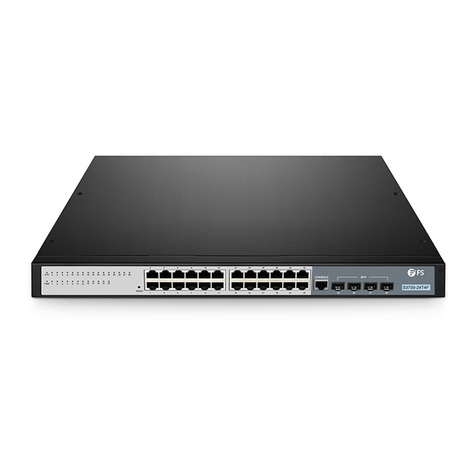
S5900-24S4T2Q SWITCH EAPS CONFIGURATION
Transit port: the transmit port can only be configured on the transit node. Both ports through which the transit node connects the
ring network are all transit ports.
Each port of the ring network can be configured as only one port role after the node's role of the switch and the control VLAN are
configured. As shown in figure 1.1, the port through which master node S1 connects transit node S4 is a primary port, the port
through which S1 connects S2 is a secondary port, and the ports through which other switches connect the ring network are all
transit ports.
Remark:
To configure a same switch to belong to multiple rings, the switch must connect different rings through different physical ports.
1.2.3 Control VLAN and Data VLAN
A private control VLAN is used between master node and transit node to transmit protocol packets. This control VLAN is specified by
user through configuration and ring's ports are added also by user to the control VLAN, which guarantees that the protocol packets
can be normally forwarded. In general, each port of the ring network is in the forwarding state in the control VLAN and the ports
which do not belong to the ring network cannot forward the packets of control VLAN.
Note:
You can specify different control VLAN for each ring on a switch. The control VLAN is only used to forward the control packets of the
ring network, not for L2/L3 communication. For example, if the VLAN port that corresponds to the control VLAN is established, the IP
address of the VLAN port cannot be pinged through other devices.
The VLANs except the control VLAN are all data VLANs, which are used to transmit the packets of normal services or the
management packets.
Note:
The data VLAN can be used for normal L2/L3 communication. For example, you can establish a VLAN port corresponding to data
VLAN and configure dynamic routing protocols.
1.2.4 Aging of the MAC Address Table
The Ethernet ring protection protocol can transmit data packets to the correct link by controlling the aging of the switch’s MAC
address table when the topology changes. In general, the time for a MAC address to age in the MAC address table is 300 seconds.
The ring protection protocol can control the aging of the MAC address table in a short time.
1.2.5 Symbol of a Complete Ring Network
Both the master node and the transit node can show whether the current ring network is complete through the state symbol
“COMPLETE”. On the master node, only when all links of the ring network are normal, the primary port is in forwarding state and the
secondary port is in blocking state can the "COMPLETE” symbol be real; on the transit node, only when its two transit ports are in
forwarding state can the “COMPLETE” symbol be true.
The state symbol of the ring network helps user to judge the topology state of the current network.
1.3 Types of EAPS Packets
The EAPS packets can be classified into the following types, as shown in table 1.1.
Table 1.1 Types of EAPS packets
Loopback detection
(HEALTH)
It is transmitted by the master node to detect whether the topology
of the ring network is complete.
Indicates that link interruption happens in the ring. This kind of
packets are transmitted by the transit node.
It is transmitted by the master node after interruption of the ring
network is detected and the packets show the MAC address aging
table of the transit node.
It is transmitted by the master node after interruption of the ring
network is resumed and the packets show the MAC address aging
table of the transit node.