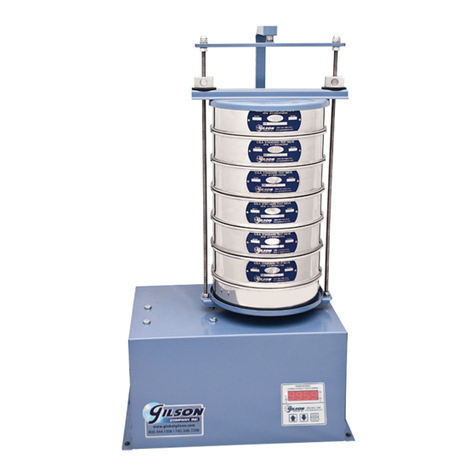
Gilson Economy 8in Sieve Shaker: SS-15
[Type here] [Type here] [Type here]
(H is for hours, M for minutes, and S for seconds.)
Toadjust the timer mode, press and hold both <UP>
and <DOWN> keys at the sametime until thedisplay
showsthemode.Oncethemodelettersaredisplayed,
press <UP> or <DOWN> to change modes. Press
<START/STOP> to accept new mode.
To set the run time, press either <UP> or <DOWN>.
Thefirstdigitontherighthandwillflashinhalf-second
intervals. Press either arrow key to adjust to the de-
sired value. To enter the displayed digit and move
to the next, press <START/STOP>. Once the last
digit on the left is entered, the timer is ready to start.
Press <START/STOP> to initiate the current run
program. Once running, pressing <START/STOP>
again will pause the timer with the current amount of
time remaining on screen. When allowed to time-
out, the timer beeps and displays DONE. Press any
key to continue. Setting and Mode values are saved
automatically.
Before performing maintenance or repairs on the sieve
shaker,ALWAYSreadandunderstandthesafety,operat-
ing, and maintenance instructions.
ALWAYS disconnect the SS-15 from its power before
performingmaintenance orrepair.TheSS-15'smotorhas
internal thermal protection which may cause it to restart
automatically.
Send back your unit's registration card. This card regis-
ters the serial number in Gilson's master file and assures
supply of proper parts when service is required. Provide
thisserialnumberwheneverorderingreplacementparts.
3.1
Cleaning the Unit:
3.1.1
Clean the unit AT LEAST once a year. It is de-
signedtogiveconsistentresults.Dirtcanaffecttest
results. An appropriate cleaning schedule for your
unit depends on the frequency of use, exposure to
dirt, and sample makeup.
3.1.2
Clean beneath the unit at least annually. Takecare
not to introduce cleaning agents into the timer or
the motor. If a thorough cleaning is required, the
motor and timermustfirstberemoved. See below.
3.1.3
To perform maintenance or repairs, or to inspect
the internal parts of the SS-15, place the unit on
either of its sides or on its back as appropriate.
Make sure to prop up the machine as necessary
to avoid damage to the power cord or platform.
3.2
Drive Belt:
3.2.1
Periodically check drive belt for wear, tension, and
alignment. A worn, loose, tight, or misaligned drive
beltcanaffecttheoperationofyourSS-15.Thebelt
should be snug: neither too tight nor too loose. A
snug fit assures longer life, less bearing wear, and
quieter operation than a belt which is too tight. A
loosebeltmaycause the unit to run tooslowlyorto
slip. The drive belt should deflect 1/64 of the value
of the space of the pulleys. The pulleys should be
aligned to avoid excessive edge wear on thebelt.
3.2.2
Toadjust or replace the belt, lay the unit on its left
side, making sure not to pinch the electrical cord.
Loosen the four Motor Mounting Bolts (#26) on the
topoftheoutercase(seePartsDiagram).Movethe
motor upordownto adjust tension inthedrivebelt.
Use a straight edge to maintain pulley alignment.
If you must adjust the belt past the end of the slots
to get proper snugness, replace the belt. NEVER
force or pry the belt over the pulley flanges.
3.3
Motor:
3.3.1
Apply a few drops of oil to the motor and bearings
at least once a year.
3.3.2
Toremovethe motor,laythe uniton back or leftside
sothatit willfallaway from other internal parts when
the mounting bolts are removed. Remove the four
motor mounting bolts on top of the outer case. As
the motor loosens remove the drive belt. Remove
themotor terminal coverplate which is held with two
screwslocatedwherethepowerandtimercordsenter
the motor.
3.3.3
Disconnect the power and timer wire terminals,
notingwhereeachis attached,loosenthecordand
remove the wires from the motor terminal box. The
motor is now completely free. Remove motor belt
pulley by loosening the set screw.
3.3.4
Havethemotor cleaned oroverhauledbya trained
electric motor repair person. Replacement motors
are available from Gilson. To install the motor,
reversethestepsoftheproceduredescribedprevi-
ously. Make sure that both pulleys are aligned and
that the belt is properly tensioned.