Z8
A3764-1.0_en/de 7
3 Application information
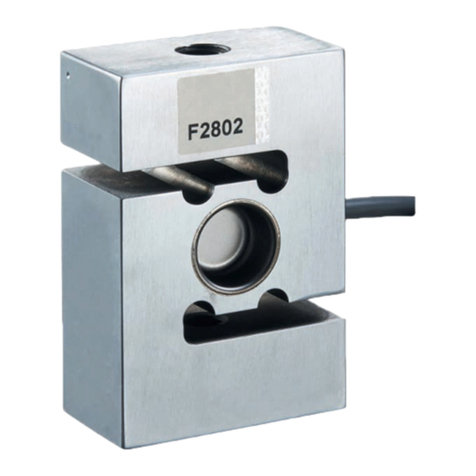
The transducers are fixed and loaded as cantilever
beams. The specified sensitivity tolerance applies for
loading in the preferred measuring direction (arrow V in
Fig. 6.1). But you can also measure in the opposite direc
tion, e.g. for alternating load. In accordance with their
intended application, the transducers are calibrated as
force‐proving instruments in units of force.
The force transducers measure dynamic loading just as
exactly as static loads. The high spring rates (small
amounts of travel) of the transducers are a particular ad
vantage here.
As they are precision measuring devices, force trans
ducers need to be handled carefully during transportation
and mounting, as knocking or dropping the transducers,
for example, can permanently damage them. Sudden
load changes (e.g. load applied in ”free fall”) in measur
ing mode can also cause an unexpected overload with
lasting damage. Where it is not possible to exclude this
type of sudden load change with certainty, they have to
be intercepted.
HBM force transducers are maintenance free and can
even be mounted in places where access is difficult.
Their electrical measurement signals can be transmitted
to remote measuring points and stations where they can
be displayed, recorded and used for control tasks.
Because of the open transducer mounting, you should
keep to the permitted field of application. The transducer
should not be operated under rough conditions or in a
corrosive atmosphere. The conditions of use can be
found in the specified climatic utilization category
(see section 5.2).