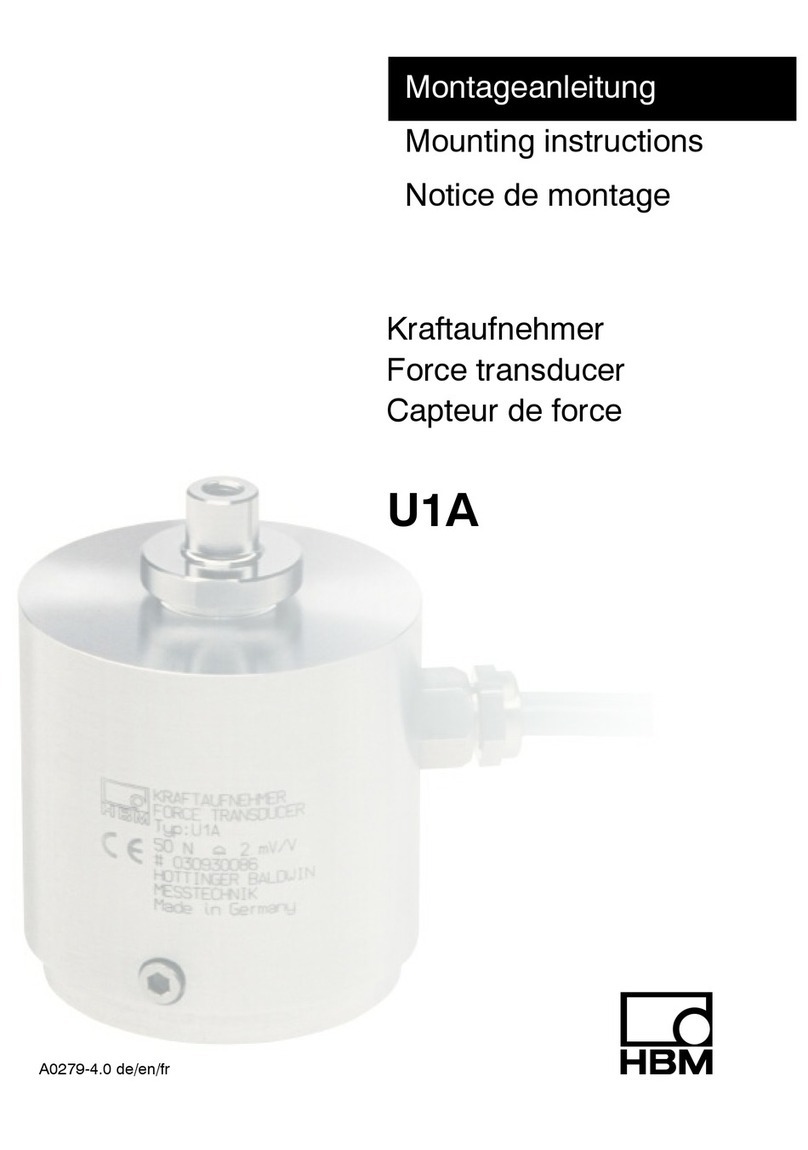
10 U9B
B 20.U9B.40 en HBM
5 Mechanical installation
5.1 Important precautions during installation
•Handle the transducers carefully.
•The force application surfaces on the transducer and on the mounting
accessories must be absolutely clean and seat properly.
•Do not overload the transducer, even briefly. Also short-term overloads
–e.g. due to unevenly distributed support loads –must be avoided.
•Each transducer should be shunted by a stranded copper cable (approx.
50mm2) during or immediately after installation. For this purpose, HBM
supplies very flexible earthing cable EEK
5.2 General guidelines for installation
Force must act on the force transducer precisely in the direction of measure-
ment as far as possible. Off-centre loading and side loading or lateral forces
are interference variables, and therefore causes for measuring errors, and
they can damage the transducer by exceeding the permissible limits. Side
loads and lateral forces also include the relevant components of any mea-
surement quantities which may be introduced at an oblique angle.
5.2.1 Mounting for tensile and compressive loads
The transducer can measure axial forces in the tensile and the compressive
directions. Even alternating loads are measured properly. To achieve this
though, the transducer must be mounted without any axial play.
Tensile and/or compressive forces are transferred via the two threaded bolts.
The force transfer parts are locked against the transducer using the hexagon
nuts included with the supplied items. To do this, the transducer is loaded with
the nominal force and the nuts tightened with the relevant tightening torque:
Nominal force (kN) Tightening torque (Nm)
0.5...1 8
2...20 40
50 200
As an installation aid, HBM recommends the knuckle eyes (see Chapter 9
”Dimensions”) which prevent transfer to the transducer of torsion and bending
moments as well as lateral forces. With dynamic loading pliable tie rods
should be used.