2 3
Features
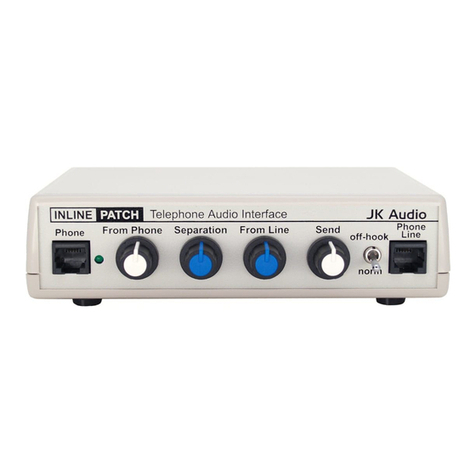
TAP-1 lets you attach an analog telephone to your consumer or
laboratory grade audio equipment or PC sound card using
standard RCA audio input and output jacks. There are three
jacks on the front of TAP-1. The RJ-11 "phone" jack is the
electrical equivilent to the wall jack that you would typically plug
your telephone into. Technically speaking, TAP-1 provides up to
70 milliamps of -48 volts DC to power your telephone and then
separates the telephone audio signal into transmit and receive
voice paths. This is similar in function to the line card on a
telephone company central office switching system. The RCA
jacksprovidehighqualitytransmitandreceivevoicepathstoyour
audioequipment.
The rear panel of the TAP-1 has three adjustments which are
accessible with a small, flat blade screwdriver. The input level
adjustmentcontrolsthevolumeofthesignalgoingthroughTAP-1
and into the phone. The output level adjusts the volume from the
phone to your audio equipment. The null adjustment is used to
finetunethe transmit/ receiveseparation betweenthetelephone
andtheTAP-1. This iscommonly referredto astrans-hybridloss
orechoreturnloss.
Installation
1) Connect a telephone to the front panel RJ-11 jack. DO
NOTCONNECTTHISJACKTOATELEPHONELINE.
2) Connect a signal source (CD player, D/A converter,
signalgenerator..)totheinputjack.
3) Connect the TAP-1 output jack to the input of your
equipment (amplifier line input, tape recorder input,
oscilloscope...).
4) PluginthesuppliedACadaptorandapplypower.
5) Adjust the line input and line output volume controls to
suit your application.
Applications
AsingleTAP-1canbeusedinapplicationssuchas:
+phonetestingandevaluation,
+trainingASRalgorithmsforphonelineuse,
+ simulating phone based services without actual
connection to a phone line.
Service Simulator Example
Input__ __Output
Computer simulating
a central office
Tap-1