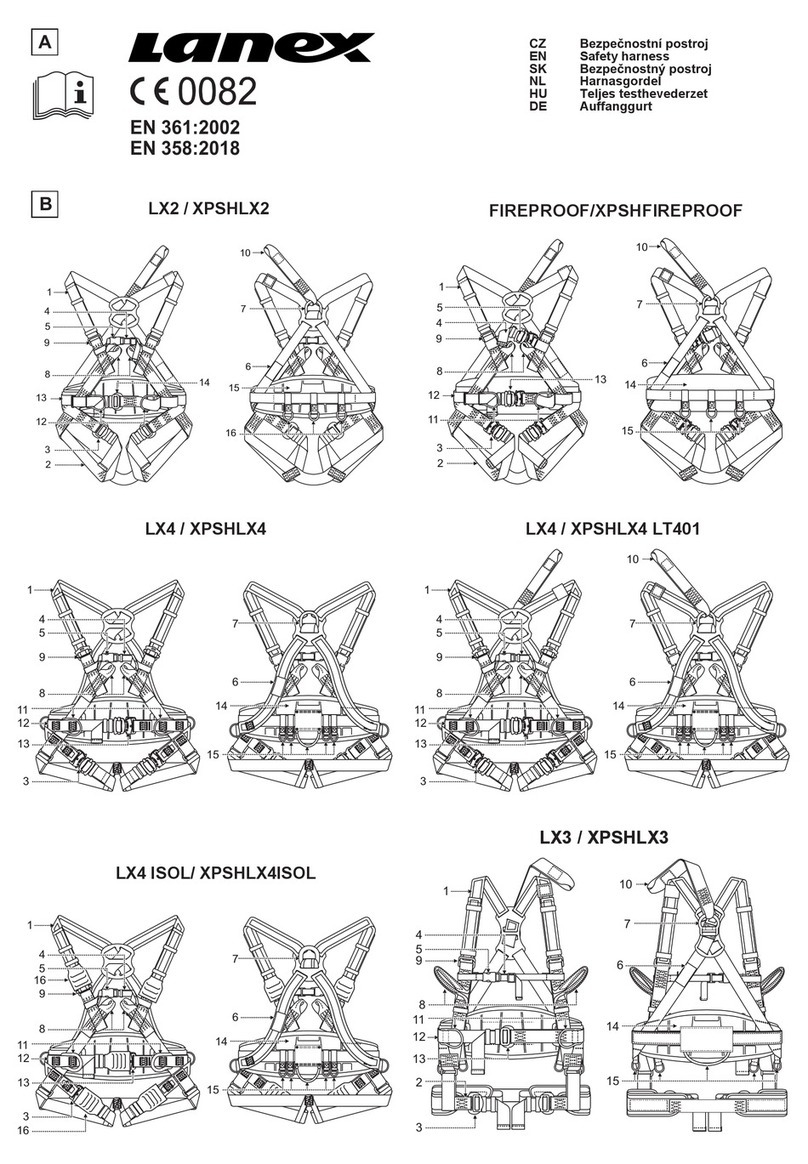
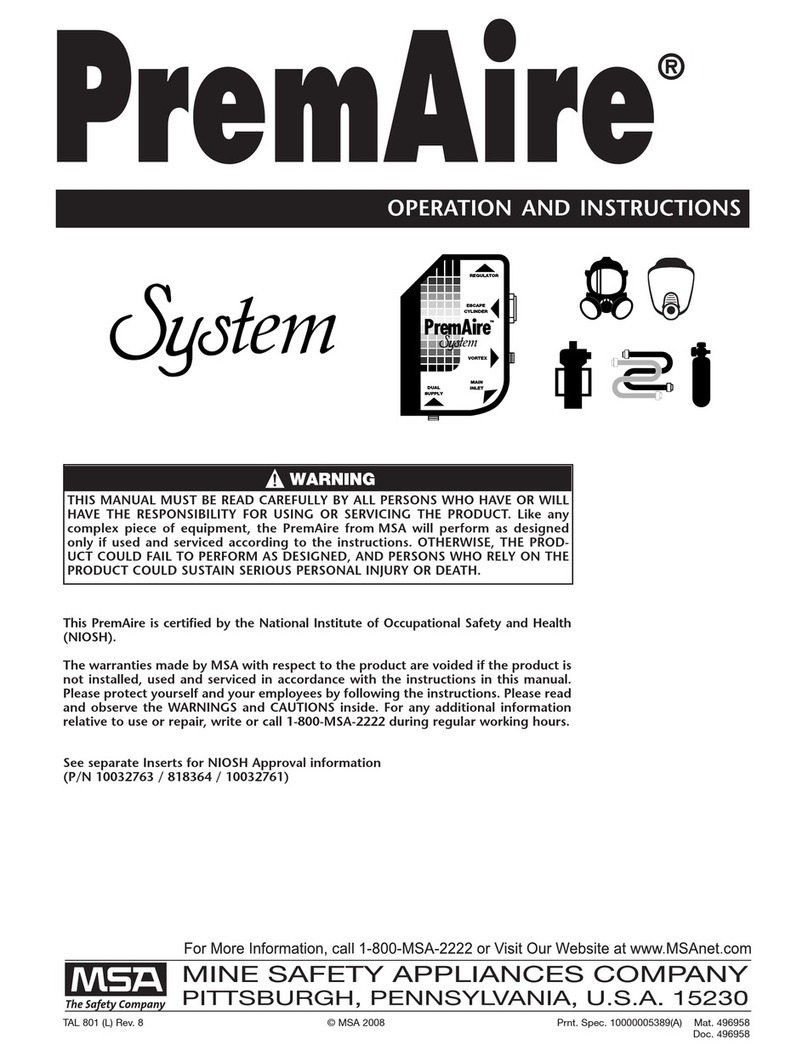
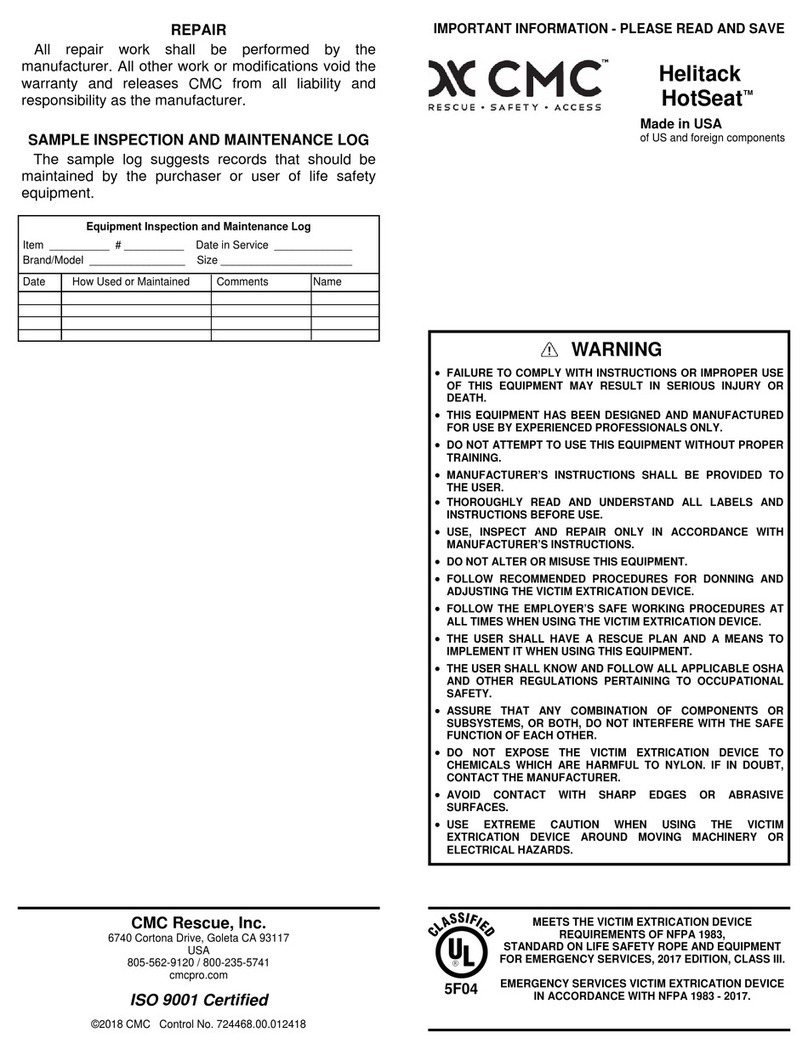
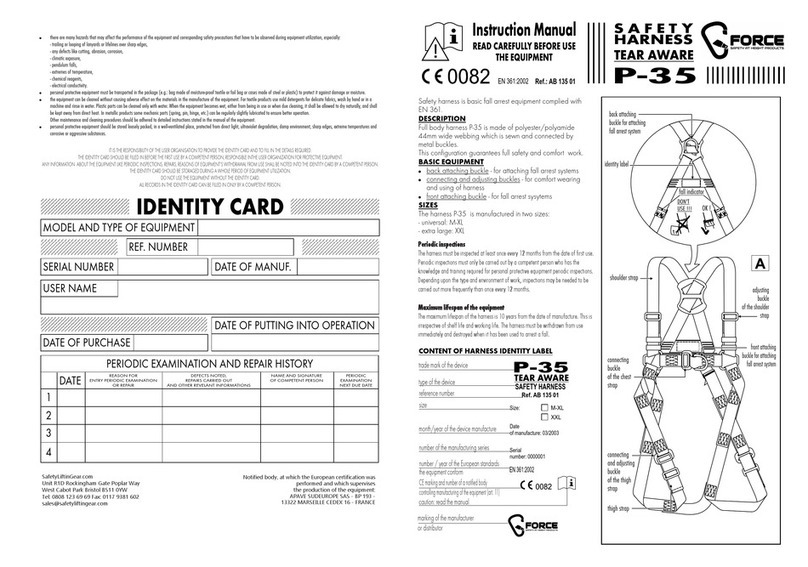
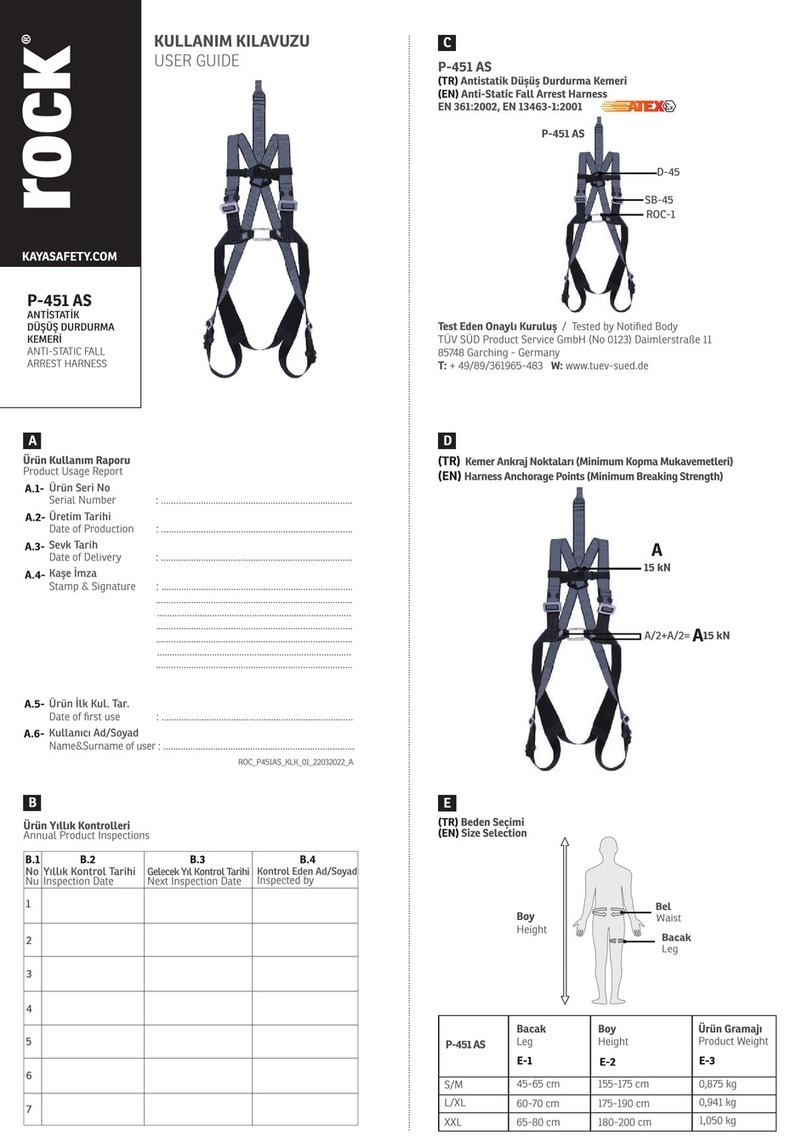
!Fall arrest system must be connected only to the attaching elements of the harness marked by
capital letter A. The fall arrest system must be connected only to: - dorsal attachment D-ring -
drawing (1) or - to frontal attachment D-ring. The dorsal attachment D-ring is marked by a
capital letter A - embossed on the crossing plate. Front attachment D-ring is marked by a
capital letter A placed on the label sewn near the D-ring . See drawings.
PUTTING ON THE HARNESS
Fastening the straps
Adjusting the straps
Tightening
Loosening
ATTENTION:
Always protect free end of the strap with the loop
protecting belt strap
protecting thigh strap
1
Harness is put on correctly if:
all straps are correctly adjusted (neither too loose nor too tight).
back attaching buckle is correctlypositioned at the level of the shoulder blades.
front connecting snap hook is correctlypositioned at the middle of the chest.
the ends of the all straps must be kept by plastic loops.
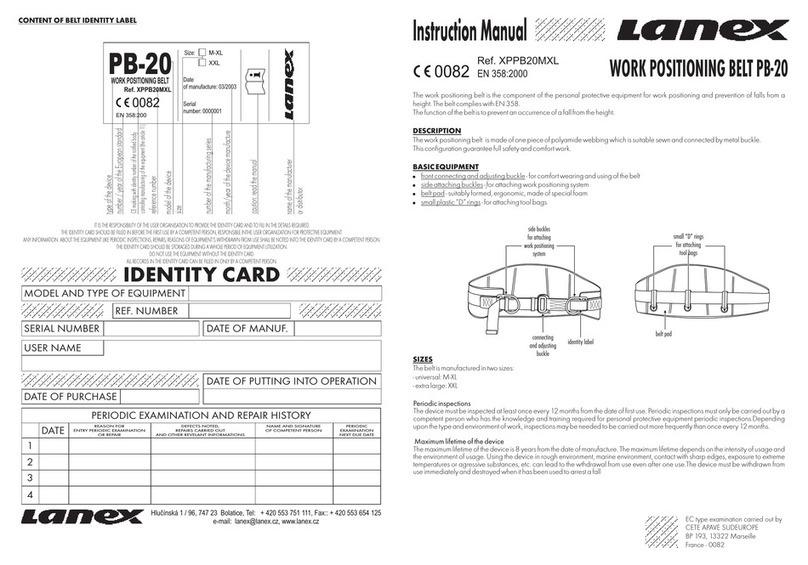
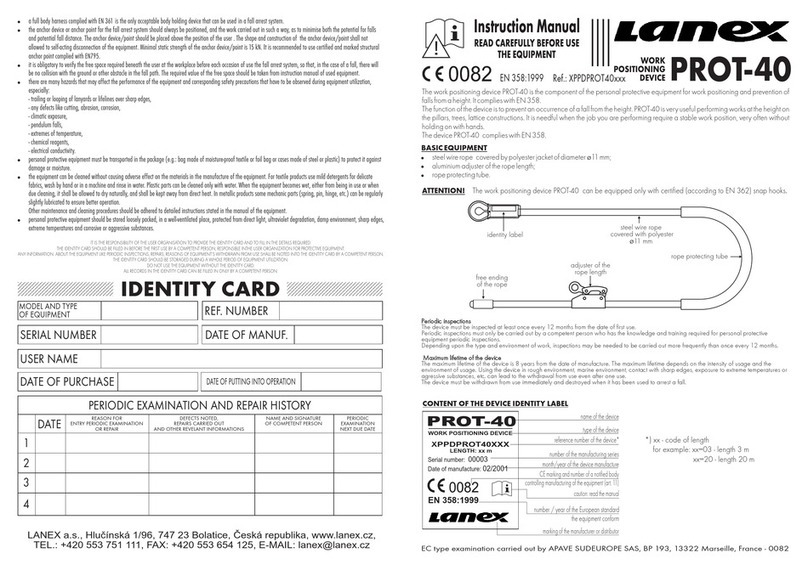
!work positioning system can be attached only to the lateral buckles of the work positioning
belt or to the frontal waist buckle - work positioning lanyard must be anchored to the point of
construction that is situated at waist level or above.
Work positioning lanyard must be kept taut to restrict free movement to a maximum 0,6 m.
!personal protective equipment shall only be used by a person trained and competent in its safe use.
!personal protective equipment must not be used by a person with medical condition that could affect the safety of the equipment user in normal and emergency use.
!a rescue plan shall be in place to deal with any emergencies that could arise during the work.
!being suspended in PPE (e.g. arresting a fall), beware of suspension trauma symptoms.
!to avoid symptoms of suspention trauma, be sure that the proper rescue plan is ready for use. It is recommended to use foot straps.
!it is forbidden to make any alterations or additions to the equipment without the manufacturer's prior written consent.
!any repair shall only be carried out by equipment manufacturer or his certified representative.
!personal protective equipment shall not be used outside its limitations, or for any purpose other than that for which it is intended.
!personal protective equipment should be a personal issue item.
!before use ensure about the compatibility of items of equipment assembled into a fall arrest system. Periodically check connecting and adjusting of the equipment
components to avoid accidental loosening or disconnecting of the components.
!it is forbidden to use combinations of items of equipment in which the safe function of any one item is affected by or interferes with the safe function of another.
!before each use of personal protective equipment it is obligatory to carry out a pre-use check of the equipment, to ensure that it is in a serviceable condition and
operates correctly before it is used.
!during pre-use check it is necessary to inspect all elements of the equipment in respect of any damages, excessive wear, corrosion, abrasion, cutting or incorrect
acting, especially take into consideration:
- in full body harnesses and belts - buckles, adjusting elements, attaching points, webbings, seams, loops;
- in energy absorbers - attaching loops, webbing, seams, casing, connectors;
- in textile lanyards or lifelines or guidelines - rope, loops, thimbles, connectors, adjusting element, splices;
- in steel lanyards or lifelines or guidelines - cable, wires, clips, ferrules, loops, thimbles, connectors, adjusting elements;
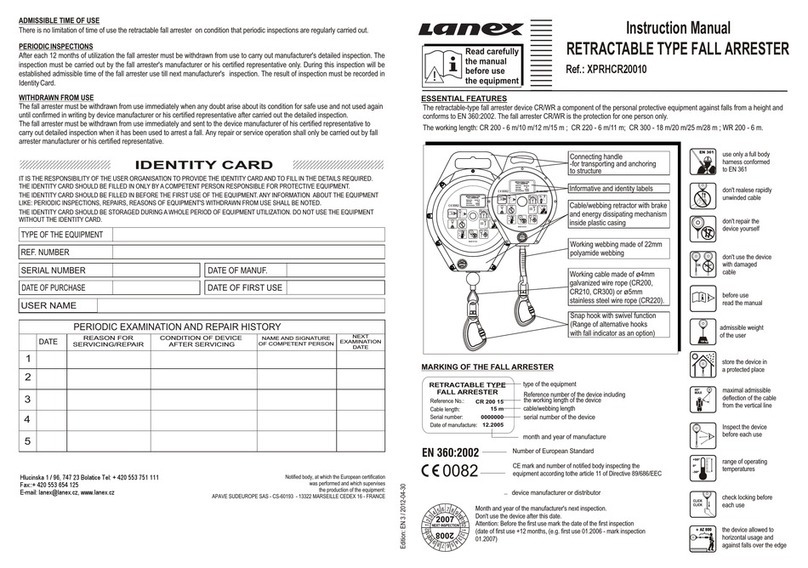
- in retractable fall arresters - cable or webbing, retractor and brake proper acting, casing, energy absorber, connector;
- in guided type fall arresters - body of the fall arrester, sliding function, locking gear acting, rivets and screws, connector, energy absorber;
- in connectors - main body, rivets, gate, locking gear acting.
!after every12 months of utilization, personal protective equipment must be withdrawn from use to carry out periodical detailed inspection. The periodic inspection
must be carried out by a competent person for periodic inspection. The periodic inspection can be carried out also by the manufacturer or his authorized
representative.
In case of some types of the complex equipment e.g. some types of retractable fall arresters the annual inspection can be carried out only by the manufacturer or
his authorized representative.
!regular periodic inspections are the essential for equipment maintenance and the safety of the users which depends upon the continued efficiency and durability of
the equipment.
!during periodic inspection it is necessary to check the legibility of the equipment marking.
!it is essential for the safety of the user that if the product is re-sold outside the original country of destination the reseller shall provide instructions for use, for
maintenance, for periodic examination and for repair in language of the country in which the product is to be used.
!personal protective equipment must be withdrawn from use immediately when any doubt arise about its condition for safe use and not used again until confirmed
in writing by equipment manufacturer or his representative after carried out the detailed inspection.
!personal protective equipment must be withdrawn from use immediately and destroyed (or another procedures shall be introduced according detailed instruction
from equipment manual) when it have been used to arrest a fall.
THE ESSENTIAL PRINCIPLES FOR USERS OF PERSONAL PROTECTIVE EQUIPMENT AGAINST FALLS FROM A HEIGHT
WARNING:
1) It is strictly forbidden to attach any fall arrest system to side buckle of work positioning belt.
2) It is strictly forbidden to attach any fall arrest system to frontal buckle designed for use as a sit harness according EN 813.
ATTACHING FALL ARREST SYSTEM
ADMISSIBLE TIME OF USE
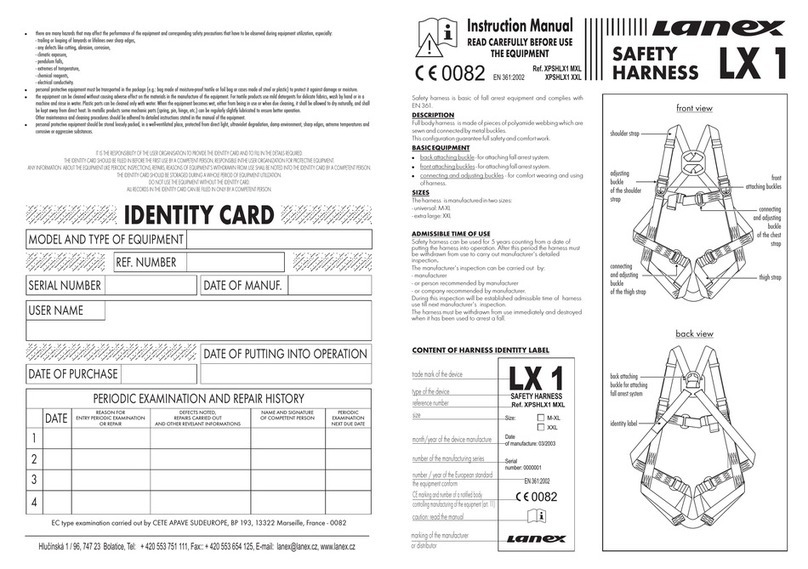
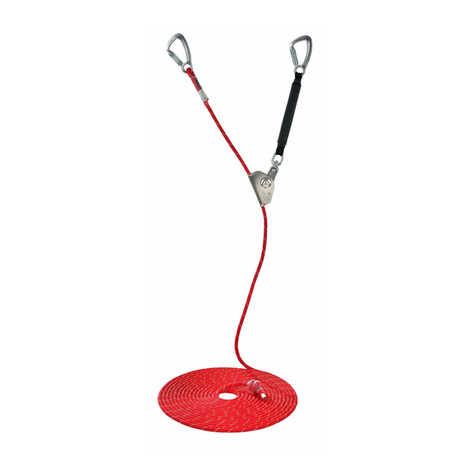
Safety harness can be used for 5 years. After this period the harness manufacturer's
The manufacturer's inspection can be carried out by:
- manufacturer
- or person recommended by manufacturer
- or company recommended by manufacturer.
During this inspection will be established admissible time of harness use till next manufacturer's inspection.
must be withdrawn from use to carry out detailed
inspection
ATTENTION: Before use the belt the first time the user should
carry out a suspension test in a safe place to ensure that the
sit harness is the correct size, has sufficient adjustment and is
of an acceptable comfort
level for the intended use.
A B C D E
A. Take the harness by the shoulder
straps. Disconnect shoulder straps
from connecting hook [Y].
B. Move the straps over the head.
Taking the harness by the belt,
put them on over the feet.
C. Connect shoulder straps
to connecting hook [Y].
D. Adjust the belt strap.
Necessarily protect free ends
of the straps with the loops.
Adjust the shoulder straps.
E. Fasten and adjust the thigh
straps. Necessarily protect
free ends of the straps with
the loops.
Y
Y
1
2
3
1
2
3
1
1
2
Opening
2