TN_IDA_1068_E_IQ_data 3 / 8 Subject to change
Figure 4: Spectrum and IQ data.
Top: The entire spectrum,
Center: Spectrum of signal converted to the base
band,
Bottom: A time section of the signal converted to the
base band expressed as IQ data.
P
Signal under consideration
fνf
P
0 f
Base band
Time 'I' 'Q'
0.00E+00
0.00208341 -0.00078946
5.00E-08
0.00243203 -0.00051186
1.00E-07
0.00280739 -0.0002444
1.50E-07
0.00316431 2.40E-05
2.00E-07
0.00353968 0.00029236
2.50E-07
0.00384864 0.00053031
3.00E-07
0.00414745 0.00076456
3.50E-07
0.00442414 0.00097576
4.00E-07
0.00461874 0.001151
4.50E-07
0.00479581 0.00128104
5.00E-07
0.00490279 0.00140462
5.50E-07
0.00493231 0.00146272
6.00E-07
0.00490372 0.00151068
6.50E-07
0.0048161 0.00151898
The IQ data find application in the transmitters and receivers in
communications installations. They are also suitable for recording
signals from the communications channel itself.
From the point of view of a basic communications installation – as
depicted in figure 3 – the IQ data appear before conversion from the
base band into the actual transmission band in the transmitter and after
conversion from the transmission band to the base band in the receiver.
The payload signal or data stream is fed to the IQ modulator in the
transmitter in the form of IQ data. The IQ modulator limits the bandwidth
of the signal and converts it into the transmission frequency band. After
addition of the I and Q components, the real, band-limited signal can be
transmitted in a radio channel.
The received signal together with any captured interference is converted
back to the base band again and band limited by the IQ demodulator in
the receiver, so that the original payload signal or data stream together
with the interference is available at the output of the IQ demodulator as
IQ data.
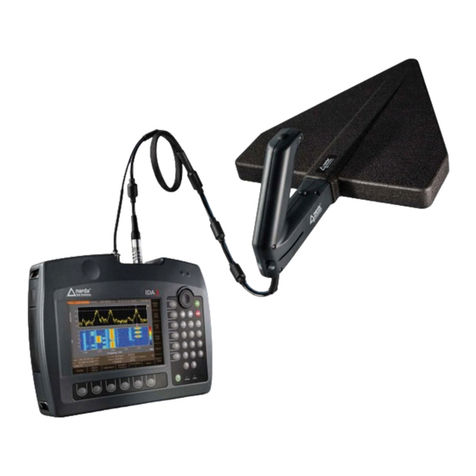
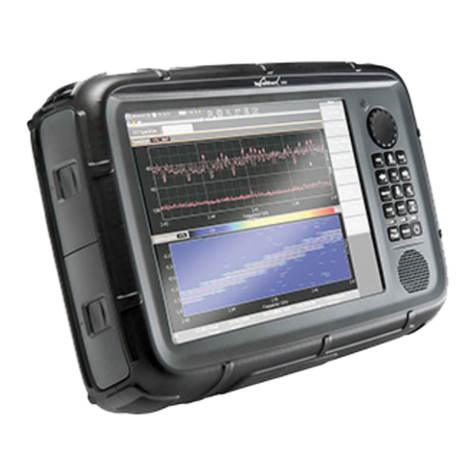
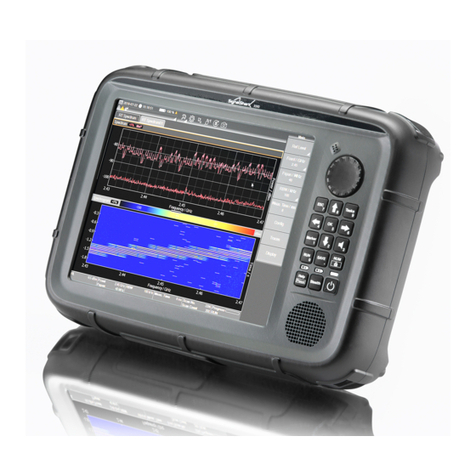
The signal can be captured by the NRA and IDA during transmission
over the radio channel. In this case, the instrument takes over the role of
a receiver that can store IQ data. The IQ data represent a specific
section of the spectrum in the time domain shifted into the base band,
as depicted clearly in figure 4.
Signals that have known modulation, such as AM or FM, can often be
directly demodulated by the IDA and output to a loudspeaker or
headphones. Experts can discern other types of modulation by the
sound after AM or FM demodulation.
The IDA can also demodulate a UMTS or LTE signal and determine
certain parameters of the transmitted signal.
Things are more difficult if the modulation of the signal is unknown. The
modulation type needs to be identified, and the characteristic of the
matching receive filter, the exact carrier frequency, the phase, and the
line digit rate all need to be determined. NRA and IDA can save the
corresponding section from the spectrum in the form of IQ data for this
purpose for subsequent processing or export to another device over an
interface.