Note: Specifications subject to change without notice.
Regional Headquarters
OMRON EUROPE B.V.
Wegalaan 67-69,2132 JD Hoofddorp
The Netherlands
Tel: (31)2356-81-300
Fax: (31)2356-81-388
OMRON ASIA PACIFIC PTE. LTD.
No. 438A Alexandra Road #05-05/08
(Lobby 2), Alexandra Technopark,
Singapore 119967
Tel: (65) 6835-3011
Fax: (65) 6835-2711
OMRON ELECTRONICS LLC
2895 Greenspoint Parkway, Suite 200
Hoffman Estates, IL 60169 U.S.A.
Tel: (1) 847-843-7900
Fax: (1) 847-843-7787
OMRON (CHINA) CO., LTD.
Room 2211, Bank of China Tower,
200 Yin Cheng Zhong Road,
Pu Dong New Area, Shanghai,
200120, China
Tel: (86) 21-5037-2222
Fax: (86) 21-5037-2200
OMRON Corporation Industrial Automation Company
Contact: www.ia.omron.com
Kyoto, JAPAN
*1 The set values for the time range are as follows:
I/O Functions
Input Connections
Panel-cutout Dimensions
Diagram (Unit: mm)
Standard panel cutout is shown in the following
diagram. (conforms to DIN 43700)
A space of 15 mm or greater (a panel cut-out
distance of 60 mm or greater) is recommended
towards the Adapter's hook side to enable easier
mounting work.
1. The thickness of a mounting panel should be
1 to 5 mm.
2. It is possible to mount Timers side-by-side.
(But only towards the non-hook side.)
Mounting and Panel-cutout Dimensions Diagram
Mounting Dimensions (Unit: mm)
Front panel dimensions
are the same for all
models.
H5CC-AWSD
3. If the products are mounted side by side,
water resistance will be lost.
Ratings (Specifications)
Nomenclature
Operating Procedures
Terminal Arrangement
Output Mode
Change from RUN Mode to Function Setting Mode.
Set the parameters using the UP Key or DOWN Key.
The characters displayed in reverse video are the default settings.
Press UP1+UP3 keys once to move to the previous parameter.
Press DW1+DW3 keys once to move to the next parameter.
Operation in Function Setting Mode
Note: Refer to the datasheet for detailed parameter settings.
Operation Key
8. UP Keys (UP1 to UP6) (UP 1, 2, 3, 4, 5 and 6 from right to left)
9. DOWN Keys (DW1 to DW6) (DW 1, 2, 3, 4, 5 and 6 from right to left)
10. Reset operation (UP6+DW6)
1.
Press RST keys (UP6+DW6) simultaneously for at least one second.
2.
LED on each key starts blinking. If not blink, that because the keys are not pressed
simultaneously. In this case, release the keys after pressing for at least 1 second,
and restart from 1. Do not release the keys until the LED starts blinking. Otherwise
the setting value may change.
3.
Press and hold until the LED turns off. If you release the keys while blinking, the
reset operation will be interrupted.
11. Mode operation (UP1+UP3 or DW1+DW3)
<Change of setting item>
1.
Press MODE keys (UP1+UP3 or DW1+DW3) simultaneously to switch setting items.
<Move to Function Setting Mode>
1.
Press MODE key (UP1+UP3 or DW1+DW3) for at least 2 seconds simultaneously.
2.
LEDs on UP1 (DW1) and UP3 (DW3) key start blinking. If not blink, that because the
keys are not pressed simultaneously. In this case, release the keys after pressing
for at least one second, and restart from 1. Do not release the keys until the LEDs
start blinking. Otherwise the setting value may change.
3.
Press and hold until the LED turns off. If you release the keys during blinking, the
mode will not be moved to Function Setting Mode.
12. Status indicator
<When Run mode is selected.>
• When the indicator display mode is on, the LED indicator shows the percentage of
the present value from 0 to 100%.
• When the indicator display mode is all off or all lit, the LEDs are all off or all lit.
Note: When you press the UP key or the DOWN key, the indicator display or all-lit
display goes off, and the LED indicator of the pressed key lights up or blinks.
<When Function Setting Mode is selected>
• The LED indicators at the settable key positions will light.
timr
pl-h
sl-h
setn
imod
iflt
outm
Time range
Output mode
Forecast setting upper limits
Set value upper limit
Absolute value setting/ forecast
value setting
NPN/PNP input mode
Input signal width
---
---
---
---
---
---
*1
1~999999
1~999999
ofst, abs
npn, pnp
20ms, 1ms
a, f-1
ot1i
ver
ot-c
ot-a
on2c
on1c
on2a
on1a
indc
ot2i
Output 1 inversion
Software version
Total run time monitor value
Total run time alarm set value
Output 2 (OUT2) ON count
monitor value
Output 1 (OUT1) ON count
monitor value
Output 2 (OUT2) ON count alarm
set value
Output 1 (OUT1) ON count alarm
set value
Indicator display mode
Output 2 inversion
---
---
---
×1,000
×1,000
The software version is only displayed. It cannot be set.
The Total run time monitor value is only displayed.
It cannot be set.
Unit: yea
The monitor value is only displayed. It cannot be set.
×1,000
The monitor value is only displayed. It cannot be set.
×1,000
n-o, n-c
0.0 ~10.0 ~99.9
---
---
---
---
0~100 ~9999
0~100 ~9999
on, alof, allt
n-o, n-c
kypt Key protect level ---
kp-1, kp-2, kp-3, kp-4,
kp-5, kp-6, kp-7
Display Parameter name
Comments
Set value
Operation in Run Mode
Operation in Run Mode
Basic Operation
Basic Operation
Forecast Value Setting
Absolute Value Setting
• The control output (output 2) turns ON when the present value reaches the set value.
• Forecast output (OUT1) turns ON when the present value reaches the forecast value.
The forecast value is the set value minus the forecast set value.
• If the forecast set value ≥ set value, OUT1 (forecast output) will turn ON as soon as timing starts.
• If the set value equals 0, the forecast output (output 1) and control output (output 2) will turn ON as soon as
timing starts.
• OUT1 (control output 1) turns ON when the present value reaches set value 1.
• OUT2 (control output 2) turns ON when the present value reaches set value 2.
• If the set value equals 0, the control output will turn ON as soon as timing starts.
• Starts timing.
Turns ON when the present value reaches
set value 1.
Turns ON when the present value reaches
set value 2.
Turns ON when the present value reaches
the forecast value.
Turns ON when the present value reaches
the set value.
• Inhibits timer operation.
• Resets present value. (The present value
returns to 0.)
• Timing stops and control output turns
OFF while reset input is ON.
•
Reset indicator is lit while reset input is ON.
Control
output 1
(OUT1)
Control
output 2
(OUT2)
Forecast
output
(OUT1)
Control
output
(OUT2)
Forecast
value
setting
Absolute
value
setting
Start signal
Reset
Gate
Inputs
Outputs
The inputs of the Timer are no-voltage (short-circuit or open) inputs or
voltage inputs.
No-voltage Inputs (NPN Inputs)
Voltage Inputs (PNP Inputs)
Open Collector
No-contact Input (NPN Transistor) No-contact Input (PNP Transistor)
Contact input
Voltage Output
Contact Input Two-wire Sensor
Short-circuit level (Transistor ON)
• Residual voltage: 3 V max.
• Impedance when ON: 1 kΩmax.
(The leakage current is approx. 12 mA when the
impedance is 0 Ω.)
No-voltage Input Signal Levels
Open level (Transistor OFF)
• Impedance when OFF: 100 kΩmin.
Use contacts which can adequately switch 10 V, 5 mA
Note 1: The DC voltage must be 30 VDC max.
No-contact
input
Contact input
Leakage current: 1.5 mA max.
Switching capacity: 5 mA min.
Residual voltage: 3.0 V DC max.
Operating voltage: 10 V DC
Applicable Two-wire Sensor
Voltage Input Signal Levels
High level (Input ON): 4.5 to 30 V DC
Low level (Input OFF): 0 to 2 V DC
Note 1: The DC voltage must be 30 V DC max.
Note 2: Input resistance: Approx. 4.7 kΩ
• Confirm that the power supply to the Timer
meets specifications before use.
*Start signal input is disabled during timing.
The names in parentheses are used for the absolute value setting.
The names in parentheses are used for
the absolute value setting.
* Terminals 7 and 10 have the same reset
function. The same function will be
performed whichever terminal is connected.
Terminals 7 and 10 are not connected
internally, so do not use them for cross
wiring.
* • The solid state output is insulated from the
internal circuitry by a photocoupler, so the
solid state output can be used as both NPN
and PNP output.
• The diode connected to
the collector of the
output transistor is used
to absorb inverted
voltage that is
generated when an
inductive load is
connected to the H5CC.
* Each time the UP1+UP3 or
DW1+DW3 Keys are pressed,
the set value display (6) will
switch between the set value
and the forecast set value.
* Each time the UP1+UP3 or
DW1+DW3 Keys are pressed,
the set value display (6) will
switch between set values 1
and 2.
Precautions for Safe Use
SAFETY PRECAUTIONS
Keys to Warning Symbols
Indicates a potentially hazardous situation which, if not
avoided, is likely to result in minor or moderate injury or in
property damage.
Do not disassemble, modify, or repair the Timer or touch internal
components. Minor electric shock, fire, or malfunction may occasionally
occur.
Do not touch any of the terminals while power is being supplied. Be sure to
mount the terminal cover after wiring. Minor injury due to electric shock
may occasionally occur.
Fire may occasionally occur. Tighten the terminal screws to the rated torque.
H5CC terminals and P3GA-11/P3G-08 Socket terminals: 6.55 to 7.97 lb-in
(0.74 to 0.90 N·m)
P2CF Socket terminals: 4.4 lb-in (0.5 N·m)
Do not use the Timer where subject to flammable or explosive gas. Minor
injury due to explosion may occasionally occur.
Do not allow pieces of metal, wire clippings, or fine metallic shavings or
fillings from installation to enter the product. Doing so may occasionally
result in electric shock, fire, or malfunction.
• Locations subject to oil.
• Locations prone to icing.
• Locations subject to exposure chemicals.
• Locations subject to bugs and small animals.
6) Do not use this Timer in dusty environments, in locations where corrosive gasses are
present, or in locations subject to direct sunlight.
7) Install the Timer well away from any sources of static electricity, such as pipes
transporting molding materials, powders, or liquids.
8) Internal elements may be destroyed if a voltage outside the rated voltage range is applied.
9) Be sure that polarity is correct when wiring the terminals.
10) Separate the Timer from sources of noise, such as devices with input signals from power
lines carrying noise, and wiring for I/O signals.
11) Do not connect more than two crimp terminals to the same terminal.
12) Up to two wires of the same size and type can be inserted into a single terminals.
13) Use the specified wires for wiring.
Applicable Wires: AWG 18 to AWG 22, solid or twisted, copper
Wiring stripping length: 5 to 6 mm (recommended)
14) Install a switch or circuit breaker that allows the operator to immediately turn OFF the
power, and label it to clearly indicate its function.
15) When the Timer is operated with no-voltage input (NPN input), approximately 14 V is
output from the input terminals. Use a sensor that contains a diode.
16)
Use a switch, relay, or other contact so that the rated power supply voltage will be reached
within 0.1 second. If the power supply voltage is not reached quickly enough, the Timer may
malfunction or outputs may be unstable. Use a switch, relay, or other contact so that the
rated power supply voltage will be reached within 0.1 second. If the power supply voltage is
not reached quickly enough, the Timer may malfunction or outputs may be unstable.
17) Use a switch, relay, or other contact to turn the power supply OFF instantaneously.
Outputs may malfunction and memory errors may occur if the power supply voltage is
decreased gradually.
18) If the set value is changed as follows during a timing operation, the output will turn ON because
of the use of a constant read-in system:
(1) For forecast value setting
Changing the value so that Present value ≥ Set value turns ON output 2 (control output).
Changing the value so that Present value ≥ Forecast value (The forecast value = set value -
forecast set value) turns ON output 1 (forecast output).
(2) For absolute value setting
Changing the value so that Present value ≥ Set value 2 turns ON output 2 (control output 2).
Changing the value so that Present value ≥ Set value 1 turns ON output 1 (control output 1).
When the set value is 0, the output turns ON the moment the signal is input. The reset
operation turns OFF the output.
19)
Do not use organic solvents (such as paint thinners or benzine), strong alkali, or strong acids.
20) Confirm that indications are working normally, including the backlight LEDs, and LCD. The
indicator LEDs, LCD, and resin parts may deteriorate more quickly depending on the
application environment, preventing normal indications. Periodic inspection and
replacement are required.
21) The waterproof packing may deteriorate, shrink, or harden depending on the application
environment. Periodic inspection and replacement are required.
1) When mounting the Timer to a panel, tighten the two mounting screws alternately, a little
at a time, so as to keep them at an equal tightness. If the panel screws are tightened
unequally, water may enter the panel.
2) Store the Timer at the specified temperature. If the Timer has been stored at a
temperature of less than -10°C, allow the Timer to stand at room temperature for at least
3 hours before use.
3) Mounting the Timer side-by-side may reduce the life expectancies of internal components.
4)
Use the Timer within the specified ranges for the ambient operating temperature and humidity.
5) Do not use or store the product in the following locations:
• Locations subject to sudden or extreme changes in temperature.
• Locations where high humidity may result in condensation.
• Locations with excessive vibration or shock.
• Locations subject to water.
1) Read this manual carefully before using the product.
2) An inrush current of approx. 14 A will flow for a short time when the power supply
is turned ON. If the capacity of the power supply is not sufficient, the Timer may
not start. Be sure to use a power supply with sufficient capacity.
3) Make sure the power supply voltage and loads are within the specifications and
ratings for the product.
4) Take caution that signal reception is possible, impossible, or indefinite during the
following periods after power ON/OFF. To allow for the startup time of peripheral
devices (sensors, etc.), the Timer starts timing operation between 200 to 250 ms
after power is turned ON. For this reason, if the set value is 249 ms or less in
operations where timing starts from power ON, the time until output turns ON will
be a fixed value between 200 and 250. The present value display will start from
250 ms. (Normal operation is possible for set values of 250 ms or more.) In
applications where a set value of 249 ms or less is required, use start timing with
signal input.
5) No input signals will be accepted from 5 to 505 ms for H5CC-A/L8, from 5 to
105 ms for H5CC-A11F, and from 5 to 1005 ms for H5CC-AUafter the power is
turned OFF.
6) Inrush current generated by turning ON or OFF the power supply may deteriorate
contacts on the power supply circuit. Turn ON or OFF to a device with the rated
current of more than 14 A.
7) Make sure that all settings are appropriate for the application. Unexpected
operation resulting in property damage or accidents may occur if the settings are
not appropriate.
8) Do not leave the Timer for long periods at a high temperature with output current
in the ON state. Doing so may result in the premature deterioration of internal
components (e.g., electrolytic capacitors). Do not install the product close
contact with the heating element.
9) Non-volatile memory is used as backup memory when the power is interrupted.
The write life of the non-volatile memory is 100,000 writes. The non-volatile
memory is written when the power is turned OFF or when switching from function
setting mode or configuration selection mode to run mode.
10) Dispose of the product according to local ordinances as they apply.
11) Do not use because it may be damaged inside the product when the product fall
by mistake.
12)
Confirm the wiring the input and output terminals correctly before power is supplied.
13) Do not use the product near radio wave receivers. Doing so may cause incoming
radio wave interference.
14) Install product so that the load doesn't span the product body.
15) H5CC models with a 24 to 240 VAC/DC power supply use a transformer-free
power supply method in which the power supply terminals are not isolated from
the signal input terminals. In such cases, unwanted current paths may
occasionally burn or destroy internal components depending on the wiring.
Always check the wiring sufficiently before use.
16) Do not wire the terminals that are not used.
17) If there is a transformer or other device with a large inductance component on the
power supply line, the inductance will cause a reverse voltage. If that occurs,
insert a CR filter in the power supply line to reduce the reverse voltage.
18) Do not use in a circuit with the waveform is distorted. The error will increase due
to the influence of the distorted waveform.
Precautions for Correct Use
CAUTION
CAUTION
Conformance to
EN/IEC Standards
• When conforming to EMC standards,
refer to the information provided in this
Instruction Manual for cable selection
and other conditions.
• This is a class A product. In residential
areas it may cause radio interference, in
which case the user may be required to
take adequate measures to reduce
interference.
•
Basic insulation is provided between
power supply and input terminals, between
power supply and output terminals, and
between input and output terminals.
• Basic insulation is provided between
power supply and output terminals, and
between input and output terminals.
When double insulation or reinforced
insulation is required, apply double
insulation or reinforced insulation as
defined in IEC 60664 that is suitable for
the maximum operating voltage with
clearances or solid insulation.
•
Connect the input and output terminals to
devices that do not have any exposed
charged parts.
H5CC-AWSD
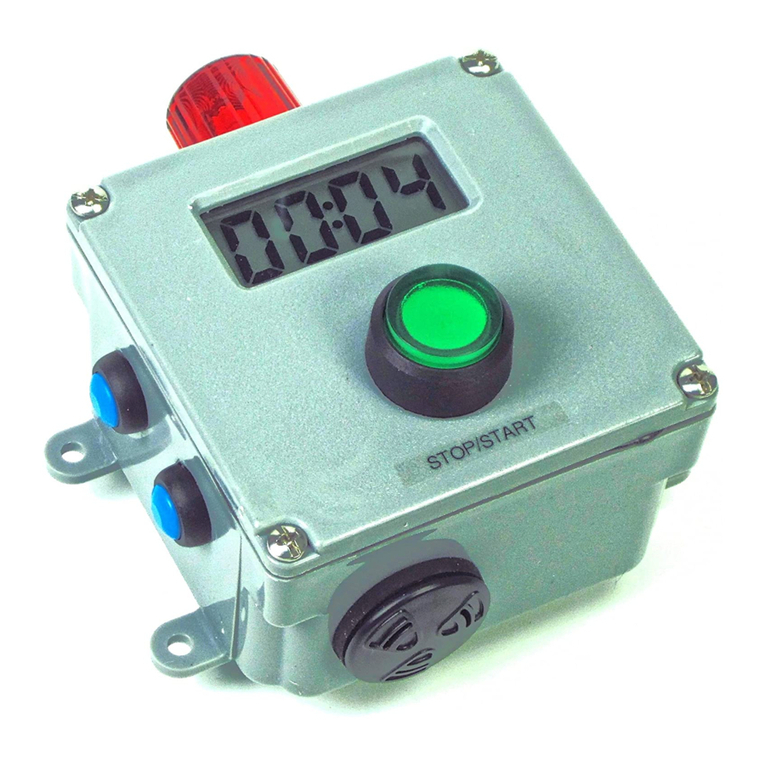
Digital Timer
OMRON Corporation
©All Rights Reserved
For details, refer to the latest datasheet (L220-E1).
SUITABILITY FOR USE
Thank you for purchasing the OMRON Product.
To ensure the safe application of the Product, read this
manual carefully before using the Product and always
keep it close at hand when the Product is in use.
3616495-0A (Side-A)
INSTRUCTION MANUAL
EN
Omron Companies shall not be responsible for conformity with any
standards, codes or regulations which apply to the combination of the
Product in the Buyer's application or use of the Product. At Buyer's request,
Omron will provide applicable third party certification documents identifying
ratings and limitations of use which apply to the Product. This information
by itself is not sufficient for a complete determination of the suitability of the
Product in combination with the end product, machine, system, or other
application or use. Buyer shall be solely responsible for determining
appropriateness of the particular Product with respect to Buyer's
application, product or system. Buyer shall take application responsibility in
all cases.
NEVER USE THE PRODUCT FOR AN APPLICATION INVOLVING
SERIOUS RISK TO LIFE OR PROPERTY OR IN LARGE QUANTITIES
WITHOUT ENSURING THAT THE SYSTEM AS A WHOLE HAS BEEN
DESIGNED TO ADDRESS THE RISKS, AND THAT THE OMRON
PRODUCT(S) IS PROPERLY RATED AND INSTALLED FOR THE
INTENDED USE WITHIN THE OVERALL EQUIPMENT OR SYSTEM.
Package Contents
• Digital Timer
• Instruction manual (this
document)
• Mounting Adapter, Waterproof
Packing, Terminal Cover
Power supply voltage 12 to 48 VDC/24 VAC, 50/60 Hz
Allowable voltage fluctuation range
85% to 110% of rated supply voltage (12 to 48 VDC: 90% to 110%)
Power consumption Approx. 5.4 VA/3.2 W at 24 VAC/12 to 48 VDC
Operating temperature range -10 to 55°C (-10 to 50°C if Timers are mounted side by side)
(with no icing or condensation)
Storage temperature range -25 to 70°C (with no icing or condensation)
Operating humidity range 25% to 85%
Altitude 2,000 m max.
Recommended fuse 0216.100
Weight Approx. 115 g (main unit only)
Installation environment Over-voltage category Ⅲ, pollution degree 2, indoor use only
(IEC 61812-1)
Input method
No-voltage input ON impedance: 1 kΩmax. (Leakage current: 12 mA when 0 Ω),
ON residual voltage: 3 V max., OFF impedance: 100 kΩmin.
Voltage input High (logic) level: 4.5 to 30 VDC, Low (logic) level: 0 to 2 VDC
(Input resistance: approx. 4.7 kΩ)
No-voltage (NPN) input/voltage (PNP) input (switchable)
Control output
Solid state output Open collector 30 VDC max., 100 mA max.
Residual voltage 1.5 VDC max. (Effective value: Approx. 1 VDC)
Leakage current 0.1 mA max.
Degree of protection IEC IP66
* Individual mounting: Degree of protection on the front panel of the Timer conforms when all
of the following conditions are satisfied:
• The Y92S-P6 waterproof packing and Y92F-30 mounting adapter are used with the Timer.
Use only these parts for replacement.
Display Section
1. Key Protect Indicator (yellow)
2. Control Output Indicator (yellow)
3. Reset Indicator (yellow) (Lit when the
reset input or Reset operation is ON.)
4. Present Value Display (Main Display)
Character height: 10 mm (white)
5. Time Unit Indicators (green) (If the
time range is 0 min, 0.0 min, 0 h, 0.0 h, or
0 h 0 min, these indicators flash to
indicate timing operation.)
6. Set Value Display (Sub-display)
Character height: 6 mm (green)
7. Set Value 1, 2 Indicator (green)
Power
ON Function
setting mode
Run
mode
UP1+UP3 or DW1+DW3
(2 s min.)
UP1+UP3 or DW1+DW3
(2 s min.)
Note: Operate with transistor ON
PLC,
Sensor
6 7 8 9
10
0 V for inputs
Reset
Signal
Gate
Reset
Note: Operate with relay ON
6 7 8 9
10
0 V for inputs
Reset
Signal
Gate
Reset
Note: Operate with transistor ON
Sensor
6 7 8 9
10
0 V for inputs
Reset
Signal
Gate
Reset
Note: Operate with transistor ON
6 7 8 9
10
0 V for inputs
Reset
Signal
Gate
Reset
Note: Operate with transistor OFF
Sensor
6 7 8 9
10
0 V for inputs
Reset
Signal
Gate
Reset
Note: Operate with relay ON
6 7 8 9
10
0 V for inputs
Reset
Signal
Gate
Reset
Note: Operate with transistor ON
Sensor
6 7 8 9
10
0 V for inputs
Reset
Signal
Gate
Reset
Self-diagnostic Functions
The following displays will appear if an error occurs.
e2 sum Memory error
(non-volatile memory) *1 OFF Reset operation Factory
setting
Rplc
*3 No
change
Total run time or Output
ON count has reached
the maintenance forecast.
No
change Reset operation *2 No change
e2 Not lit Memory error (RAM) OFF Turn ON the power
again. No change
e1 Not lit CPU error OFF Either perform Reset
operation or reset
the power supply. No change
Main
display
Sub-
display Description Output
status Correctionmethod Set value
after reset
*1. This includes times when the life of the non-volatile
memory has expired.
*2. This is displayed if the alarm set value for either of the
two outputs is exceeded if a model with two outputs
is used. The total ON count will not be cleared by
using Reset operation.
*3. The normal display and Rplc will appear alternately.
When Reset operation is performed, Rplc will no
longer be displayed even if the alarm set value is
exceeded. (Monitoring is possible, however, because
the Timer will continue without clearing the total run
time and the output ON count.) If the power supply is
turned OFF/ON after the Rplc display is turned OFF
by Reset operation, Rplc will be displayed again. In
order to prevent the display even after the power
supply is turned OFF/ON, change the alarm set value
to equal to or greater than the count value, or change
the alarm set value to 0 to be invalid.
Mode A: Signal ON delay (Timer resets when power
comes ON.)
• Timing starts when the start signal goes ON.
• While the start signal is ON, the timer starts when the
power comes ON or when the reset input goes OFF.
• A sustained control output is used.
Mode F-1: Cumulative (Timer does not reset
when power comes ON.)
• Start signal enables timing (timing is stopped
when the start signal is OFF or when the power
is OFF).
• A sustained control output is used.
Displayed only when forecast value setting is made.
Function setting mode
Precautions for Compliance with
UL Standards and CSA Standards
Display Set value
----.-- s0.01s~9999.99s (default setting)
-----.- s0.1s~99999.9s
------ s1s~999999s
--:--:-- hms 0h0min01s~99h59min59s
-----.- m0.1min~99999.9min
------ m1min~999999min
----:-- hm 0h01min~9999h59min
-----.- h0.1h~99999.9h
------ h1h~999999h
---.--- s0.001s~999.999s
Notice to Users of the H5CC in the USA and Canada
Please use the following installation information instead of the general information in
the instruction manuals in order to use the product under certified conditions of UL and
CSA when the product is installed in the USA or Canada. These conditions are required
by NFPA 70, National Electrical Code in the USA and the Canadian Electrical Code, Part
I in Canada and may vary from information given in the product manuals or safety
precautions.
• Installation in a Panel
H5CC is normally installed on a flat surface in an operation panel. Use a Type 1
Enclosure for the operation panel.
• Environment
Surrounding Air Temperature: -10 to 40°C
• Accessories (Order Separately)
11-pin
11-pin, finger-safe type
8-pin
8-pin, finger-safe type
P2CF-11
P2CF-11-E
P2CF-08
P2CF-08-E
Track Mounting/
Front Connecting
Socket
(48)
57.57.5
Panel
Y92F-30 (provided)
Flush Mounting Adapter
Y92S-P6 (provided)
Waterproof Packing
58
48
15 or greater
60 or greater
□45+0.6
ー0
A
A (48n 2.5) 1
0
n Units mounted
side-by-side
Forecast set value Present value
Set value
Forecast value
0
Forecast output (OUT1)
Control output (OUT2)
* UP1+UP3 or
DW1+DW3
Present value
Set value
Present value
Forecast set value
0.0
0.0
0.0
0.0
Present value
Set value 2
Set value 1
0
Control output 1 (OUT1)
Control output 2 (OUT2)
* UP1+UP3 or
DW1+DW3
Present value
Set value 1
Present value
Set value 2
0.0
0.0
0.0
0.0
6 7 8 9 10
12 13 OUT1
OUT2
(+)(-)
0 V
12345
*
Reset
Signal
Gate
Reset
Power for load
+
Load
Power for load
+
Load
NPN Output PNP Output
Power for load
+
Timer
Inductive
load
Output Operation
Chart Power
Timing Sustained
Timing
Signal
Forecast output
OUT1
Control output
OUT2
Control output
OUT1
Control output
OUT2
Output Operation
Chart
Power
Timing
Signal
Forecast output
OUT1
Control output
OUT2
Control output
OUT1
Control output
OUT2
*
H5CC TIMER
1
7
9
26
12
8
11
10
4
5
3
48
48
H5CC TIMER