Page 10
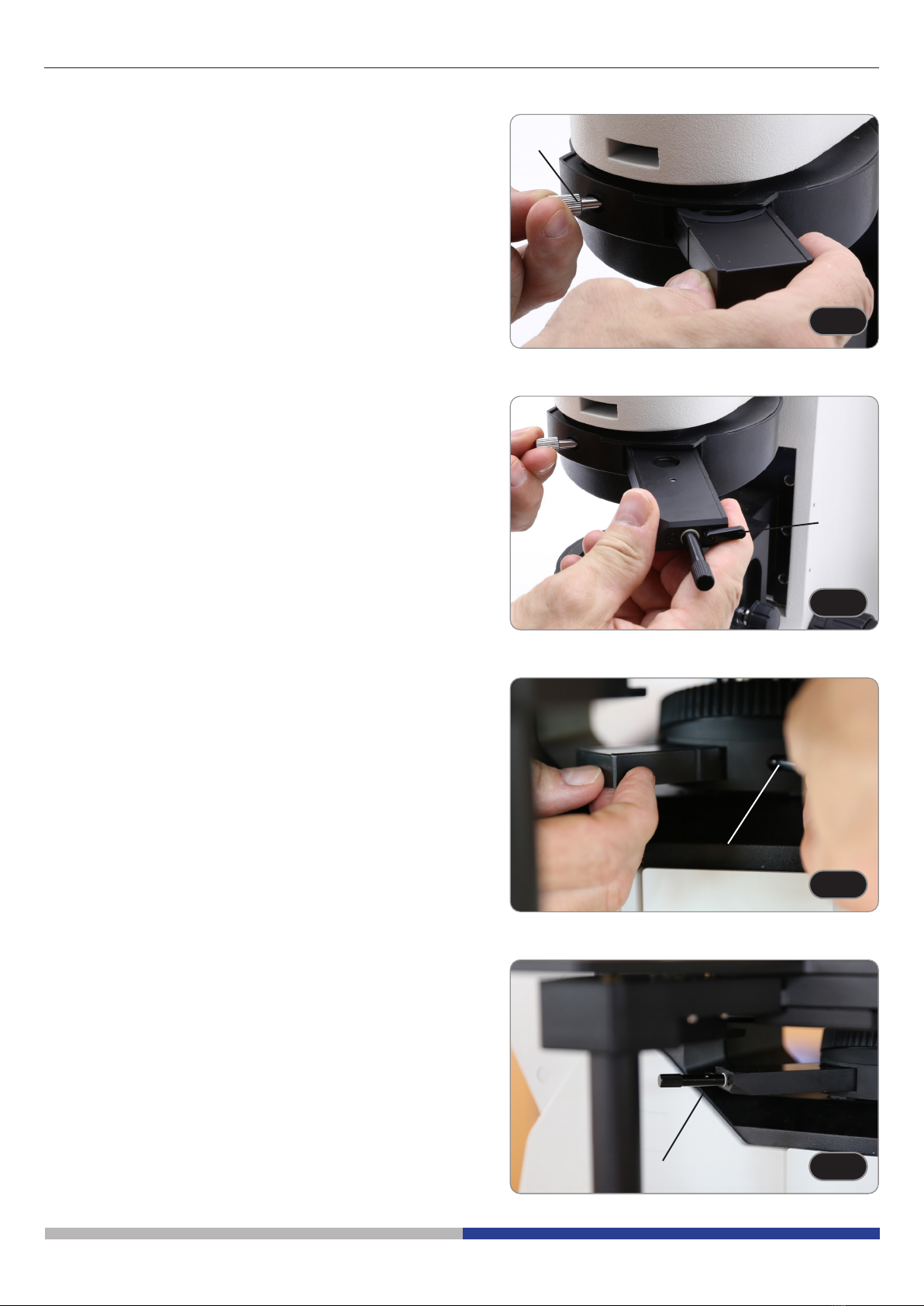
FFig. 11ig. 11
FFig. 13ig. 13
FFig. 12ig. 12
①
8. Remove the mirror, place the specimen on the stage and
adjust the focus.
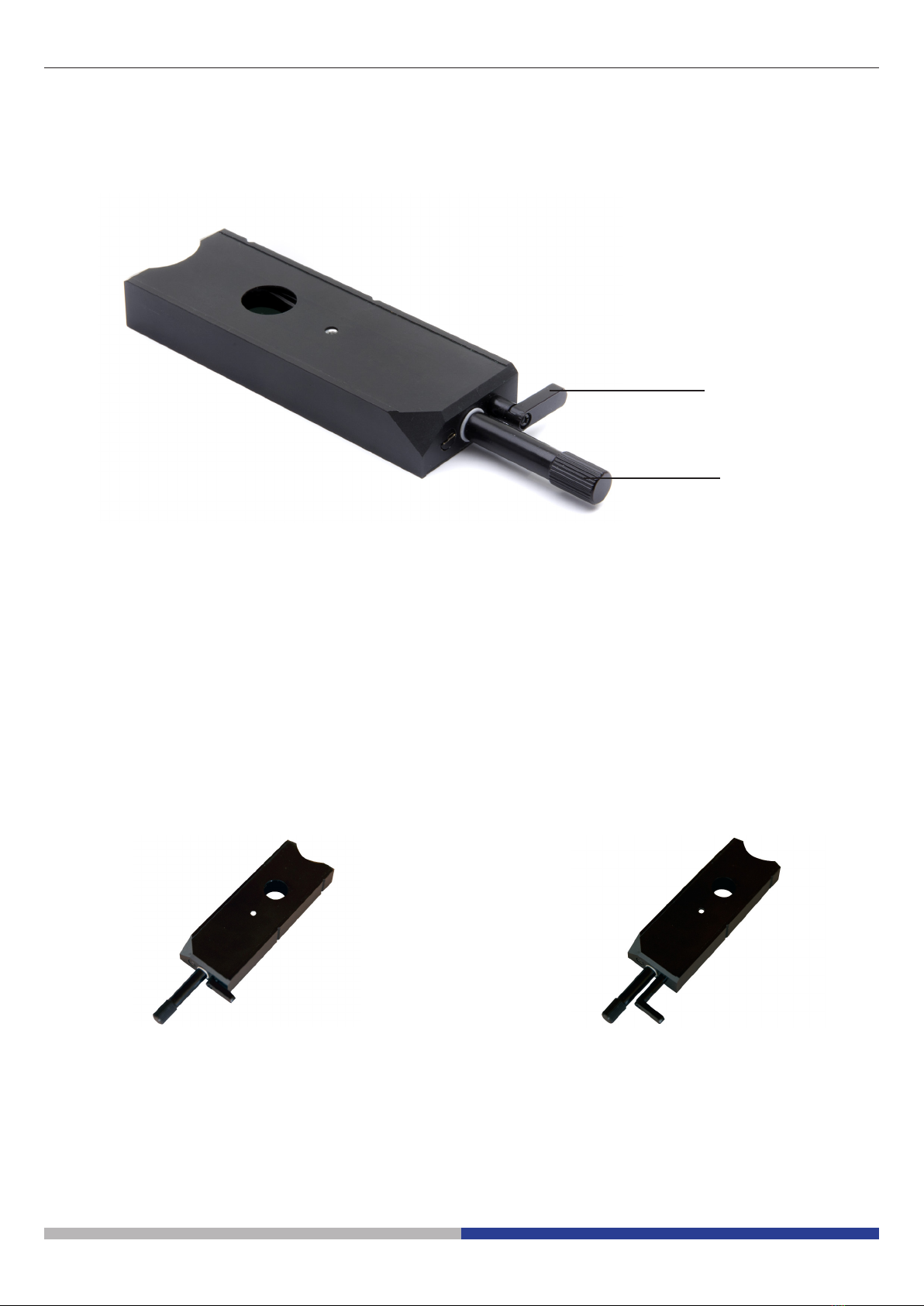
9. Adjust the background contrast by turning the prism movement
knob ② on the DIC slider. (Fig. 11)
10. When the prism movement knob ② on the DIC slider is turned,
the interference color in the background varies continuously
from the gray to magenta (from -100 to 600 nm). Set the
interference color which can provide best contrast with respect
to the specimen.
• If the background color is dark, the observation is similar to
darkeld.
• If the background color is grey, three-dimensional high contrast
images can be achieved rich in grey shades.
• If the background color is close to magenta, even small phase
variation can be observed as a change in color.
②
9.3 IM-5MET
• As with observation in polarized light, DIC observation
cannot be performed when the BF/DF switch on the mi-
croscope is in the ‘DF’ position.
1. Move the lever in “BF” position for brighteld illumination.
2. Insert the polarizer “PO” with the inscription facing the user.
(Fig. 12)
3. Move the polarizer “PO” into the light path until the slider
clicks into its position.
4. Insert analyzer “AN” with the inscription facing up. (Fig. 13)
5. Move the rotatable analyzer “AN” into the light path until the
slider clicks into its position.
6. Put a at mirror on the stage and get into approximate focus
the mirror surface.
7. While observing into the eyepieces, rotate the scale of the
analyzer ①until you achieve the darkest image. (Fig. 14)
• Now the light extinction (so-called “crossed Nicol position”)
is achieved.
8. Remove the mirror, put a specimen on the stage and focus
the specimen.
9. Adjust the background contrast by turning the prism movement
knob on the DIC slider ②. (Fig. 11)
10. When the prism movement knob ② on the DIC slider is turned,
the interference color in the background varies continuously
from the gray sensitive color to magenta sensitive color (from
-100 to 600 nm). Set the interference color which can provide
best contrast with respect to the specimen.
• If the background color is dark, the observation is similar to
darkeld.
• If the background color is grey, three-dimensional high contrast
images can be achieved rich in grey shades.
• If the background color is close to magenta, even small phase
variation can be observed as a change in color.
FFig. 14ig. 14
①