2019-01
10
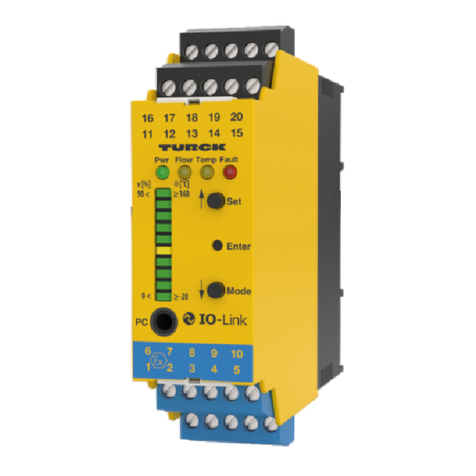
INX***DH-F199-B16-***, INY***DH-F199-B16-***
Product Description
2 Product Description
2.1 Use and Application
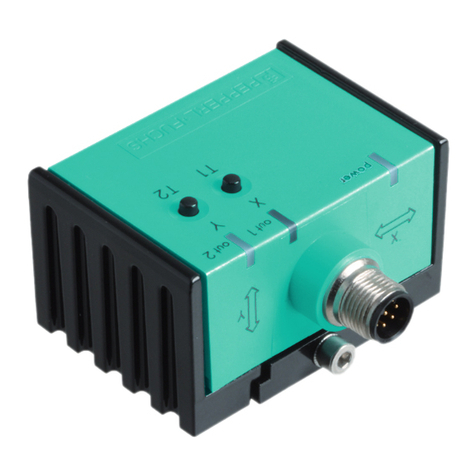
INX***DH-F199-B16-*** and the INY***DH-F199-B16-*** series inclination sensors sense and
measure the tilt angle (inclination/slope/elevation) of an object in relation to the force of gravity.
The basic principle behind these inclination sensors is a microelectromechanical systems
(M MS) sensor cell that is embedded in a fully molded application-specific integrated circuit
(ASIC). The angle is measured via the relative change in electrical capacitance in the M MS
cell.
INX***DH-F199-B16-*** sensors are 1-axis sensors that sense and measure tilt on the x-axis
INY***DH-F199-B16-*** sensors are 2-axis sensors that sense and measure tilt on the x-axis
and y-axis.
Communication with the inclination sensors, including configuration and data output, runs via a
CANopen interface.
CANopen Interface
CANopen is based on the Controller Area Network (CAN), which was developed by automotive
industries in the 80s. The CANopen application protocol was introduced by the multi-vendor
association CAN in Automation (CiA) to ensure full compatibility of industrial automation
products. It is a multiple-access system (maximum: 127 devices), which means that all devices
can access the bus.
These devices are the components of the CANopen bus. In simple terms, CANopen works as a
client-server model. ach device checks whether the bus is free, and if it is free the device can
send messages. If two devices try to access the bus at the same time, the device with the
higher priority level has permission to send its message first. Devices with the lowest priority
level must cancel their data transfer and wait before re-trying to send their message.
Communication Profile and Operating Modes
INX***DH-F199-B16-*** and INY***DH-F199-B16-*** series inclination sensors conform to the
CANopen communication profile CiA DS 410 for inclinometers.
Various software tools for configuration and parameter-setting are available from different
suppliers. It is easy to align and program the inclination sensors using the DS (electronic
datasheet) configuration file provided at www.pepperl-fuchs.com.
The devices support the following operating modes:
■
Polled mode: The position value is transmitted only on request.
■
Cyclic mode: The position value is sent cyclically (regular, adjustable intervals) on the
bus.
■
SYNC mode: The position value is sent after a synchronization message (SYNC) is
received. The position value is sent every n SYNCs (n ≥ 1).
■
State change mode: The position value is transmitted whenever the position of the
inclinometer changes (minimum time interval settable).
2.2 Accessories
Various accessories are available. See datasheet or relevant product page on the Internet
www.pepperl-fuchs.com.