manuals.online logo
Brands
  1. Home
  2. •
  3. Brands
  4. •
  5. Sanyo
  6. •
  7. VCR System
  8. •
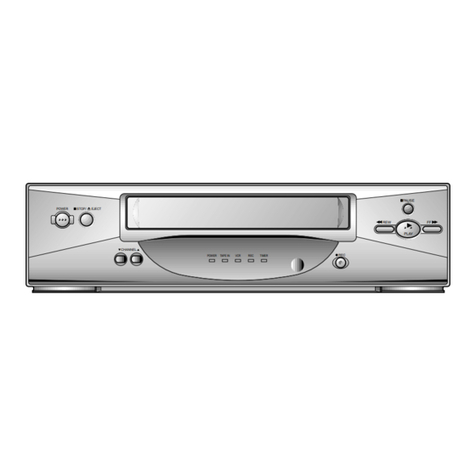
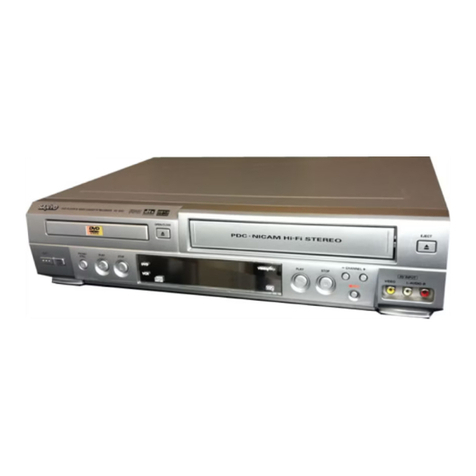
  9. Sanyo VHR-510 User manual

Sanyo VHR-510 User manual

Other manuals for VHR-510

1

This manual suits for next models

2

Other Sanyo VCR System manuals

Sanyo SRC-800A User manual

Sanyo

Sanyo SRC-800A User manual

Sanyo VHR-230 series User manual

Sanyo

Sanyo VHR-230 series User manual

Sanyo VHR-M341 User manual

Sanyo

Sanyo VHR-M341 User manual

Sanyo TLS-1500P User manual

Sanyo

Sanyo TLS-1500P User manual

Sanyo VHR-279E User manual

Sanyo

Sanyo VHR-279E User manual

Sanyo VHR-VK310A User manual

Sanyo

Sanyo VHR-VK310A User manual

Sanyo SRT-8040 User manual

Sanyo

Sanyo SRT-8040 User manual

Sanyo VZU-232CA User manual

Sanyo

Sanyo VZU-232CA User manual

Sanyo VHR-770 User manual

Sanyo

Sanyo VHR-770 User manual

Sanyo VHR-690 User manual

Sanyo

Sanyo VHR-690 User manual

Sanyo VHR-420 User manual

Sanyo

Sanyo VHR-420 User manual

Sanyo VHR-H619 User manual

Sanyo

Sanyo VHR-H619 User manual

Sanyo VWM-950 User manual

Sanyo

Sanyo VWM-950 User manual

Sanyo VHR-M340 User manual

Sanyo

Sanyo VHR-M340 User manual

Sanyo VHR-VT821A NZ User manual

Sanyo

Sanyo VHR-VT821A NZ User manual

Sanyo FISHER V95 I Mechanism Manual

Sanyo

Sanyo FISHER V95 I Mechanism Manual

Sanyo TLS-9072 User manual

Sanyo

Sanyo TLS-9072 User manual

Sanyo VHR-M261EV User manual

Sanyo

Sanyo VHR-M261EV User manual

Sanyo P90 Manual

Sanyo

Sanyo P90 Manual

Sanyo HV-DX2E User manual

Sanyo

Sanyo HV-DX2E User manual

Sanyo VHR-VK910A User manual

Sanyo

Sanyo VHR-VK910A User manual

Sanyo VHR-495E User manual

Sanyo

Sanyo VHR-495E User manual

Sanyo VHR-790 User manual

Sanyo

Sanyo VHR-790 User manual

Sanyo VHR-220 series User manual

Sanyo

Sanyo VHR-220 series User manual

Popular VCR System manuals by other brands

RCA VR678HF user guide

RCA

RCA VR678HF user guide

Zenith VRL4270HF Operating guide & warranty

Zenith

Zenith VRL4270HF Operating guide & warranty

Akai VS-606EA Operator's manual

Akai

Akai VS-606EA Operator's manual

Panasonic NV-SJ412EE operating instructions

Panasonic

Panasonic NV-SJ412EE operating instructions

FUNAI 27C-450 Service manual

FUNAI

FUNAI 27C-450 Service manual

Sony SLV-X37 operating instructions

Sony

Sony SLV-X37 operating instructions

JVC SR-VS20U - Dual Format S-vhs/minidv Recorder instructions

JVC

JVC SR-VS20U - Dual Format S-vhs/minidv Recorder instructions

Grundig GV 7400 EURO Service manual

Grundig

Grundig GV 7400 EURO Service manual

Zenith VCM321 Installation and operating guide

Zenith

Zenith VCM321 Installation and operating guide

JVC HR-A43U, HR-A63U instructions

JVC

JVC HR-A43U, HR-A63U instructions

Aiwa VX-S135U operating instructions

Aiwa

Aiwa VX-S135U operating instructions

RCA VR725HF user guide

RCA

RCA VR725HF user guide

JVC 0703-AH-PJ-BJ instruction manual

JVC

JVC 0703-AH-PJ-BJ instruction manual

TruTech ZV450TT8 owner's manual

TruTech

TruTech ZV450TT8 owner's manual

JVC HR-DVS1EK instructions

JVC

JVC HR-DVS1EK instructions

Sensory Science DDV2120 user guide

Sensory Science

Sensory Science DDV2120 user guide

JVC HR-VP78U instructions

JVC

JVC HR-VP78U instructions

RCA VR611HF user guide

RCA

RCA VR611HF user guide

manuals.online logo
manuals.online logoBrands
  • About & Mission
  • Contact us
  • Privacy Policy
  • Terms and Conditions

Copyright 2025 Manuals.Online. All Rights Reserved.

FILE NO.
SERVICE MANUAL
Video Cassette Recorder VHR”51O
(Australia)
VHR”530
(Australia)
VHR-245EE
(East Europe)
,—._—
I
CONTENTS
SELF-DIAGNOSIS DISPLAY ............................ 2mlPAL
1.
2.
3.
4.
L
DISASSEMBLY .................................,..5
ELECTRICAL ADJUSTMENT ......................... 9
TEST POINTS FORTAPE PATH ADJUSTMENT ....... 14 Please see other materials with Reference No.
PARTS LIST given in table below.
ACCESSORIES ................................... 15
PACKING MATERIALS ............................. 15
CABINET &CHASSIS PARTS.... ................... 15 ~1I
MECHANISM PARTS .............................. 16 Li
EL’ECTRICAL PARTS ..............................18
CIRCUIT DIAGRAMS (Refer to the separate volume)
PRODUCT SAFETY NOTICE
The components designated by asymbol (~)in this schematic diagram designates components whose value are of special significance
to product safety. Should any component designated by asymbol need to be replaced, use only the part designated in the Parts List.
Do not deviate from the resistance, wattage, and voltage ratings shown,
NOTE: 1. Parts order must contain model number, part number, and description.
2. Substitute parts maybe supplied as the service parts.
3. N.S.P.: Not available as service parts.
Design and specifications are subject to change without notice.
.-
PP2/A2, A, EE214315532,33, 19 REFERENCE No. SM531467
155w(N) D1
~
jSELF-DIAGNOSIS DISPLAY f
/,,,,,,,,,,,,,,,,,,,..,/.,..,.,/,,.,//,//./,//,/,//,,A
MechanismMode Display/HeadOutput Drop Warning Display/CylinderRotationAccumulated
TimeDisplay
This unit displays the diagnosis contents of abnormalities and the mechanism mode on its display panel in 2-digit numbers.
When the head playback output has dropped, the “L” sign will be blinked. Some models (listed later) will also display the cylinder
rotation accumulated time.
These display shows the outline of the problems. Use it as a reference when servicing the unit.
1.Self-DiagnosisContentsand MechanismMode Display
.
.
.
When the STOP button on the remote control is pressed for about 10 seconds continuously, the self- diagnosis number will be
displayed on the reception channel display of the display panel and number indicating the failed mechanism mode (changed
mode when being shifted) on the tape counter “seconds” display for 3seconds each.
During self-diagnosis display, displays other than the diagnosis number/mechanism mode number and the cylinder
accumulated rotation time display described later (some models only) will be turned off and when displays end, the normal
display will be returned automatically.
Refer to “Self-Diagnosis Contents” for the self-diagnosis numbers and the “Mechanism Mode Display Contents” for the
mechanism mode numbers.
Self-Diagnosis number Mechanism mode number
(Reception channel display) (Tape counter “Seconds” display)
Self-Diagnosis Contents
No. Problem Main Possible Cause Mechanism Operations and
State After Occurrence
00 There is no abnormality in the mechanism.
The cylinder motor does not rotate. ●The cylinder motor isfaulty. Shifts to the STOP mode.
01 ●The control of the cylinder motor is
faulty.
●The tape winds around the cylinder.
The take-up reel does not rotate.
02 ●The take-up reel is caught. Shifts to the STOP mode.
●The reel belt is faulty.
●The take-up torque has decreased.
The capstan motor does not rotate.
03 ●The capstan motor is faulty. Shifts to the STOP mode.
●The control of the capstan motor is
faulty.
The tape cannot be loaded with the .Error in the operations of the tape Unloads, shifts to the INITIAL mode,
cassetta inserted. loading mechanism.
(But unloading can be performed.) and tha power goes off.
●Foreignparticlesin the tape Ioad-ing
04 mechanism.
●The tape end sensor is faulty.
●The reel brake of the tape cassette
has not been released.
Tape loading and unloading cannot be ●The tape guide is caught. The powar isforcibly turned off with the
05 performed with the cassatte inserted. ●The loading motor is faulty. mechanism at its current position.
●The control of the loading motor is
faulty. —
–2–

Notice
--
—
‘.-
siq/llMo
❑CORRECTION HPRODUCTION CHANGE
❑SERVICE FLASH ❑ADD INFORMATION FILE NO.
Please add this notice to the Service Manual listed below.
ICategory :Video Cassette Recorder Date :Ju1.1O.1995
IModel Name
VHR-51O Reference No. Destination
SM531467 Australia
VHR-530 SM531467 Australia
WR-245EE SM531467 East Europe
The reason of change.
A:Misprint
D:Design
Section
4~E= ES
[Page 15)
PP2/A2,A,EE2
.Oc.
$40.
BQuality Reliability CStandardizatim
E:Multiple Use F:Deletion
Old
New
Old
New
Part No.
645 011 0993
645 011 1686
645 011 1693
645 011 0993
645 011 1686
645 014 3212
613 147 3591
613 153 8559
613 147 3591
613 153 8559
Descr@on
REMOCON,INFRARED
(WITH COVER BATTERY)
(VHR-245EE ONLY)
REMOCON,INFRARED
(WITH COVER BATTERY)
(VHR-51O ONLY)
REMOCON,INFRARED
(WITH COVER BATTERY)
(VHR-530 ONLY)
REMOCON,INFRARED
(WITH COVER BATTERY)
(VHR-245EE ONLY)
REMOCON,INFRARED
(WITH COVER BATTERY)
(VHR-51O ONLY)
REMOCON,INFRARED
(WITH COVER BATTERY)
(VHR-530 ONLY)
COVER BATTERY
(FOR REMOCON)
(EXCEPT VHR-245EE)
COVER BATTERY
(FOR REMOCON)
(VHR-245EE ONLY) ......
COVER BATTERY
(FOR REMOCON)
(VHR-51O ONLY)
(EXCEPT VHR-51 O)
lnterchar_ge–
ability
No
No
No
No
?easor
D
D
143 155 32,33,19 Printed in Japan Reference PMM531467-01
SANYO Electrc Co.Ltd.
Osaka,Japan
Secticn
COMPL PWB,
CP-1-A
(Page 19)
Lot.
No.
IC301 Old
New
Part No.
410 236 3209
410 231 8407
410 230 9306
410 236 3209
410 244 7305
410 238 6307
Ikscripticn
IC LC866736A-5826
(VHR-245EE ONLY)
IC LC866728A-5784
(VHR-51O ONLY)
IC LC866744A-5761
(VHR-530 ONLY)
IC LC866736A-5826
(VHR-245EE ONLY)
IC LC866728A-5906
(VHR-51O ONLY)
IC LC866744A-5859
(VHR-530 ONLY)
Inter*e-
ability
No
Ream
D
No
‘-#--
--
J
15502(1) D2
i-
No. Problem Main Possible Cause Mechanism Operations and
State After Occurrence
Front unloading cannot be performed ●The cassette drive mechanism is Front loads and shifts to the STOP or
when ejecting the cassette. faulty. INITIAL mode.
(Front loading can be performed.) oThe front door is caught. oWhen the power switch is turned on
06 before eject operations: Shifts to the
STOP mode.
.When the power switch is turned off
before eject operations: Shifts to the
INITIAL mode and the power goes
off.
Front loading and front unloading oThe tape cassette is caught in the The power is forcibly turned off with
cannot be performed when ejecting cassette drive mechanism. the mechanism at its current position.
the cassette. ●The main cam and front rack gear of
07 the front loading mechanism have
not engaged properly.
●The gears of the front loading
drive mechanism have not en.
gaged properly.
The mechanism becomes 1(REVIEW) ●The mechanism mode switch con- The power is forcibly turned off with
08 while moving from 2(IDLER), 3(STILL), tact is faulty, the mechanism at its current position.
4(BRAKE), and to 5(STOP).
The mechanism becomes 7(INITIAL) .The mechanism mode switch con- Carries out tape take-up operations,
09 while moving from 1(REVIEW), 2tact is faulty.
(IDLER), 3(STILL), 4(BRAKE), and to shifts to the INITIAL mode, and the
5(STOP). power goes off.
Note: For details of mechanism operations corresponding to the mechanism positions of the self-diagnosis numbers 08 and
09 above, refer to the separate volume on the V95 Imechanism manual.
These manual reference numbers are shown in the cover.
Mechanism Mode Display Contents
I
I
—I
Vlode No. Mechanism Mode Mode No. Mechanism Mode Mode No. Mechanism Mode
00 CASSETTE OUT 08 PLAY 16 VIDEO INSERT
01 STANDBY 09 REC 17 VIDEO INSERT -PAUSE
02 STOP 10 AUDIO DUBBING 18 AUDIO/VIDEO INSERT
03 STILL 11 X2 SPEED PLAY 19 REVERSE X2 SPEED PLAY
04 REC-PAUSE 12 CUE
05 AUDIO DUBBING -PAUSE 13 REVIEW
06 FRAME ADVANCE 14 FAST FORWARD
07 SLOW 15 REWIND 99 OTHERS
2. HeadOutput Drop Warning Display
●
●
When the STOP button on the remote control is pressed for 10 seconds continuously 10 seconds after play starts, “L” will
be displayed blinking at the first digit of the minutes position on the tape counter when the head output is lower than
the specified value to indicate an abnormality.
The cause of the abnormality maybe due to drop in the playback output caused by drop in the efficiency of the cassette used
or head clogging. Refer to “Head Playback Output Voltage Check” as a means to judge the abnormality.
n1: ‘“””i$’””:4““~~~n3
,.,,,.,.....
Display panel
L1-f .:’ ‘“L.. LIL
Head output drop warning display
(Tape counter” Ist digit of Minutes. ”position)
----
–3–
15532(N) 03
Head playback output voltage check
)assette Use
Cassette
with
normal
playback
output
Recorded
cassette
(With tabs)
Rental
cassette
(Without
tabs)
Warning
Display
“L”
blinking
“L”
blinking
“L”
blinking
Envelope Detection Output Voltage
Envelope detec-
tion output 4V
(IC301 Pin 25 or
C3016 HOT side:
see Fig. 2-l-1) Ov
Switching pulse
(TP183: see Fig.
2-l-2)
-----------------------------------
--- t
CH-I CH-2
Envelope detec-
tion output 4V t-----------------------------------
(IC301 in 25 or
C3016 HOT side:
see Fig. 2-l-1) ov~!Gthan
Switching pulse
(TP183: see Fig. CH-I CH-2
2-l-2)
Envelope detec-
tion output
Ov+
,$V -----------------------------------
(IC301 Pin 25 or
C3016 HOT side:
see Fig. 2-l-1)
Switching pulse
(TP183: see Fig. CH-I CH-2
2-l-2)
Less than
0.5V
Main Cause
When the output voltage dif-
ference of the two channels
is 0.5 to 0.95V
●The video heads of both are
normal
Envelope detec-
tion output
k~l=than
4V -----------------------------------
(IC301 Pin 25 or
C3016 HOT side:
see Fig. 2-l-1) Ov
Switching pulse
(TP183: see Fig. CH-I ICH-2
2-l-2)
When the output voltage dif-
ference of the two channels
is more than 0.95V
●Tracking adjustment has not
been performed accurately
●One video head is clogged
●One video head has worn out
When the average outputvoltage
of the two channels is less than
0.5V
●Tracking adjustment has not
been performed accurately
●Both video heads are clogged
●Both video heads have worn
out
When the output voltage dif-
ference of the two channels is
more than 0.95V
●Tracking adjustment has not
been performed accurately
●One video head is clogged
●One video head has worn out
Some rental cassettes may have extremely low video playback outputs even when both video heads are
normal. As the average output voltage of the two heads may be less than 0.5V for some, no warning displays
will be shown.
3. Cvlinder rotation accumulatedtime disdav onlv VHR-530 emdovs this function (However,
.
.
thisfunctionW-IIbe equippedonlyfrom_themiddleof production.-
Press the STOP button on the remote control for approximately 10 seconds and the cylinder rotation accumulated time
excluding the cassette out and standby operation time will be displayed on the “Hours” display in units of 100 hours. (“33” will
be displayed for 3seconds for 3,300 to 3,399 hours.)
To erase the cylinder rotation accumulated time display, press the RESET button on the remote control during the
accumulated time display.
(
IA
Cylinder rotation accumulated display (Tape counter “Hours” display)
–4–
15502(N) Ml
1. DISASSEMBLY
-. 1-1.REMOVAL OF CABINET,MECHANISM UNIT,AND MAIN BOARD
REMOVING THE CABINET PARTS (Fig. l-l-l) 2. Remove the screw@ at the back of the chassis.
1. Remove the cabinet and bottom cover by removing the 3. Remove the red screw@ in the chassis, remove the red
four screws @and four screws@. screw@, and remove the holder in this order.
2. Remove the front panel by removing the locks of the 4. Remove the two screws@ and two screws@ of the
clamps (A) using ascrewdriver, etc. and slightly rotating mechanism unit. The two screws @of the cassette tray
the bottom part in the direction of the arrow. can be removed easily by pushing the tray lock lever in
Notes: ●Electrical adjustments for the this model can be the arrow direction to remove the lock as shown in the
performed with only the cabinet removed. enlarge view Aand by pushing the lid opener lever in
●When replacing the bottom cover, do not tighten the arrow direction to remove the lock as shown in the
the screws @too much. Excess tightness may enlarge view B.
damage the screw taps on the chassis. 5. Lift up the whole mechanism unit and main board (CP-I
PWB assembly), and as shown in Fig. 1-1-3, push the two
REMOVING THE MECHANISM MAIN UNIT AND THE lock claws (D) of the chassis in the arrow direction so that
CP-I PWB ASSEMBLY (Fig.1-l-2 and l-l-3) they can be removed from the chassis.
After removing the cabinet parts, remove the mechanism
—unit and the CP-I PWB assembly connected as follows.
1. Spread out the Iockclaws (C) in the arrow direction slight-
ly and remove the TM-1 PWB as shown in Fig. 1-1-2.
M-PP4H/G-l
FrontPanel
.. IQ \Main Unit
‘4
\
oBottom Cover
“’”””;*
@b “Fig. 1-1-1
–5–
m
\
15502(N) M2
M-PP2UE-2
Af@
Terminal Board
\@?~
\ll
Tray Lock Lever
ner Lever
\
Fig.
Holder
—
B
1-1-2
M-PP2UE-3
Mechanism M<in Unit %“7 ‘“B’
i.ssembly
TM-1 PWB’
Clamps(D)
Assembly
,Chassis
Fig. 1-1-3
—
-/
-
–6–
15502(1) M3
1-2,TEMPORARILYSEITING UP AND CONNECTINGCP-I PWB ASSEMBLY
The following is an example of how to place and connect the main board without ajig, when repairing the CP-1 PWB
assembly.
1. Place the mechanism unit and main board up side down 2. Operate the unit using the buttons on TM-1 PWB or the
as a whole on aflat surface with the foil side of the main remote control.
board facing up.
1-
M-PP4HIG-4 CP-1 PWB Assembly (Foil side)
\
TM-1
\
Mechanism Main Unit Fig. 1-1-4
1-3.INSTALLATIONOFTHEFRONTPANEL
When installing the front panel to the chassis after repaires and adjustments.
1. Pressirm down the door opener lever of the mechanism Note: Opened cassette door position does not install the
main unit. front panel to the chassis.
2. Set the cassette door to half-opened state as shown in
Fig.1-l-5, and install the front panel to the chassis.
.-
M-PP4H/G-5
Do& Opener Lever
(Position A) Cass&te Door
(Position B) Fig. 1-1-5
.- 1
–7–
15515(N) L1
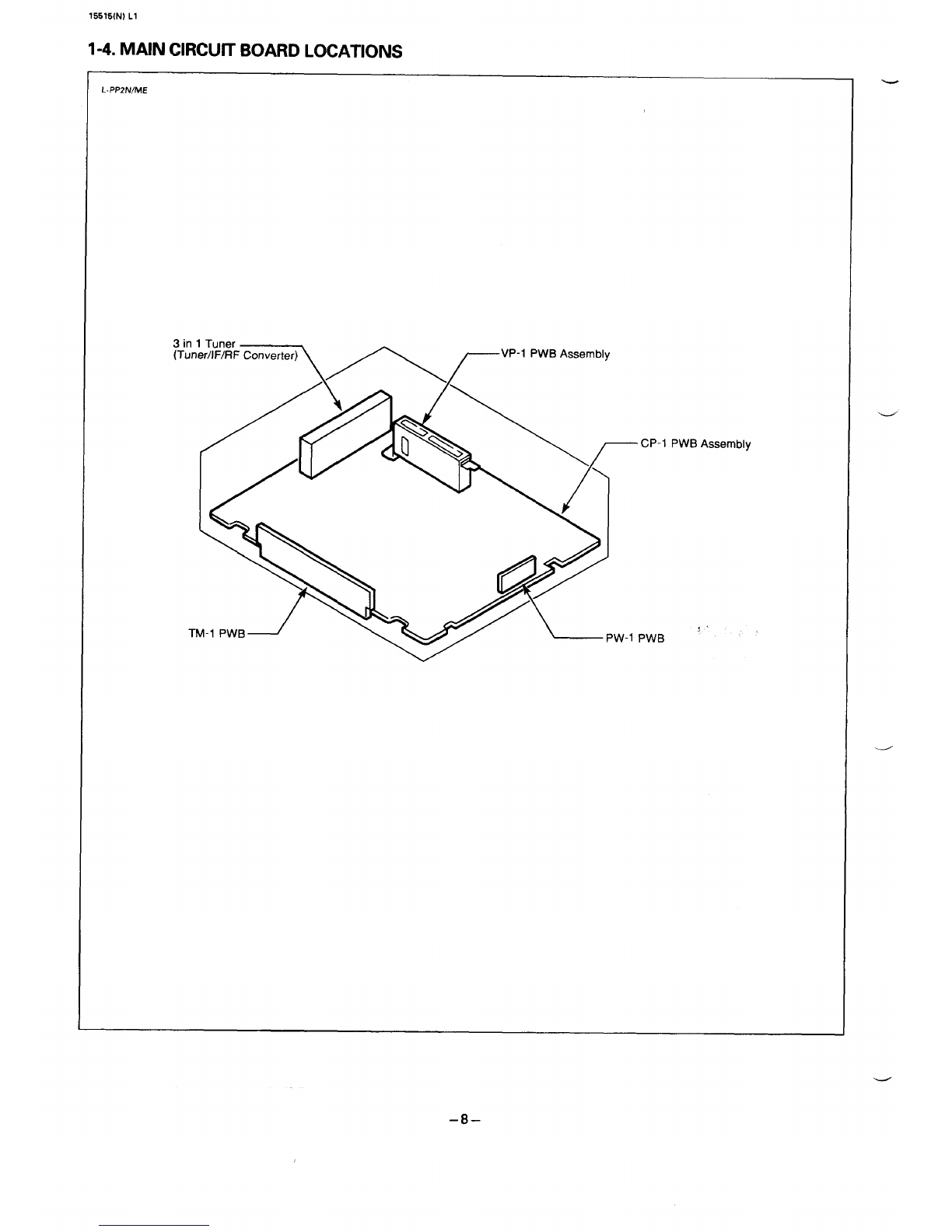
1-4.MAIN CIRCUITBOARD LOCATIONS
L. PP2N/ME
PWB Assembly
w
–8–