4
Changing the Charger Module
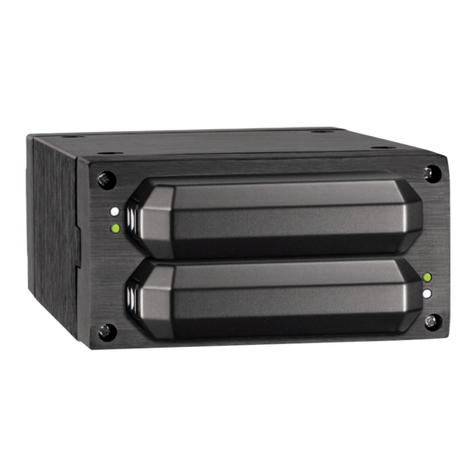
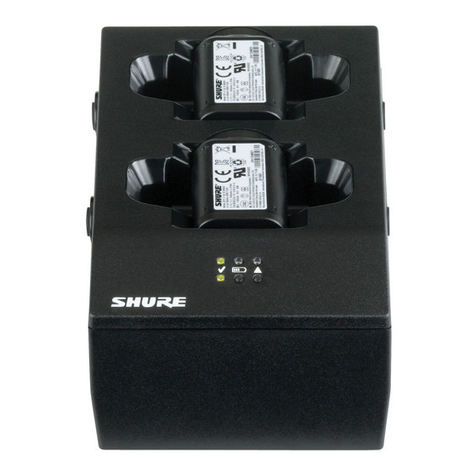
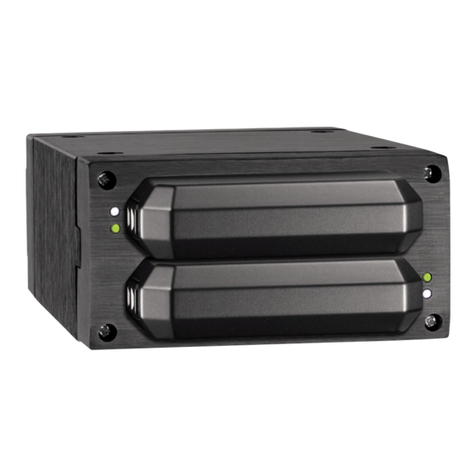
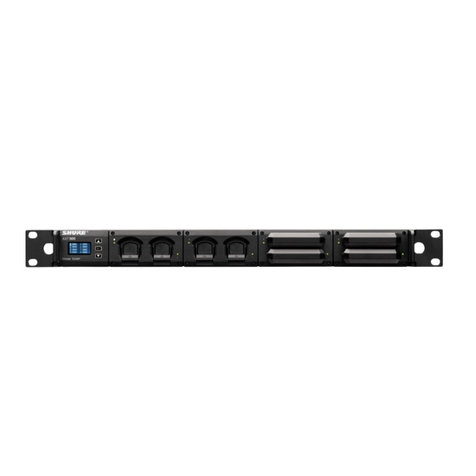
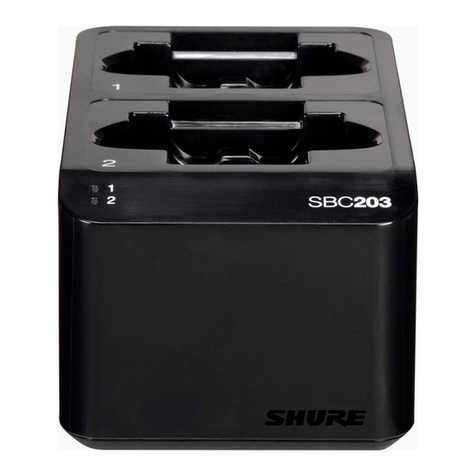
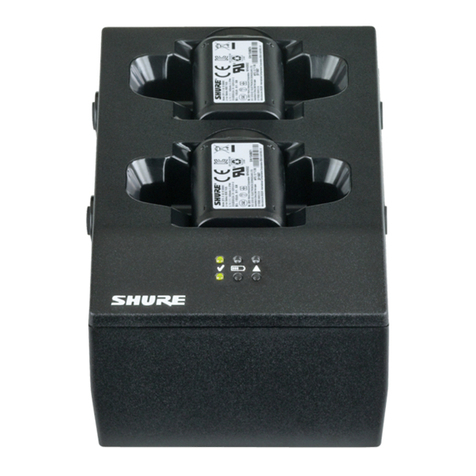
The modular design of the charger housing accepts either the AXT902 hand-
held charging module or the AXT901 bodypack charging module. Use the fol-
lowing instructions to change the charging module.
Caution! Remove DC power and remove batteries when installing the charg-
ing module.
1. Remove the 4 mounting screws that secure the charging module.
2. Pull the charger module to remove it from the housing.
3. Insert the replacement charger module into the housing (note the orientation
of the guide rails).
4. Insert the mounting screws (4 pieces) and tighten them to secure the charg-
ing module.
Power LED off. DC power fault - check connection to power
supply. Ensure PS50 power supply is con-
nected to an AC power source.
Charge status LED does
not illuminate.
Battery is not fully inserted.
Battery does not charge Battery discharged below 3.0 volts. Try another
battery.
Troubleshooting
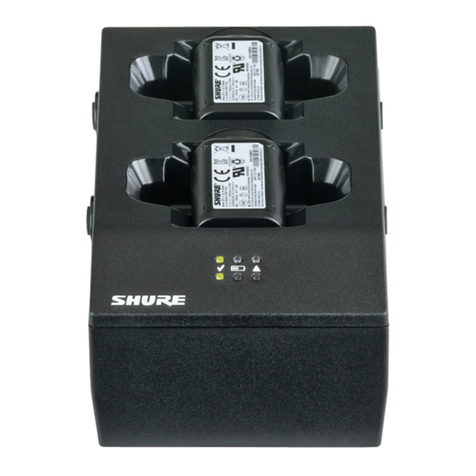
Specifications- AXT903/904 Portable Battery Chargers
Battery Type Up to 2 rechargeable Li-Ion batteries (AXT910/AXT920/920SL)
Charge Time 50%=1 hour; 100%=3 hours
Operating Temperature
Range -18°C (0°F) to +40°C (104°F)
Battery Charging
Temperature Range 0°C (32°F) to 60°C (140°F)
Storage Temperature
Range -29°C (-20°F) to 74°C (165°F), without batteries
Dimensions 45 mm x 86 mm x 114 mm (1.8 in. x 3.4 in. x 4.5 in.), H x W x D
Weight 350 g (12.3 oz.), without batteries or PS50 External Power Supply
Housing Cast and extruded aluminum
Power Requirements 5.5 V DC, 2.72 A
Certifications
Conforms to electrical safety requirements based on IEC 60065.
c UL us listed by Underwriters Laboratories, Inc.
Authorized under the verification provision of FCC Part 15B.
This Class B digital apparatus complies with Canadian ICES-003. Cet appareil
numérique de la classe B est conforme à la norme NMB-003 du Canada.
This device complies with Industry Canada licence-exempt RSS standard(s).
Operation of this device is subject to the following two conditions: (1) this de-
vice may not cause interference, and (2) this device must accept any interfer-
ence, including interference that may cause undesired operation of the device.
Le présent appareil est conforme aux CNR d’Industrie Canada applicables
aux appareils radio exempts de licence. L’exploitation est autorisée aux deux
conditions suivantes : (1) l’appareil ne doit pas produire de brouillage, et (2)
l’utilisateur de l’appareil doit accepter tout brouillage radioélectrique subi,
même si le brouillage est susceptible d’en compromettre le fonctionnement.
The CE Declaration of Conformity can be obtained from Shure Incorporated or
any of its European representatives. For contact information please visit www.
shure.com
The CE Declaration of Conformity can be obtained from: www.shure.com/
europe/compliance
Authorized European representative:
Shure Europe GmbH
Headquarters Europe, Middle East & Africa
Department: EMEA Approval
Jakob-Dieffenbacher-Str. 12
75031 Eppingen, Germany
Phone: 49-7262-92 49 0
Fax: 49-7262-92 49 11 4
Meets essential requirements of the following European Directives:
• Low Voltage Directive 2006/95/EC
• WEEE Directive 2002/96/EC, as amended by 2008/34/EC
• RoHS Directive 2002/95/EC, as amended by 2008/35/EC
Note: Please follow your regional recycling scheme for electronic waste
• Battery Directive 2006/66/EC
Please follow your regional recycling scheme for battery disposal.
• Conforms to European Regulation (EC) No. 1275/2008, as amended.
Information to the user
This equipment has been tested and found to comply with the limits for a
Class B digital device, pursuant to Part 15 of the FCC Rules. These limits are
designed to provide reasonable protection against harmful interference in a
residential installation. This equipment generates uses and can radiate radio
frequency energy and, if not installed and used in accordance with the instruc-
tions, may cause harmful interference to radio communications. However,
there is no guarantee that interference will not occur in a particular installation.
If this equipment does cause harmful interference to radio or television recep-
tion, which can be determined by turning the equipment off and on, the user
is encouraged to try to correct the interference by one or more of the following
measures:
• Reorient or relocate the receiving antenna.
• Increase the separation between the equipment and the receiver.
• Connect the equipment to an outlet on a circuit different from that to which
the receiver is connected.
• Consult the dealer or an experienced radio/TV technician for help.