6WIKA Operating instructions temperature transmitter Model T24.10
2370242.06 02/2006 GB/D/E
GB
3.1 Functional description
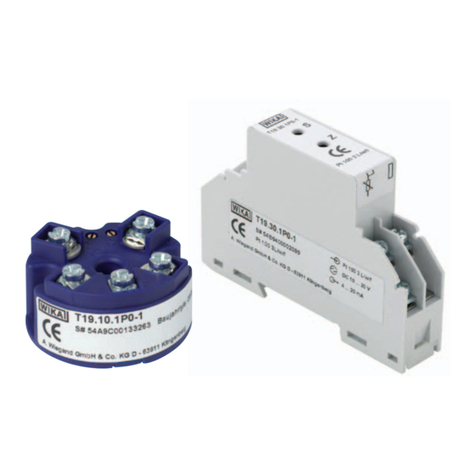
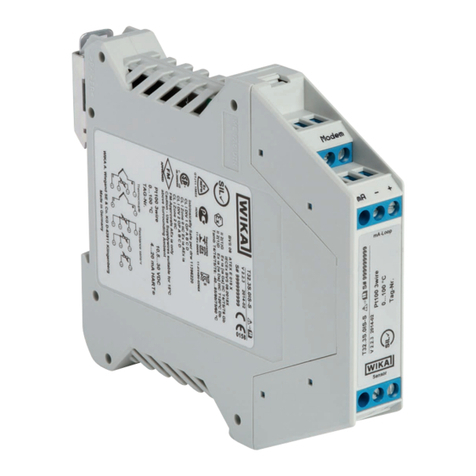
The analogue temperature transmitter serves for the conversion of a
resistance value into a proportional current signal (4-20 mA). The
analogue signal is transmitted to a series-connected logic unit, e.g. an
SPS or an alarm contact, where it is monitored for upper deviations
from a maximum value or lower deviations from a minimum value.
For failure monitoring the logic unit has to be capable of recognising
HI alarms (> 21 mA) as well as LO alarms (< 3.6 mA). The electrical
components of the transmitter are arranged in a plastic case and
completely encapsulated. Due to the internal analogue signal proces-
sing these transmitters can also be used in multiplexed systems.
The transmitters described in these operating instructions feature an
internal conductive connection between the sensor input and the
analogue output. There must not be any conductive connection (e.g.
via earth) between the connected sensor and the analogue output!
3. Intended use
3.2 Ambient conditions
T24.10.***
Ambient/
storage temperature
Standard range: -40 ... +85 °C
Extended range: -40 ... +105 °C 1)
Climate class: Cx (-40 … +85 °C, 5 % to 95 % rel. air humidity)
DIN EN 60 654-1
max. permissible 100 % relative humidity (unlimited with insulated
humidity sensor connection wires), moisture condensation
permissible DIN IEC 68-2-30 Var. 2
Vibration 10 … 2000 Hz 10 g DIN IEC 68-2-6
Shock DIN IEC 68-2-27
Salt mist DIN IEC 68-2-11
Case material plastic, PBT, glass fibre reinforced
Case ingress protection IP 66 / IP 67 IEC 529 / EN 60 529
Terminals ingress prot. IP 00 IEC 529 / EN 60 529
1) without explosion protection
For further technical details please refer to WIKA data sheet TE 24.01