manuals.online logo
Brands
  1. Home
  2. •
  3. Brands
  4. •
  5. DANLERS
  6. •
  7. Switch
  8. •
  9. DANLERS CESPLL10VDC Quick start guide

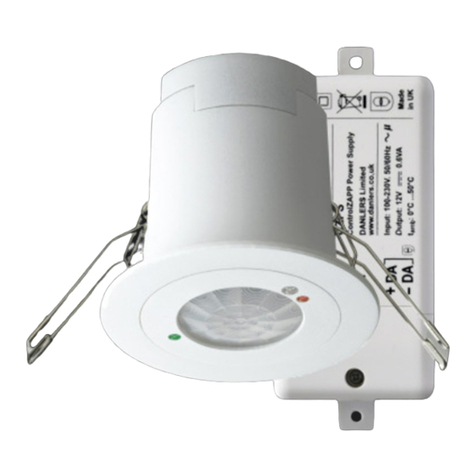
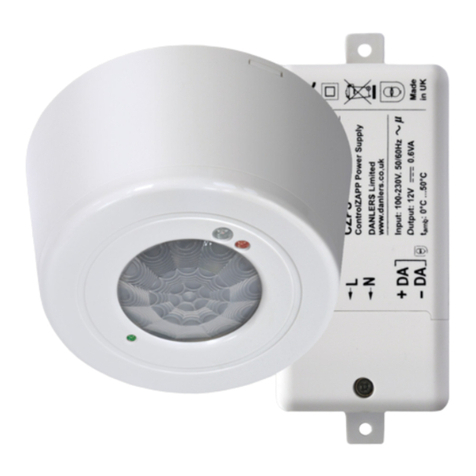
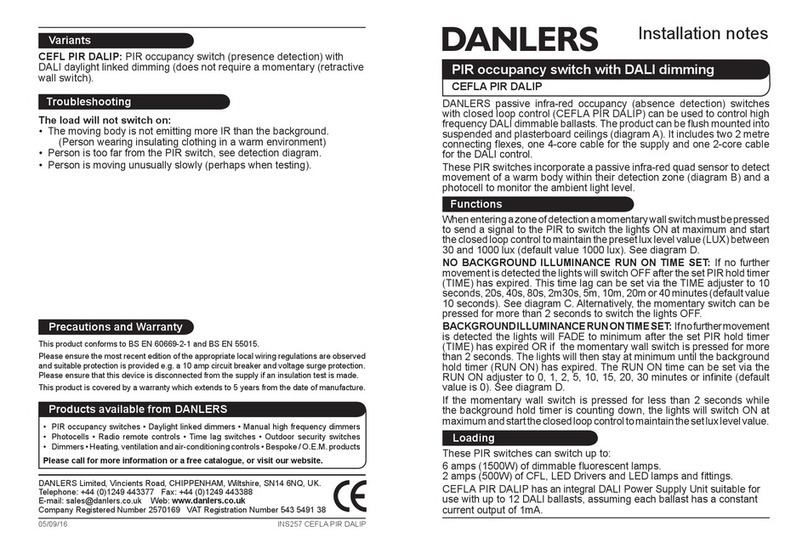
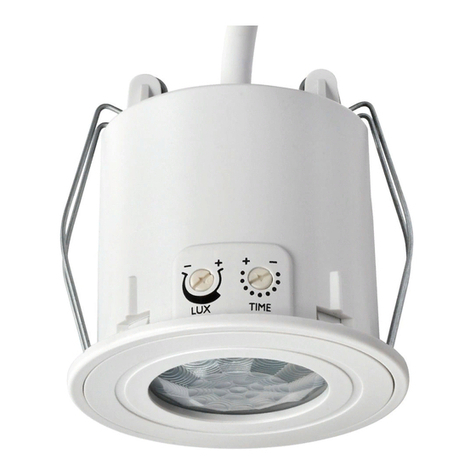
DANLERS CESPLL10VDC Quick start guide

This manual suits for next models

1

Other DANLERS Switch manuals

DANLERS CZ HB ND Quick start guide

DANLERS

DANLERS CZ HB ND Quick start guide

DANLERS ControlZAPP CZ CEFL DALI Quick start guide

DANLERS

DANLERS ControlZAPP CZ CEFL DALI Quick start guide

DANLERS GRTLA MK User manual

DANLERS

DANLERS GRTLA MK User manual

DANLERS TLSW 10 ILM Quick start guide

DANLERS

DANLERS TLSW 10 ILM Quick start guide

DANLERS CESRAPIRSD Quick start guide

DANLERS

DANLERS CESRAPIRSD Quick start guide

DANLERS BMPIR10M Quick start guide

DANLERS

DANLERS BMPIR10M Quick start guide

DANLERS WACE RFS Quick start guide

DANLERS

DANLERS WACE RFS Quick start guide

DANLERS GRTL MK Quick start guide

DANLERS

DANLERS GRTL MK Quick start guide

DANLERS CESRA PIR DSIP Quick start guide

DANLERS

DANLERS CESRA PIR DSIP Quick start guide

DANLERS CZ CEFL Quick start guide

DANLERS

DANLERS CZ CEFL Quick start guide

DANLERS BMEXPIR Quick start guide

DANLERS

DANLERS BMEXPIR Quick start guide

DANLERS TLSW HB Quick start guide

DANLERS

DANLERS TLSW HB Quick start guide

DANLERS CESRA PIR 10VDC Quick start guide

DANLERS

DANLERS CESRA PIR 10VDC Quick start guide

DANLERS COPIR IP66 User manual

DANLERS

DANLERS COPIR IP66 User manual

DANLERS CESF PIR User manual

DANLERS

DANLERS CESF PIR User manual

DANLERS CESF PIR User manual

DANLERS

DANLERS CESF PIR User manual

DANLERS WAPIR Quick start guide

DANLERS

DANLERS WAPIR Quick start guide

DANLERS CEFL PIR LR Quick start guide

DANLERS

DANLERS CEFL PIR LR Quick start guide

DANLERS TWSW Quick start guide

DANLERS

DANLERS TWSW Quick start guide

DANLERS CESF PIR Quick start guide

DANLERS

DANLERS CESF PIR Quick start guide

DANLERS DUSW Quick start guide

DANLERS

DANLERS DUSW Quick start guide

DANLERS CESF PIR IP66 Quick start guide

DANLERS

DANLERS CESF PIR IP66 Quick start guide

DANLERS CEFL PIR Quick start guide

DANLERS

DANLERS CEFL PIR Quick start guide

DANLERS ControlZAPP CZ CEFL Quick start guide

DANLERS

DANLERS ControlZAPP CZ CEFL Quick start guide

Popular Switch manuals by other brands

SMC Networks SMC6224M Technical specifications

SMC Networks

SMC Networks SMC6224M Technical specifications

Aeotec ZWA003-S operating manual

Aeotec

Aeotec ZWA003-S operating manual

TRENDnet TK-209i Quick installation guide

TRENDnet

TRENDnet TK-209i Quick installation guide

Planet FGSW-2022VHP user manual

Planet

Planet FGSW-2022VHP user manual

Avocent AutoView 2000  AV2000BC AV2000BC Installer/user guide

Avocent

Avocent AutoView 2000 AV2000BC AV2000BC Installer/user guide

Moxa Technologies PT-7728 Series user manual

Moxa Technologies

Moxa Technologies PT-7728 Series user manual

Intos Electronic inLine 35392I operating instructions

Intos Electronic

Intos Electronic inLine 35392I operating instructions

Cisco Catalyst 3560-X-24T Technical specifications

Cisco

Cisco Catalyst 3560-X-24T Technical specifications

Asante IntraCore IC3648 Specifications

Asante

Asante IntraCore IC3648 Specifications

Siemens SIRIUS 3SE7310-1AE Series Original operating instructions

Siemens

Siemens SIRIUS 3SE7310-1AE Series Original operating instructions

Edge-Core DCS520 quick start guide

Edge-Core

Edge-Core DCS520 quick start guide

RGBLE S00203 user manual

RGBLE

RGBLE S00203 user manual

Thrustmaster FLIGHT SIMULATOR X quick guide

Thrustmaster

Thrustmaster FLIGHT SIMULATOR X quick guide

Southwire SURGE GUARD 41390 RVC troubleshooting guide

Southwire

Southwire SURGE GUARD 41390 RVC troubleshooting guide

Buhler Nivotemp NT 61 Brief instructions

Buhler

Buhler Nivotemp NT 61 Brief instructions

Kramer VS-41HDCP user manual

Kramer

Kramer VS-41HDCP user manual

Techly IDATA AU-270 user manual

Techly

Techly IDATA AU-270 user manual

Belkin F1U109 user manual

Belkin

Belkin F1U109 user manual

manuals.online logo
manuals.online logoBrands
  • About & Mission
  • Contact us
  • Privacy Policy
  • Terms and Conditions

Copyright 2025 Manuals.Online. All Rights Reserved.

Installation notes
DANLERS Limited, Vincients Road, CHIPPENHAM, Wiltshire, SN14 6NQ, UK.
Telephone: +44 (0)1249 443377 Fax: +44 (0)1249 443388
E-mail: [email protected] Web: www.danlers.co.uk
Company Registered Number 2570169 VAT Registration Number 543 5491 38
Products available from DANLERS
• PIR occupancy switches • Daylight linked dimmers • Manual high frequency dimmers
• Photocells • Radio remote controls • Time lag switches • Outdoor security switches
• Dimmers • Heating, ventilation and air-conditioning controls • Bespoke / O.E.M. products
Please call for more information or a free catalogue, or visit our website.
This product conforms to BS EN 60669-2-1. Product complies to Class 2 insulation.
Please ensure the most recent edition of the appropriate local wiring regulations are
observed and suitable protection is provided e.g. 6 amps over current, 1kV over voltage.
Please ensure that this device is disconnected from the supply if an insulation test is made.
This product is covered by a warranty which extends to 5 years from the date of manufacture.
Precautions and Warranty
06/04/17 INS218 CESPLL10VDC
Variants
Variants can be supplied to special order, please ask for details.
Troubleshooting
The load will not switch on:
• The LUX adjuster is set too low and is inhibiting the switch.
• The moving body is not emitting more IR than the background.
(Person wearing insulating clothing in a warm environment)
• Person is too far from the PIR switch, see detection diagram.
• Person is moving unusually slowly (perhaps when testing).
Loading
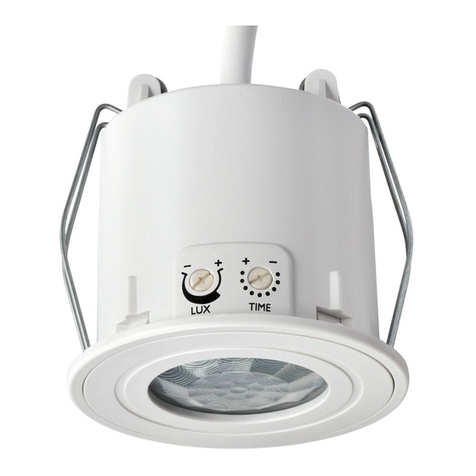
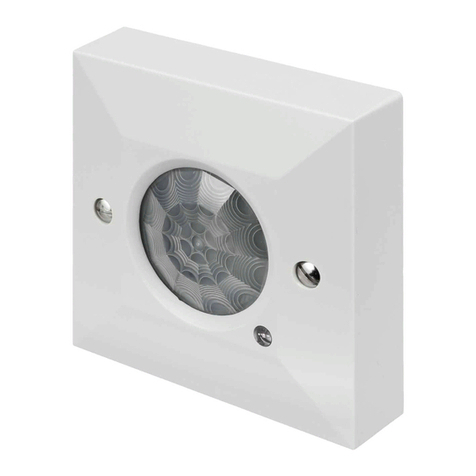
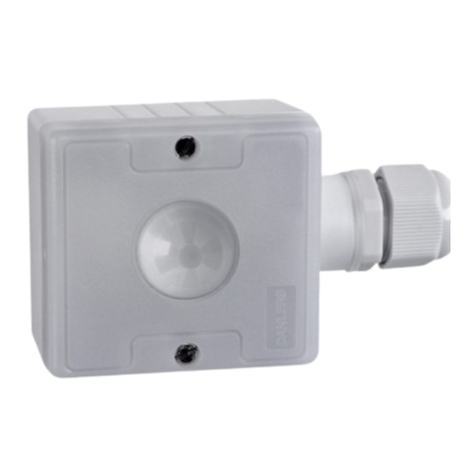
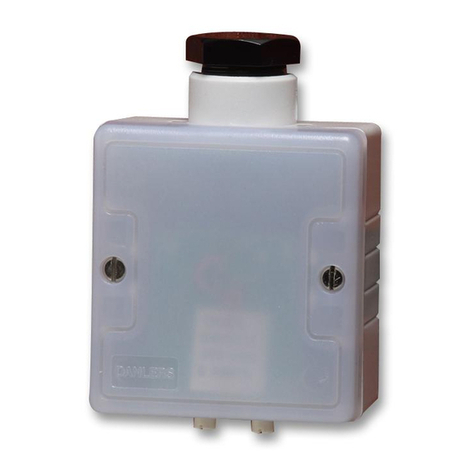
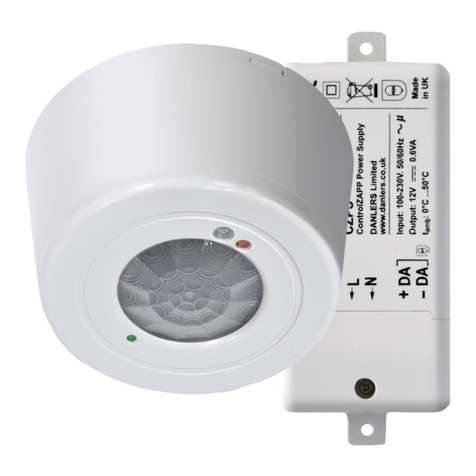
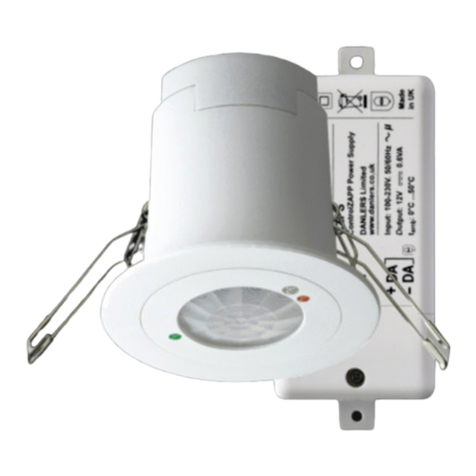
PIR occupancy switch with 1-10V
‘Step Down’ illuminance
CESPLL10VDC CEFPLL10VDC IP66
CESPLL10VDC(IP66) can be used to control high frequency 1-10VDC
dimmable ballasts. The products can be surface mounted onto ceilings.
These PIR switches incorporate a passive infra-red quad sensor to
detect movement of a warm body within their detection zone (diagram
B), a photocell to monitor the ambient light level and a adjustment
spindle to select the level of ‘Step Down’ illuminance.
Upon detecting movement, the PIR will switch the 1-10V dimmable
ballast to 100% on via the Switched Line output if the room is darker
than the setting on the rst lux adjuster (LUX, diagram D). Upon
nonoccupation the 1-10V dimmable ballast will switch to a pre-set
lower light level (‘Step Down’ illuminance), variable from 10% to
100% in 9 steps.
There is also a time lag function for adjusting the time that must
elapse with no movement detected before the PIR switch will switch
to its lower ‘Step Down’ level. This time lag can be set via the TIME
adjuster to 10 seconds, 20s, 40s, 1 minute 15 seconds, 2m30s, 5m,
10m, 20m or 40 minutes (diagram D).
CESP LL10VDC (IP66) also incorporates a sensitivity adjuster, labelled
‘SENS’, to reduce the range and sensitivity of detection (diagram D).
CESPLL10VDC can be ceiling mounted on the square pattress box
(not supplied). CESPLL10VDC IP66 is weatherproof to an IP66 rating
and can be ceiling mounted on the square pattress box (PABO)
supplied (to maintain an IP66 rating a suitable cable gland would
have to be tted).
These PIR switches can control up to 20x 1-10V dimmable ballasts,
assuming each ballast has a constant current output of 1mA.
-0
+10 C
2
SL
2
NC
-0
+10
BALLAST
OUTPUT
DANLERS
‘Step Down’ PIR
Occupancy Switch
PIR Occupancy
Switch with
slave relay
PIR Occupancy
Switch with
slave relay
PIR Occupancy
Switch with
slave relay
C
2
SL
2
NC
C
2
SL
2
NC
E. Controlling corridors and larger areas
For the control of larger areas and corridors it is advised that
CESPLL10VDC (or CEFPLL10VDC IP66) are used in conjuntion with
DANLERS standard ceiling mounted PIR occupancy switches such as
CEFLPIR or CESFPIR and a DANLERS slave relay (CESLBL).

Installation procedure
1. Please read these notes carefully before commencing work. In case of
doubt please consult a qualied electrician.
2. POSITIONING: The CESPLL10VDC (IP66) should be installed to
achieve correct coverage of the area, see diagram B. Avoid locating this
product where it is exposed to drafty conditions (exposed lobbies, open
ceiling voids or near fans) or near heat sources.
3.
To cover larger areas and corridors PIRs should be spaced in a 5 metre grid
formation, with one CESPLL10VDC(IP66) and the rest with switching PIRs
with Volt Free secondary output and Normally Closed, Logic Gold relay
contacts (CESFPIRVFNCLG) with all
Switch Line outputs wired in series
(diagram E).

4. Make sure the power is
isolated from the circuit.
The PIR should be connected
as shown in diagram C:
Start-up mode
When the PIR is powered up, it will switch on the load for 1 minute, the load
will then switch off and the PIR will enter its Operating Mode. If a manual
override-off switch is positioned before the PIR in the circuit (diagram C,
note 1) it will do this each time the wall switch is switched on.
Time, Lux and ‘Step Down’ set-up
For convenience, ensure that the TIME is set to the minimum when setting up
the LUX level. Afterwards set the TIME to a value suitable for the application.
The LUX is best set up when the local ambient light is at approximately the
minimum desired working light level. With the LUX set fully clockwise wait
for the PIR to switch off. Rotate the LUX adjuster slowly anticlockwise (- to
+), whilst waving your hand approximately 1m below the PIR, until the load
switches on.
The single adjuster spindle on the back of the PIR is used to regulate the ‘Step
Down’ illuminance function lux level, see diagram A opposite. This must be
adjusted in situ so that the desired level of brightness is achieved under the
luminaire(s) being controlled. In areas where no natural daylight is present it
is advised that the LUX level is set to . inhibit off.
L
N
1
tsallab
10
1
tsallab
10
1
tsallab
10
CESPLL10VDC (IP66)
control lines
230 VAC
Optional
switch for
overriding off
TIME
min max
LUX
max min
SENS
min max
20s
40s
1m15s
2m30s
5m
10m
10s
20m
40m 100
∞
1000
66% 100%
Typical settings
up to 5m
up to 7m
Strong detection zone
i.e. person moving arm
or walking towards PIR
Secondary detection zone
i.e. person walking
perpendicular to PIR
For optimum coverage
recommended mounting
height: 2.4 to 5m
B: Detection diagram
C: Wiring diagram,
single PIR
D: Adjusting time
and lux at the
side of product
‘Step Down’ set-up
The STEP DOWN low light level range is
adjusted via the spindle on the top of the product
and allows the 1-10VDC ballast to switch from
10% to 100% in 9 steps. Fully clockwise will allow
the ballast to switch to 100% on nonoccupation.
Fully anti-clockwise will allow the ballast to
switch to 10% on non-occupation.
A: ‘Step Down’ adjuster on
the back of the product
100
%
10%
L
S
te
p
Do
wn
A
d
j
uster
Terminal
block