2.1 American Naonal Standards Instute (ANSI) and Occupaonal Safety and Health Administraon (OSHA): The SRD discussed in this
manual meets the standards of ANSI Z359.14-2021, ANSI A10.32-2012, and Occupaonal Safety and Health Administraon (OSHA)
regulaons 1926.502 and 1910.140. ANSI requires SRDs be classied according to the type of usage the user would be exposed to, and are
tested either as Class 1 or Class 2. Dynamic performance means that the SRD is installed in a tesng drop tower. A test weight is aached
to the SRD and then dropped. Test results are recorded.
Parameters recorded are:
The Arrest Distance is the total vercal distance required to arrest a fall. The Arrest Distance includes the deceleraon distance and the
acvaon distance. The Average Arrest Force is the average of the forces applied to the body and the anchorage by the fall protecon
system. The Maximum Arrest Force is the maximum amount of force that may be applied to the body and the anchorage by the fall
protecon system. In addion to the above tests conducted in ambient condions, the units must be retested for average and peak forces
under certain environmental condions, where the units are cooled, then tested, heated, then tested, or saturated in water and tested
again. Separate units may be used for each test. All test results are recorded.
This test data is then used to establish the basis for fall clearance guidelines published in the user instrucon manual.
Class 1 and 2: Class 1 devices shall be used only on overhead anchorages and shall be subjected to a maximum free fall of 2 feet
(0.6 m) or less. Class 2 devices are intended for applicaons where an overhead anchorage may not be available or feasible and be
subjected to a free fall of no more than 6 feet (1.8 m) over an edge.
To be declared a Class 1 and Class 2 device, ANSI requires an SRD to have an overhead Arrest Distance of less than 42” (1.1 m), an Average
Arrest Force of less than 1,350 lbs (6 kN) [1,575 lbs (7 kN) condioned] and a Maximum Arresng Force of 1,800 lbs (8 kN), for both
ambient and condioned tesng.
When dynamically tested in accordance with requirements of ANSI Z359.14-2021, FallTech Class 1 and Class 2 Self-Retracng Devices have
an AAF of 1,350 lbs (6 KN) or less and an AD of less than 42” (1.1 m).
Please see Secon 5 of this user instrucon manual for how to calculate your Minimum Required Fall Clearance (MRFC).
Class 2 SRLs shall include labels illustrang a fall clearance table and a diagram of the axes shown on the table. These labels shall be
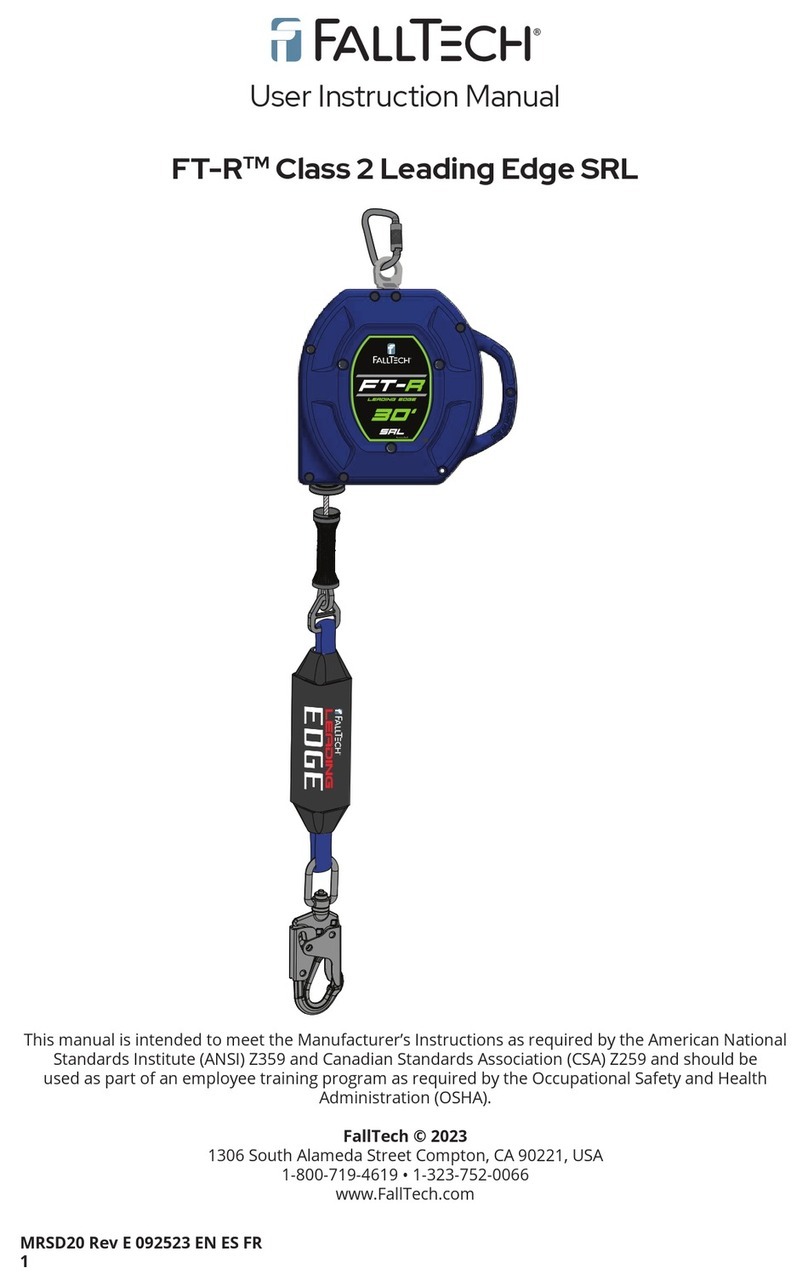
axed to the product. The FT-R Leading Edge includes these labels in the Energy Absorber.
Please see Secon 5.2 of this user instrucon manual for how to calculate your Minimum Required Fall Clearance (MRFC) using the
axed labels.
Classicaon informaon found on product labels is based on test results. Table 1B provides test performance results for the SRD
discussed in this manual. NOTE: Arrest distance is one of several parts of the Minimum Required Fall Clearance (MRFC). MRFC is discussed
in detail in Secon 5 .
OSHA requires an SRD limit the free fall to 2 feet (0.91m) or less. If the maximum free fall distance must be exceeded, the employer must
document, based on test data, that the maximum arresng force will not be exceeded, and the personal fall arrest system will funcon
properly. The SRD discussed in this manual was successfully tested for horizontal use and falls over a steel edge without burrs, as found
on steel shapes and metal sheeng, and may be used in situaons where a fall may occur over similar edges, such as found on steel
shapes or metal sheeng.
• Arrest Distance (AD)
• Average Arrest Force (AAF)
• Maximum Arrest Force (MAF)
MSRD20 Rev B 110421 5
2.2 Canadian Standards Organizaon (CSA): The FT-R SRL-LE described in this manual, when used per the instrucon in this manual
meets or exceeds CSA Z259.2.2-2017. CSA requires that all SRDs be classied according to their respecve type, and are classied either
as; Class SRL, Class SRL-R, Class SRL-LE, or Class SRL-LE-R. The FT-R SRL-LE Self Retracng Device in this manual is Class SRL-LE.
CSA Test Parameters used in this manual are:
The Arrest Distance is the total vercal distance required to arrest a fall. The Arrest Distance includes the deceleraon distance and the
acvaon distance. The Average Arrest Force is the average of the forces applied to the body and the anchorage by the fall protecon
system. The Maximum Peak Arrest Force is the maximum amount of force that may be applied to the body and the anchorage by the fall
protecon system. In addion to the above tests conducted in ambient condions, the units must be retested for average and peak forces
under certain environmental condions, where the units are cooled, then tested, and saturated in water and tested again. Separate units
are used for each test. All test results are recorded.
This test data is then used to establish the basis for fall clearance guidelines published in the user instrucon manual. See Table 1C.
• Arrest Distance (AD)
• Average Arrest Force (AAF)
• Maximum Peak Arrest Force (MPAF)