3.0 Applicaon
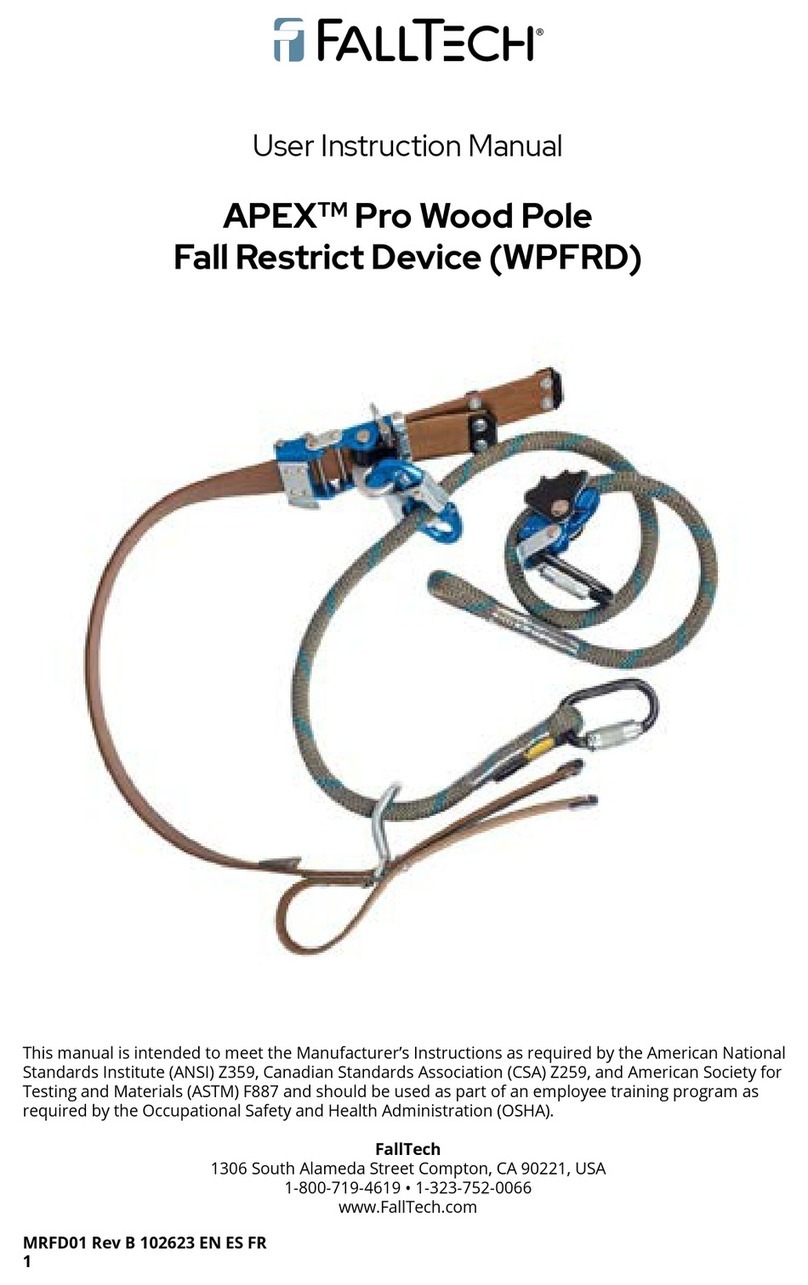
3.1 Purpose: The FallTech® Wood Pole Fall Restrict Device is a pole-climbing device to be used as part of a personal fall restrict system for use
when climbing and working on wood ulity poles.
3.2 Personal Fall Restrict System: A Personal Fall Restrict System is an assembly of components and subsystems used to restrict or limit
freefall during a fall event. It typically consists of a WPFRD and a properly ed lineman’s body belt. Maximum permissible free fall in a
typical Personal Fall Restrict System is 2’ (0.6 m). Ensure that adequate fall clearance exists in the potenal fall path to prevent
contact with a lower level or obstrucon. The WPFRD discussed in this manual may be used on wood poles only.
3.3 Rescue: Ensure a wrien rescue plan, method and system is in place and readily available for rapid response. Rescues may require
specialized equipment or measures. Rescue operaons are beyond the scope of this manual. See ANSI Z359.4 and Z359.2. See Secon 5
for specic instrucons for Pole Top Rescue.
4.0 System Requirements
4.1 Capacity: The Falltech WPFRD is designed for use by a single user with a combined maximum weight of user, tools, clothing, etc.,
of 425 lbs (191 kg).
4.2 Compability of Connectors: Connectors are considered to be compable with connecng elements when they have been designed to
work together in such a way that their sizes and shapes do not cause their gate mechanisms to inadvertently open regardless of how
they become oriented. Contact FallTech if you have any quesons about compability. Connectors must be compable with the
anchorage or other system components. Do not use equipment that is not compable. Non-compable connectors may unintenonally
disengage. Connectors must be compable in size, shape, and strength. Self-closing, self-locking connectors are required by ANSI, CSA,
ASTM, and OSHA.
4.3 Compability of Components: Equipment is designed for use with approved components and subsystems only. Substuons or
replacements made with non-approved components or subsystems may jeopardize compability of equipment and may aect the safety
and reliability of the complete system.
4.4 Making Connecons: Only use self-locking connectors with this equipment. Only use connectors that are suitable to each applicaon.
Ensure all connecons are compable in size, shape, and strength. Do not use equipment that is not compable, see Figure 2.
Visually ensure all connectors are fully closed and locked. Connectors are designed to be used only as specied in each product’s user’s
instrucons.
MFRD01 Rev A 113022 5
ANever connect two acve components (snap hooks or carabiners) to each other.
BNever connect two acve components (snap hooks or carabiners) to a single D-ring at the same me.
CNever connect in a way that would produce a condion of loading on the gate.
DNever aach to a object in a manner whereby the gate (of the snap hook or carabiner) would be
prevented from fully closing and locking. Always guard against false connecons by visually inspecng for closure and lock.
ENever aach explicitly to a constuent subcomponent (webbing, cable or rope) unless specically provided for by the manufacturer’s instrucons for both
subcomponents (snap hook or carabiner and webbing, cable or rope).
FNever aach in a manner where an element of the connector (gate or release lever) may become caught on the anchor thereby producing addional risk of
false engagement.
GNever aach a spreader snap hook to two side/posioning D-rings in a manner whereby the D-rings will engage the gates; the gates on a spreader must
always be facing away from the D-rings during work posioning.
Figure 2 - Non-Compable Connecons