manuals.online logo
Brands
  1. Home
  2. •
  3. Brands
  4. •
  5. marklin
  6. •
  7. Toy
  8. •
  9. marklin 76394 User manual

marklin 76394 User manual

Other marklin Toy manuals

marklin 416000 series User manual

marklin

marklin 416000 series User manual

marklin Gattung B VI User manual

marklin

marklin Gattung B VI User manual

marklin 24671 User manual

marklin

marklin 24671 User manual

marklin 26558 User manual

marklin

marklin 26558 User manual

marklin 46116 User manual

marklin

marklin 46116 User manual

marklin 37895 User manual

marklin

marklin 37895 User manual

marklin 37903 User manual

marklin

marklin 37903 User manual

marklin 43252 User manual

marklin

marklin 43252 User manual

marklin 29342 User manual

marklin

marklin 29342 User manual

marklin 37629 User manual

marklin

marklin 37629 User manual

marklin 29060 User manual

marklin

marklin 29060 User manual

marklin 48291 User manual

marklin

marklin 48291 User manual

marklin 43866 User manual

marklin

marklin 43866 User manual

marklin 60760 User manual

marklin

marklin 60760 User manual

marklin 26253 User manual

marklin

marklin 26253 User manual

marklin 39671 User manual

marklin

marklin 39671 User manual

marklin 43991 User manual

marklin

marklin 43991 User manual

marklin 244997 User manual

marklin

marklin 244997 User manual

marklin 37571 User manual

marklin

marklin 37571 User manual

marklin SBB User manual

marklin

marklin SBB User manual

marklin 36653 User manual

marklin

marklin 36653 User manual

marklin 36501 User manual

marklin

marklin 36501 User manual

marklin BR 003 User manual

marklin

marklin BR 003 User manual

marklin baureihe 38 User manual

marklin

marklin baureihe 38 User manual

Popular Toy manuals by other brands

FUTABA GY470 instruction manual

FUTABA

FUTABA GY470 instruction manual

LEGO 41116 manual

LEGO

LEGO 41116 manual

Fisher-Price ColorMe Flowerz Bouquet Maker P9692 instruction sheet

Fisher-Price

Fisher-Price ColorMe Flowerz Bouquet Maker P9692 instruction sheet

Little Tikes LITTLE HANDIWORKER 0920 Assembly instructions

Little Tikes

Little Tikes LITTLE HANDIWORKER 0920 Assembly instructions

Eduard EF-2000 Two-seater exterior Assembly instructions

Eduard

Eduard EF-2000 Two-seater exterior Assembly instructions

USA Trains EXTENDED VISION CABOOSE instructions

USA Trains

USA Trains EXTENDED VISION CABOOSE instructions

Modellbau Laffont Z1601 Assembly instructions

Modellbau Laffont

Modellbau Laffont Z1601 Assembly instructions

NOCH 12905 instruction manual

NOCH

NOCH 12905 instruction manual

Eduard Ki-61-Id quick start guide

Eduard

Eduard Ki-61-Id quick start guide

Viessmann Vollmer 45616 Mounting instruction

Viessmann

Viessmann Vollmer 45616 Mounting instruction

Vollmer 42004 Mounting instruction

Vollmer

Vollmer 42004 Mounting instruction

Phoenix Model CLASSIC-EP instruction manual

Phoenix Model

Phoenix Model CLASSIC-EP instruction manual

H-KING Sopwith Camel British WW1 Fighter instruction manual

H-KING

H-KING Sopwith Camel British WW1 Fighter instruction manual

MODSTER Predator 4x4 Crawler user manual

MODSTER

MODSTER Predator 4x4 Crawler user manual

DHK Hobby 8136 User instruction manual

DHK Hobby

DHK Hobby 8136 User instruction manual

THUNDER TIGER Raptor 50 V2 kit manual

THUNDER TIGER

THUNDER TIGER Raptor 50 V2 kit manual

Timberkits Skateboarder instructions

Timberkits

Timberkits Skateboarder instructions

Hangar 9 Funtana 125 Assembly manual

Hangar 9

Hangar 9 Funtana 125 Assembly manual

manuals.online logo
manuals.online logoBrands
  • About & Mission
  • Contact us
  • Privacy Policy
  • Terms and Conditions

Copyright 2025 Manuals.Online. All Rights Reserved.

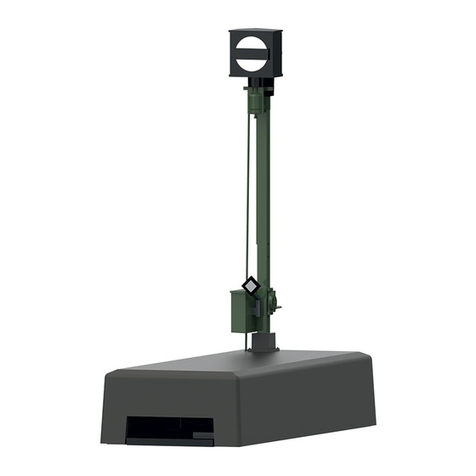
76394
Ausfahrsignal
2
• The change in the signal aspects happens
prototypically with a gentle changeover.
• When the signal is set at „slow“, the operator is
responsible for adjusting the speed of the train.
• The signal control module can only be used
to control signals from the Märklin series that
belong to it.
Les signaux lumineux principaux H0 de cette série
électronique ont les caractéristiques suivantes :
• Tous les signaux principaux se composent
d‘un module de commande et du mât de
signalisation correspondant.
• Les signaux peuvent être commutés en mode
conventionnel (transfo 6647, pupitre de com-
mande 72720) ou en mode Digital (p. e. avec
Keyboard 6040, Central Station 60212). En
cas de commande digitale, aucun décodeur
complémentaire n‘est nécessaire.
• Le changement de position du signal se fait
en douceur de façon réaliste (fondu enchaîné).
• En cas de position „ralentissement“, l‘opéra-
teur est tenu d‘adapter la vitesse.
• Le module de commande ne peut être utilisé
que pour la commande des signaux de la
série Märklin correspondante.
Die H0-Lichtsignale aus dieser Elektronik-
Serie bieten folgende Eigenschaften:
• Alle Hauptsignale bestehen aus einem Signal-
Steuermodul und dem zugehörigen Signalmast
• Die Signale können konventionell (Trafo 6647,
Stellpult 72720) oder Digital (z. B. mit Key-
board 6040, Central Station 60212) geschaltet
werden. Beim Schalten über Digital ist kein
weiterer Decoder notwendig.
• Vorbildgerecht geschieht das Umstellen der
Signalbilder durch weiches Überblenden.
• Bei Stellung „Langsamfahrt“ ist der Bediener für
eine Anpassung der Geschwindigkeit zuständig.
• Das Signal-Steuermodul kann nur zum
Ansteuern der Signale aus der zugehörigen
Märklin-Serie verwendet werden.
The H0 color light signals from this electronic
series offer the following features:
• All home signals consist of a signal control
module the signal mast that goes with it.
• These signals can be operated conventionally
(6646/6647 transformer, 72720 control box) or
digitally (example: with 6040 Keyboard, Cen-
tral Station 60212). No additional decoder is
required when operating the signals digitally.

3
De H0-lichtseinen uit deze elektronische
serie hebben de volgende eigenschappen:
• alle hoofdseinen bestaan uit een sein-bestu-
ringsmodule en een daarbij behorende seinmast.
• de seinen kunnen conventioneel (trafo 6647,
schakelkast 72720) of digitaal (bijv. met een
keyboard 6040
, Central Station 60212
) gescha-
keld worden. Bij het digitale schakelen is geen
extra decoder nodig.
• bij het omschakelen van het seinbeeld wordt,
overeenkomstig het voorbeeld, het vorige beeld
langzaam door het nieuwe beeld overstuurt.
• bij het seinbeeld „langzaam rijden“ moet de be-
dienaar zelf de snelheid van de trein aanpassen.
• de sein-besturingsmodule kan alleen gebruikt
worden voor het aansturen van de seinen uit
de bijbehorende Märklin- serie.
La señales luminosas de la serie electrónica
tienen las siguientes características:
• Todas las señales principales se componen de
un módulo de gobierno y un poste de luces.
• Las señales se pueden gobernar de forma
convencional (transformador 6647, pupitre
72720) o también Digital (p.e. con el Keyboard
6040, Central Station 60212). Para un gobier-
no Digital no hace falta ningún decoder.
• Transición suave del cambio de luces, al igual
que la realidad.
• El usuario debe adaptar la velocidad de su
locomotora si la señal marca „marcha lenta
prevista“.
• El módulo de gobierno de señales solamente
sirve para las señales de la serie de Märklin.
I segnali luminosi in H0 provenienti da questa
serie elettronica presentano le seguenti
caratteristiche:
• Tutti i segnali principali sono costituiti da un
modulo di comando del segnale e dal corri-
spettivo paletto del segnale
• Tali segnali possono venire commutati in
modo tradizionale (trasformatore 6647,
quadro di comando 72720) oppure in modo
Digital (ad es. con Keyboard 6040, Central
Station 60212). Nel caso della commutazione
tramite Digital non è necessario alcun ulteriore
Decoder.
4
• La modificazione degli aspetti di segnala-
mento avviene in modo fedele al prototipo
attraverso una leggera dissolvenza.
• In caso di disposizione su „marcia con rallen-
tamento“, è responsabile il manovratore per
un adeguamento della velocità.
• Il modulo di comando del segnale può venire
utilizzato soltanto per il controllo dei segnali
appartenenti alla corrispettiva serie Märklin.
HO ljussignaler från denna elektronikserie
erbjuder följande egenskaper:
• Alla huvudsignaler består av en signalstyrmo-
dul och tillhörande signalstolpe
• Signalerna kan ställas konventionellt (Trafo
6647, Ställpult 72720) eller digitalt (t ex med
Keyboard 6040, Central Station 60212). Vid
koppling via Digital behövs ingen ytterligare
dekoder.
• Omställning av signalbilderna sker före-
bildstroget genom mjuk övergång
• Vid inställning „krypfart“ är användaren skyl-
dig att anpassa hastigheten själv.
• Signalstyrmodulen kan endast användas för att
styra signalerna från tillhörande Märklinserie.
De nye H0-lyssignaler i denne elektronikserie
har følgende egenskaber:
• Alle hovedsignaler består af et signal-styre-
modul og den tilhørende signalmast.
• Signalerne kan tilsluttes konventionelt (Trafo
6647, Styrepult 72720) eller digitalt (f.eks. med
Keyboard 6040, Central Station 60212). Ved
digital tilslutning er der ikke brug for ydeligere
dekoder.
• Ligesom på forbilledet sker omstillingen af
signalbillederne ved hjælp af blød ind- og
udblænding.
• Ved stillingen „Langsom kørsel“ skal brugeren
sørge for tilpasning af hastigheden.
• Signal-styremodulet kan kun anvendes til sty-
ring af signaler i den tilhørende Märklinserie.
5
Signalbilder beim Vorbild
Signal Aspects in the Prototyp
Positions signalétiques réelles
Seinbeelden bij het voorbeeld
Signalbild Hauptsignal:
Signal aspect for a home signal:
Position de signal principal :
Seinbeeld hoofdsein:
Posición señal principal:
Aspetti di segnalamento di un
segnale principale:
Signalbild huvudsignal:
Signalbillede for hovedsignal:
Bedeutung:
Meaning:
Signification :
Betekend:
Significado:
Significato:
Innebörd:
Betydning:
Fahrt
Go
Voie libre
Rijden
Marcha
Via libera
Körning
Kør
Halt
Stop
Arrêt
Stop
Paro
Arresto
Stopp
Stop
Langsamfahrt
Proceed Slowly
Ralentissement
Langzaam rijden
Marcha lenta
Rallentamento
Krypfart
Langsom kørsel
Halt - Rangierfahrt erlaubt
Stop - Switching
Maneuver Allowed
Arrêt, sauf manoeuvres
Stop, rangeren toegestaan
Paro-maniobras permitidas
Arresto-movimento di
manovra consentito
Stopp-rangerfart tillåtet
Stop - Rangering tilladt
Posiciones de las señales en la realidad
Aspetti del segnalamento nel caso del prototipo
Signalbilder hos förebilden
Signalbilleder på forbilledet
6
Fahrstrom:
Track Current:
Courant traction :
Rijstroom:
Corriente de tracción:
Corrente di trazione:
Körström:
Kørestrøm:
ein
on
branché
aan
encendida
inserita
till
til
aus
off
débranché
uit
apagada
esclusa
från
fra
ein
on
branché
aan
encendida
inserita
till
til
ein
on
branché
aan
encendida
inserita
till
til
!
7
Einstellen der Digital-Adresse
Hinweis: Bei konventionellem Anschluss ist
keine Adresseinstellung notwendig.
Allgemeine Hinweise:
• Einstellen der Adresse ist nur möglich, wenn
sich das Signal-Steuermodul mit angeschlos-
senem Signalmast in der Verpackung befindet
(mit eingerasteten Adressierstifte in der Verpa-
ckung am Signal-Steuermodul).
• Benötigte Digitalkomponenten zum Einstellen
der Adresse: 1x Control Unit, 1x Transformer,
1 - 2 Keyboard(s) oder 1x Central Station.
• Die Adresse wird nur in dem Hauptsignal
gespeichert.
Tastaturbelegung am Keyboard:
Ausfahrsignal: 2 nebeneinanderliegende Tasten-
paare am Keyboard.
Tastaturbelegung an der Central Station:
Diese entnehmen Sie bitte der Anleitung zur
Central Station
Beispiel:
Signaltyp: vierbegriffiges Ausfahrsignal
Schalter: Tastenpaar 13 + 14 am Keyboard Nr. 1
Vorgehensweise zur Adresseingabe
1. Control Unit, Keyboard und Transformer an-
schließen. Control Unit noch nicht einschalten.
2. Signal- Steuermodul mit angeschlossenem
Hauptsignalmast in der Original- Verpackung
belassen (!). Nur das braune und gelbe An-
schlusskabel vom Signal- Steuermodul an die
braune und rote (!) Ausgangsklemme an der
Control Unit anschließen.
3. Keyboard- Adresse auf die gewünschte Adres-
se stellen. In unserem Beispiel (Keyboard Nr. 1)
alle 4 Codierschalter in Stellung „off“.
4. Control Unit 6021 einschalten. Taste „stop“
drücken.
5. Taste „go“ drücken. Das Hauptsignal beginnt
abwechselnd zwischen 2 Signalbilder umzu-
schalten. Sollten die nachfolgenden Schritte
nicht innerhalb einiger Sekunden begonnen
werden, so beendet die Elektronik automa-
tisch den Adressiervorgang.
6. Grüne Taste am 13. Tastenpaar des Key-
boards solange drücken, bis alle LED am
Signal leuchten. Erst jetzt die Taste loslassen.
7. Das Hauptsignal beginnt abwechselnd zwi-
schen zwei Signalbildern umzuschalten.
8
8. Grüne Taste am 14. Tastenpaar des Key-
boards solange drücken, bis alle LED am
Signal leuchten. Erst jetzt die Taste loslassen.
9. Control Unit ausschalten, Signal und Signal-
Steuermodul können jetzt in die Anlage einge-
baut werden.
Hinweis:
• Bei langen Pausen während der Programmie-
rung beendet das Signal den Programmiermo-
dus ohne Änderung. In diesem Fall mit dem
kompletten Adressiervorgang wieder vorne
beginnen. Während der Adressierung darauf
achten, dass die Pausen zwischen den einzel-
nen Tastaturbefehlen nicht zu lange sind.
• Nach Beendigung oder Abbruch der Pro-
grammierung schaltet das Signal nach einigen
Sekunden in den Demonstrationsmodus. In
diesem Modus werden verschiedene Signal-
bilder des jeweiligen Signaltyps dargestellt.
• Vor dem Austesten des Signals muss die
Steuerelektronik aus der Verpackung entfernt
werden.
Setting the Digital Address
Important: No address needs to be set for
conventional wiring connections.
General Information:
• The address can be set only when the signal
control module with the signal mast connect-
ed to it is in its packaging. (with the address
pin snapped into the packaging on the signal
control module).
• The necessary digital components for setting
the address: 1 each Control Unit, 1 each
transformer, 1 - 2 Keyboard(s), or 1 x Central
Station.
• The address is only stored in the home signal.
Button Assignment on the Keyboard:
Exit Signal: 2 consecutive pairs of buttons on
the Keyboard.
Control button assignment on the Central Station:
Please see the instructions for the Central Sta-
tion about this topic.
Example:
Signal Type: Four-Aspect Exit Signal
Controller: Button Pair 13 + 14 on Keyboard No. 1.
9
Procedure for Entering the Address
1. Connect the Control Unit, Keyboard, and
transformer. Do not turn the Control Unit on
yet.
2. Leave (!) the signal control module with
the home signal mast connected to it in its
original packaging. Connect only the brown
and the yellow wires from the signal control
module to the brown and red (!) terminal clips
on the Control Unit.
3. Set the Keyboard address to the desired
address. In our example (Keyboard No. 1) all
four coding switches at the „off“ position.
4. Turn on the 6021 Control Unit. Press the
„stop“ button.
5. Press the „go“ button. The home signal will
begin to switch between 2 signal aspects.
If the following step does not begin within
several seconds, the electronic circuit will end
the address setting process automatically.
6. Press the green button on button pair 13 of the
Keyboard until all of the LED‘s on the signal
light up. Only release the button at this point.
7.The main signal will begin to switch between 2
signal aspects.
8. Press the green button on button pair 14 of the
Keyboard until all of the LED‘s on the signal
light up. Only release the button at this point.
9. Turn the Control Unit off. The signal and the
signal control module can now be installed on
the layout.
Note:
• For long breaks during programming, the
signal terminates the programming mode
without a change. In this case, start from the
beginning again with the complete addressing
procedure. While addressing is taking place,
ensure that the breaks between the individual
keyboard commands are not too long.
• Once the programming has ended or has
been cancelled, the signal switches to dem-
onstration mode after a few seconds. In this
mode, various signal aspects of the respective
signal type are displayed.
• The control electronic circuit must be removed
from the packaging before testing the signal.
10
Réglage de l‘adresse Digital
Remarque: en cas de connexion convention-
nelle, aucun réglage d‘adresse n‘est nécessaire.
Remarques générales :
• Le réglage de l‘adresse n‘est possible que si
le module de commande se trouve dans l‘em-
ballage avec le mât de signal branché (avec
ergots d‘adressage encliquetés au module de
commande dans l‘emballage).
• Composants Digital nécessaires pour le
réglage de l‘adresse : 1x Control Unit,
1x transformateur, 1 - 2 Keyboard(s)
ou
1 x Central Station.
• L‘adresse est enregistrée uniquement dans le
signal principal.
Disposition du clavier sur le Keyboard :
Signal de départ : 2 paires de touches situées
l‘une à côté de l‘autre sur le Keyboard.
Affectation des touches de la Central Station:
Veuillez consulter la notice d’utilisation de la
Central Station
Exemple:
Type de signal : signal de départ à
quatre positions.
Commutateurs : paires de
touches 13 + 14 sur Keyboard n 1.
Procédure pour l‘entrée de l‘adresse
1. Raccorder Control Unit, Keyboard et transfor-
mateur. Ne pas encore activer la Control Unit.
2. Laisser tel quel dans l‘emballage d‘origine le
module de commande avec le mât de signal
branché (!). Uniquement raccorder les câbles
brun et jaune du module de commande au
bornes de sortie brune et rouge (!) de la
Control Unit.
3. Encoder sur le Keyboard l‘adresse désirée.
Dans notre exemple (Keyboard n 1), les
4 sélecteurs de codage sont en position „off“.
4. Activer la Control Unit 6021. Presser la touche
„stop“.
5. Presser la touche „go“. Le signal principal
commence à passer alternativement d‘une
position à l‘autre. Si les étapes suivantes ne
sont pas franchies endéans les secondes sui-
vantes, l‘électronique met automatiquement
fin au processus d‘adressage.
6. Presser la touche verte de la paire de touches
13 du Keyboard jusqu‘à ce que toutes les
diodes lumineuses s‘allument sur le signal. Ne
relâcher la touche que maintenant.
7. Le signal principal commence à passer alter-
nativement d`une position à l`autre.