10
or ropes is forbidden, since the textile woven
fabric can be damaged by that.
*This equipment may be used only within
the in-service conditions as stipulated and the
planned intended purpose.
*The use of this equipment is permitted to
instructed and expert persons only, or use is
subject to direct expert monitoring.
*There must be no health problems
present (alcohol, drugs, medication, heart or
circulation problems).
*Furthermore, it must be considered
before the use of this equipment how a possibly
necessary rescue can be realized safely
(emergency - rescue plan).
*Personal Protective Equipment against
fall from a height should be made available to
the user in person.
*Before every use, test the overall
Personal Protective Equipment against fall from
a height and do not use damaged devices
(function test). For your own safety, have it
checked by from another person whether your
full body harness is adjusted correctly.
*In case of utilization in a fall arrest
system (EN363), always note that there is
sufficient open space below the user.
*Limit possible fall paths to a minimum
through guided-type fall arresters and similar.
*Note the correct composition of the
overall PPE, since incorrect combinations of
equipment parts with regard to each other
(compatibility) can impair secure functioning.
Changes or extensions may not be carried out
without prior written approval from the
manufacturer. In the same way, all repairs may
be carried out only in agreement with the
manufacturer.
*Do not expose to acids, oils or corrosive
chemicals, and if this is unavoidable rinse off
immediately after use and have equipment
tested by an expert.
*Protect against sharp-edged objects.
*Textiles are to be protected against heat
higher than 60°C. Attention is to be paid to
melting of the webbing. Weld bead markers are
also to be considered as melting.
*Avoid any corrosion danger and extreme
heat and cold.
Anchor point:
The anchor point according to EN 795 (minimum
strength 10 kN) is to be selected (as far as
possible above the head) so that free fall and
the fall height is limited to a minimum. The max.
angle to the vertical should never exceed 30° in
this case (swinging).
3.1 Use of the reception eyelet
(Identification A)
The reception eyelet is determined exclusively
for use with a fall arrest system according to EN
363 e.g.:
In combination with the following:
¾Fastenings with fall energy absorber EN
354/355
¾Retractable-type fall arresters EN 360
¾Guided-type fall arresters EN 353-2
¾Abseiling and rescue devices EN 341 and
1496
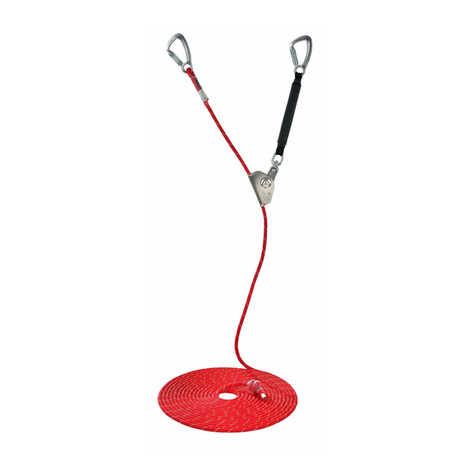
3.2 Use of the rear reception eyelet in the
Var. B 3 as a back eyelet extension:
In the implementation Var. B3, full body harness
is provided with a fastenings of Type Band B3
with a maximum fastening length of 0.5 m. This
fastening is fixed-sewn on at the back-reception
eyelet and is used to facilitate operation of this
back-reception eyelet (e.g. in case of utilization
with retractable-type fall arresters). The Type
Band B3 webbing employed here has been
tested successfully over an edge. A steel edge
with radius R = 0.5 mm, without burr, was
employed in this case. Based on this test, the
equipment in corresponding composition is
suitable for use over similar edges (inquire with
the manufacturer about this), such as exist for
example on rolled-steel profile sections, on
timber beams or on encased, rounded roof
parapets.
*Caution:
In case of the use of fastenings with fall energy
absorbers, it is to be ensured that the maximum
length of 2 m is not exceeded (fastenings + fall
energy absorber 1.5 m + stitched web in the
back-reception eyelet 0.5 m). If guided-type fall
arresters are employed, the snap hook must be
hooked directly into the reception eyelet (D-ring).
Also in case of fastenings with fall energy
absorbers with length 2 m, the snap hook must
be placed directly into the reception eyelet.
3.3 Use of the rear reception eyelet in
Var. BFD with fixed sewn-on fastenings
with integrated tear / fall-energy absorber
(Type BFD 3)
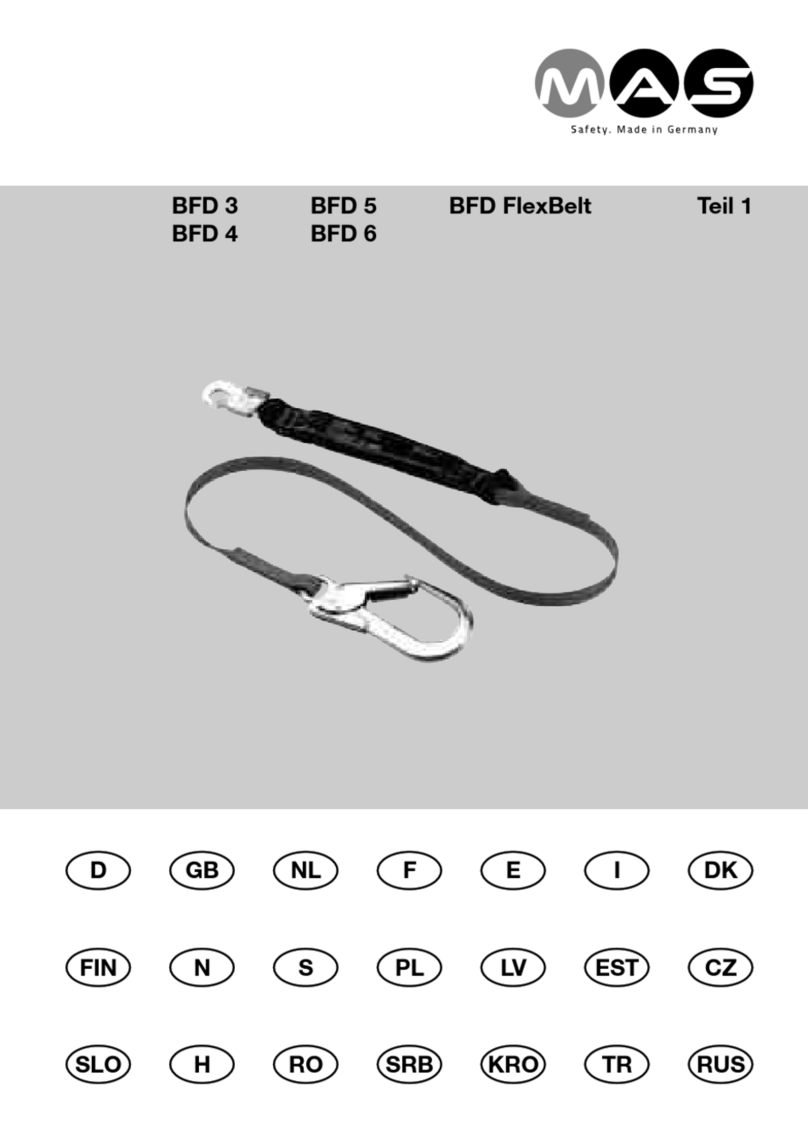
*Caution:
In this implementation, max. admissible total
weight (rated load) of the person 100 KG
In case of the implementation of Var. BFD, a
fastening with tear / fall-energy absorber Type
BFD 3, with a maximum length of 2 m, has been
fixed sewn into the rear reception eyelet. This
1. Application
Full body harnesses are employed by the user
for protection in an area endangered by falling
from a height, and may be employed only as
specified.
Personal Protective Equipment (PPE) against
fall from a height may be employed as a
protection against fall from a height for short-
term work only.
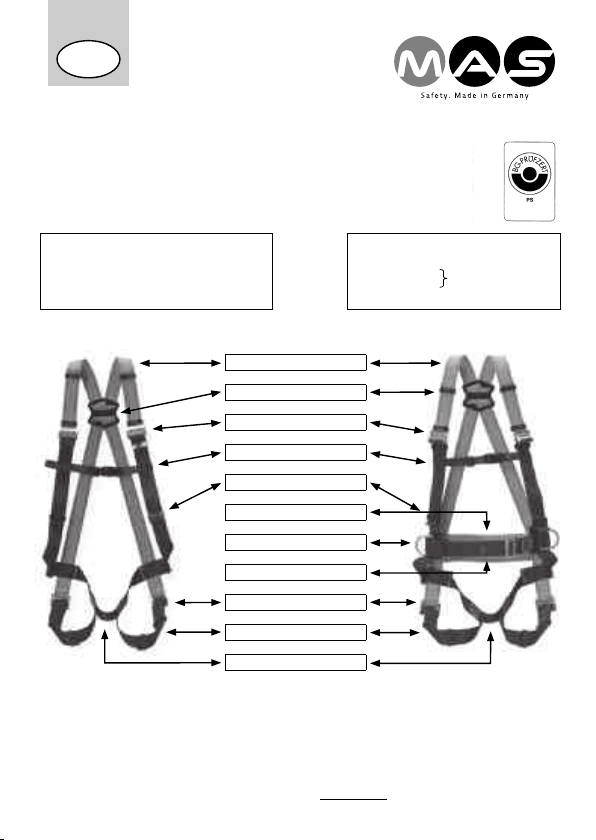
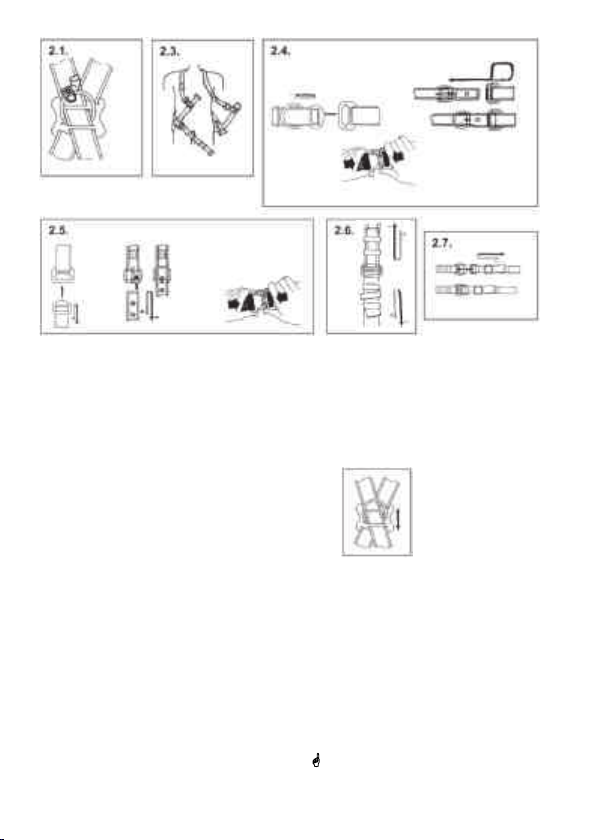
2. Putting on the full body harness
1. Lift the full body harness at the rear D-
ring.
2. Open all close-offs.
3. Place the full body harness on like a
jacket from behind over the shoulder,
and ensure the webbing is not twisted.
4. If the full body harness is equipped with
an abdominal belt, adjust the belt
according to the abdominal
circumference. A ride-up protection
eyelet, if existing, should be located at
the level of the navel.
5. To close the leg belts, grip through the
step and pull the webbing toward the
front. Then close the belt buckles and
adjust the webbing accordingly. The leg
connection belt must fit on the thigh
under the buttocks.
6. Shorten or extend the shoulder straps by
threading back the webbing and thus
adjust to the correct length.
7. Close the breast belt and adjust
according to the required length.
8. Pull the plastic slides under the
respective close-offs and the second to
the end of the webbing. Slipping of the
webbing is prevented by that.
After adjusting the full body harness, check that
no webbing is twisted, and that all buckles are
correctly closed and correctly seated. The rear
reception eyelet (D-ring with back plate) should
always be at shoulder height and the breast belt
should rest centrally on the breast.
Important:
Become familiar with the function of the full body
harness before first use.
In this case, put on the full body harness as
described above and, as a trial, attach at ground
level with fastening (e.g. safety rope). Load the
belt through body weight; leg loops must
enclose the thighs trouble-free. Hanging in the
belt should usually not cause any difficulties,
otherwise check the belt adjustment. With the
loading of the full body harness, the webbing
settles into the respective hardware parts and
any yielding of the webbing is thus minimized.
3. Notes on use
*Any labeling or identification of this
equipment with a solution-content
Textmaker/Edding on supporting webbing
2.5.
2.6.
2.7.
2.4.
2.1.
2.3.
20590_GBA_MAS 10 + 90_2013 BP_neues Logo_cs5.indd 10 10.12.14 09:49