2 - 2
CAUTION
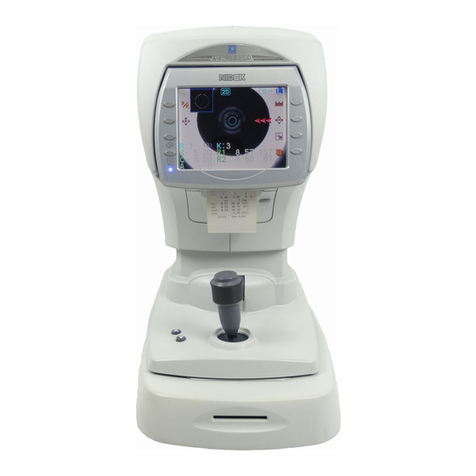
• In advance of a measurement of each patient, wipe the forehead rest and chin rest with a
clean cloth. Moreover, remove one chin rest paper for each patient if a bunch of the chin
rest paper is fixed on the chin rest. If necessary, wipe the forehead rest and chin rest using
a cloth dampened with rubbing alcohol.
• In the event a failure occurs in the instrument, do not touch the inside of the instrument,
but remove the power cord from the outlet and contact your authorized distributor.
• Keep the measuring window away from fingerprints and dust.
The measurement accuracy may deteriorate substantially.
• Information on the avoidance of overexposure to potentially hazardous optical radiation (ISO
15004: 1997)
Spectrally weighted photochemical radiances LBand LAgive a measure of the potential that
exists for a beam of light to cause photochemical hazard to the retina. LBgives the measure
for eyes in which the crystalline lens is in place. LA gives this measure either for eyes in which
the crystalline lens has been removed (aphakes) and has not been replaced by a UV-blocking
lens or for the eyes of very young children.
The value stated for this ophthalmic instrument gives a measure of hazard potential when the
instrument is operated at maximum intensity and maximum aperture. The values of LAor LB
for the AR-600 are sufficiently low as shown on the following page.
The retinal exposure dose for a photochemical hazard is a product of the radiance and the
exposure time. For instance, at a radiance level of 1 mW/(cm2•sr), 240 min irradiation of the
dilated (8 mm diameter) pupil would cause the retinal exposure dose level to attain the
recommended exposure limit. If the value of radiance were reduced to 0.1 mW/(cm2•sr), ten
times that time (i.e. 2400 min) would be needed to reach the recommended limit. The
recommended exposure dose is based on calculations arising from theAmerican Conference
of Governmental Industrial Hygienists (ACGIH) - Threshold Limit Values for Chemical
Substances and Physical Agents (1995 - 1996 edition).
The following page shows the graph of spectrum output for the AR-600. Patients will be at
low risk of acute optical radiation with the AR-600. However, it is recommended that the
intensityoflight directedintothe patient’seyebe limited totheminimum levelwhichis necessary
for diagnosis. The total of the retinal exposure dose must be carefully watched for infants,
aphakes and persons with diseased eyes who are at greater risk when other ophthalmic
instruments with a high level of radiance are used in conjunction.