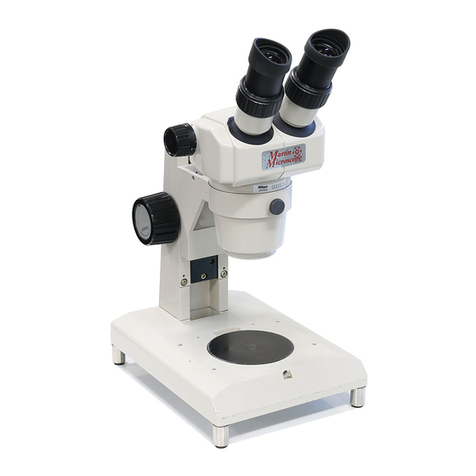
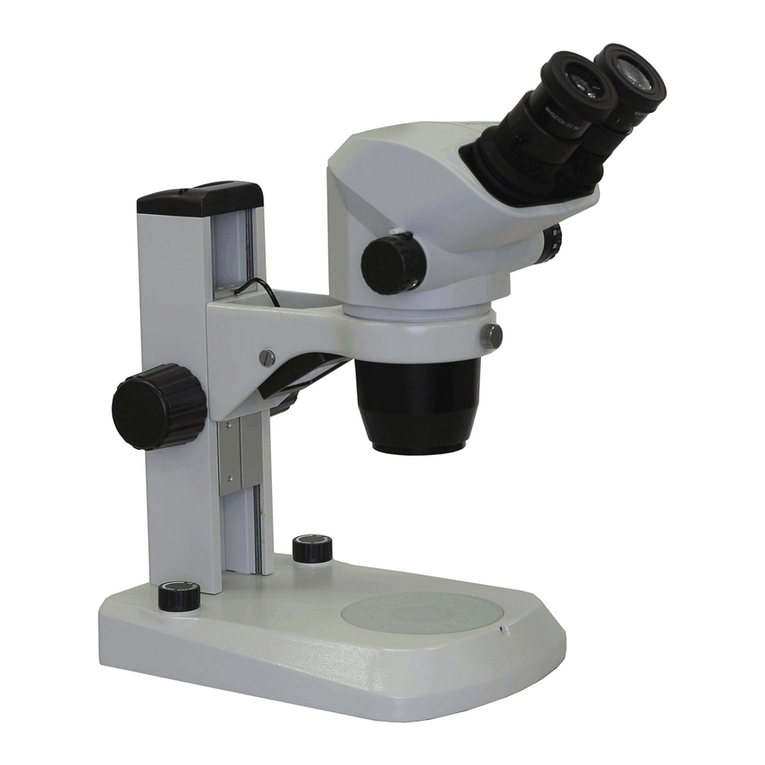
Nikon SMZ1000 User manual

Stereoscopic Zoom Microscope
SMZ1000 / SMZ800
Instructions
M248 E 06.2.NF.3


1
Thank you for purchasing the Nikon product.
This instruction manual is written for the users of Nikon
Stereoscopic Zoom Microscopes.
To ensure correct usage, read this manual carefully before
operating the instrument.
•It is prohibited to reproduce or transmit this manual in part or
whole without Nikon’s expressed permission.
•The contents of this manual are subject to change without notice.
•Although every effort has been made to ensure the accuracy of
this manual, if you note any points that are unclear or incorrect,
contact your nearest Nikon representative.
•Some of the products described in this manual may not be
included in the set you have purchased.
•If the equipment is used in a manner not specified by the
manufacturer, the protection provided by the equipment may be
impaired.
Warning/Caution Symbols Used in This Manual
Though Nikon products are designed to provide you with the
utmost safety during use, incorrect usage or disregard of the
instructions may cause personal injury or property damage. For
your own safety, read the instruction manual carefully and
thoroughly before using the product. Do not discard this manual.
Always keep it near the product for easy reference.
Inside this instruction manual, safety instructions are indicated
with the symbols shown below. Be sure to follow the instructions
marked with these symbols for your safety.
Symbol Meaning
Disregarding instructions marked with this
symbol may lead to death or serious injury.
Disregarding instructions marked with this
symbol may lead to injury or property
damage.
WARNING
CAUTION

2
WARNING
1. Intended use of this product
This product is intended only for microscopy. Do not
use it for any other purpose.
2. Do not disassemble
Disassembly may result in damage to the instrument.
Never disassemble any part except as described in this
operation manual. Contact your Nikon representative if
you notice any malfunction of this instrument.
3. Check the input voltage
When using an illuminator, check that the input voltage
displayed on the power supply of the illuminator
matches the operating voltage. Contact your Nikon
representative if the displayed voltage does not match the
operating voltage. Use of an improperly matched
illuminator may result in damage to equipment.
4. Power cord
Always turn the power switch off and unplug the power
cord when replacing the lamp of an illuminator as failure
to do so may result in electric shock or equipment
damage.
5. Heat from the light source
When using an illuminator, do not place cloth or paper or
highly flammable materials, such as gasoline, benzene,
thinner or alcohol, near the lamp as there is a danger of
fire.
•Always use lamps that are of the specified rating only.
For the lamp rating, please refer to the operation
manual.
•Always turn the power switch off and unplug the
power cord when replacing the lamp of a illuminator
as failure to do so may result in electric shock or
equipment damage.
Be sure to always follow these guidelines.

3
CAUTION
1. Caution when replacing lamps
The lamp and the surrounding area become very hot
during and immediately after using the illuminator. Be
careful not to burn yourself. In addition, when replacing
a lamp be sure the lamp has cooled sufficiently.
2. Check the light source
Always use lamps that are of the specified rating only.
Use of a lamp having a different specification may result
in damage to equipment. For the lamp rating, please
refer to the operation manual.

4
1. Installation location
Note the following points when installing the stereoscopic
microscope.
•Install the microscope in a location with the temperature between
0° and 40°C, and humidity of less than 80%. If installed in a hot
and humid location, mold may form on the lenses or condensation
may occur inside, resulting in reduced performance or damage to
the microscope.
•Do not install the microscope in a location subject to direct
sunlight.
•Install the microscope in a location that is not subject to vibration.
•Install the microscope in a location that is free from dust and dirt.
2. Handle the microscope carefully
The stereoscopic microscope is a precision optical instrument.
Handle it carefully and do not subject it to impact. Shock from
impact during transportation or operation as well as forcible
operations may cause damage to the instrument.
3. Cleaning the lenses
Do not let dust, fingerprints, etc. to get on the lenses. Dirt on the
lenses will adversely affect the view of the image. If any lenses
become dirty, clean them as described below.
•Use an air blower to blow dust away. If this does not suffice, brush
away the dust with a soft brush or gently wipe it away with a piece
of gauze.
•Only if the lenses become dirty with fingerprints or grease stains,
slightly dampen a piece of soft, clean cotton cloth with absolute
alcohol (ethyl alcohol or methyl alcohol) and gently wipe away the
dirt. Do not use the same part of the cloth more than once.
•Since absolute alcohol is highly flammable, be careful in handling
it so that it does not ignite.
•Observe the manufacturer’s handling instructions when handling
absolute alcohol.

5
Be sure to always follow these guidelines.
4. Cleaning painted or plastic parts
Use of silicon cloth is recommended when cleaning painted parts,
plastic parts and printed parts. If such a part becomes excessively
dirty, wipe it gently with gauze dampened in a mild detergent
solution. Do not use organic solvents (such as alcohol, ether, or paint
thinner) as this may result in deformation of the part or remove of
lettering.
5. Storage
Store the microscope in a location with low humidity where mold is
unlikely to form. Do not store the microscope in a location subject
to direct sunlight or high temperature and humidity. During storage,
place a plastic cover over the equipment to prevent dust
accumulation.
6. Regular inspections
Regular inspections are recommended in order to maintain peak
performance. Please consult your Nikon representative for details
about regular inspections.

6
Contents
Warning/Caution Symbols Used in This Manual ...........................1
Be sure to always follow these guidelines. ....................................2
WARNING ..........................................................................................2
CAUTION ...........................................................................................3
INomenclature ...................................................................................8
II Assembly .........................................................................................12
III Usage................................................................................................ 15
1Preparations For Observation ......................................................15
1. Adjust the torque of the focus knob.......................................15
2. Adjust the interpupillary distance. .........................................15
3. Adjust the diopter. .................................................................16
2Focusing ......................................................................................16
1. Check the working distance...................................................16
2. Focus on the sample. .............................................................16
3Zoom ...........................................................................................17
1. Change the zooming magnification. ......................................17
4If You Cannot Focus On The Sample Though The Zooming
Body Is At The Highest Position. ................................................18
IV Using Accessories ........................................................................19
1Reticles ........................................................................................19
2Eyepiece Tube ............................................................................. 19
1. P-BTL low eye-level eyepiece tube ....................................... 19
2. P-BERG tilted eyepiece tube ................................................. 20
3P-IER Eyelevel Riser .................................................................. 20
4Plan 1X ERGO Objective ...........................................................21
5SM-S4L 4 X 4 Stage L ................................................................ 22
VIlluminator .......................................................................................23
1Halogen Illuminators ................................................................... 23
1. Lamp ......................................................................................24
2. Attaching G-LS to the stand [C-PS & C-PSC] ...................... 25
3. Arm for halogen illuminators ................................................25
4. Power supplies ....................................................................... 27

7
5. Lighting area adjustment [G-LS]...........................................29
6. Attaching filters [C-DSLS] ....................................................29
2P-ICI2 Coaxial Episcopic Illuminator .........................................29
VI Photomicrographic and TV-related Accessories ..................32
1. Photomicrographic magnification ......................................... 33
2. Attaching the beam splitter ....................................................33
3. Photo reticles ......................................................................... 34
4. Photomicrography procedure ................................................ 34
Table 1: Total Magnification and Real Field ...................................... 36
Table 2: Observable Sample Heights [mm] .......................................38

8
INomenclature
The figures on p.8 & 9 show a SMZ1000 zooming body, with P-BT
binocular eyepiece tube, C-W 10X eyepieces, Plan Apo 1X objective,
C-FMC focusing mount, and C-PS160 plain stand.
Eyepieces
10X, 15X, 20X and
30X eyepieces are
available.
Diopter ring
Refer to “Adjust the
diopter” on p.16.
Eyepiece tube
clamp screw
Zooming body
Outside diameter of the
part to be mounted the
focusing mount: ø76
Groove for mounting
accessories
Holds the Fluorescent
ring illuminator, Fiber
optic ring illuminator
and the like. Outside
diameter: ø60
Plan 1X, Achro 0.5X,
Plan 1X ERGO, Plan
Apo 0.5X, Plan Apo 1X,
ED Plan 1.5X and ED
Plan 2X objectives are
available. HR Plan Apo
series objectives for
SMZ1500 can be used
also, but the magnifi-
cation in this case
becomes 1.25 times the
magnification indicated
on the objective itself.
Refer to Table 1 on p.36.
Stage plate clamp
screw
Fixes the stage plate
to the stand base.
Zooming body
clamp screw
Fixes the zooming body
to the focusing mount.
Objective
Zooming knob
Changes the
magnification of the
sample image. Refer
to “Zoom” on p.17.
P-BT Binocular
eyepiece tube
Eyepiece sleeve
P-BTL low eye-level
eyepiece tube and P-
BERG tilted eyepiece
tube are also
available.
Coarse focus knob
Fine focus knob
C-PS160 Stand base
Various stands are
available.
Refer to “Focusing”
on p.16.
Refer to “Focusing”
on p.16.
Stage plate
The black or the
white side can be
chosen according to
the sample.
Screw for mounting
accessories
Holds the 1/4 lambda
plate and the like.
The screw on the
inside diameter:
M55 ×0.75
Stand
Other manuals for SMZ1000
1
This manual suits for next models
1
Table of contents
Other Nikon Microscope manuals
Nikon
Nikon eclipse e100 User manual

Nikon
Nikon Ee1078 User manual

Nikon
Nikon SMZ645 User manual

Nikon
Nikon DS-L4 User manual
Nikon
Nikon E800 User manual
Nikon
Nikon SMZ-1B User manual
Nikon
Nikon Eclipse E600 User manual
Nikon
Nikon YS100 User manual
Nikon
Nikon ECLIPSE E200 MV Series User manual
Nikon
Nikon Eclipse TS100 User manual
Nikon
Nikon ECLIPSE E600 POL User manual
Nikon
Nikon eclipse fn1 User manual

Nikon
Nikon T1-FM User manual
Nikon
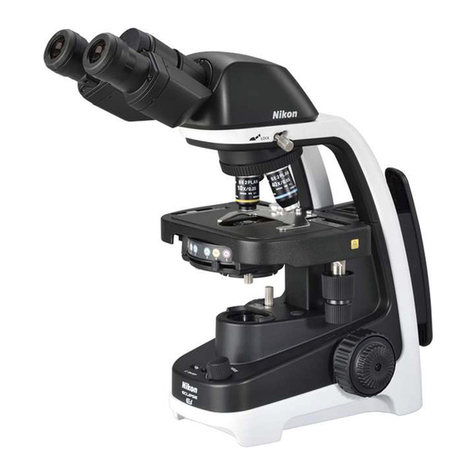
Nikon ECLIPSE Ei User manual
Nikon
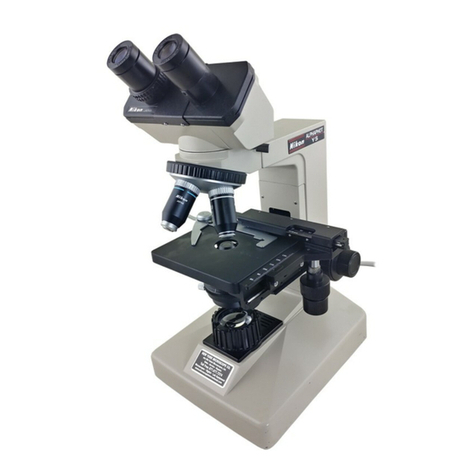
Nikon Alphaphot User manual
Nikon
Nikon A1+ Manual
Nikon
Nikon Eclipse LV100POL User manual

Nikon
Nikon E800 User manual
Nikon
Nikon SMZ25 User manual

Nikon
Nikon SMZ745T User manual