10
Preface
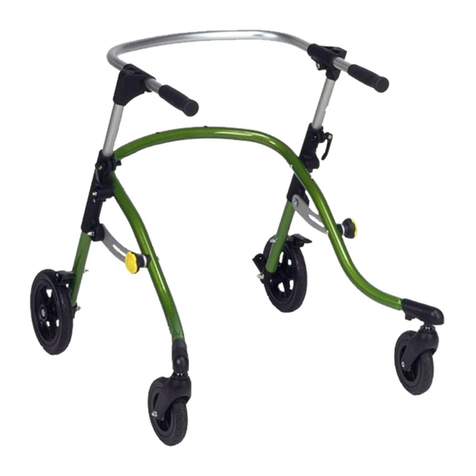
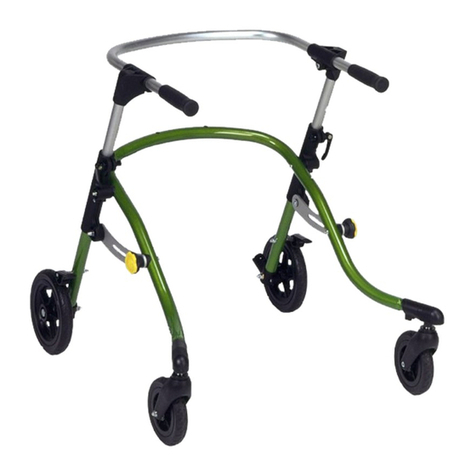
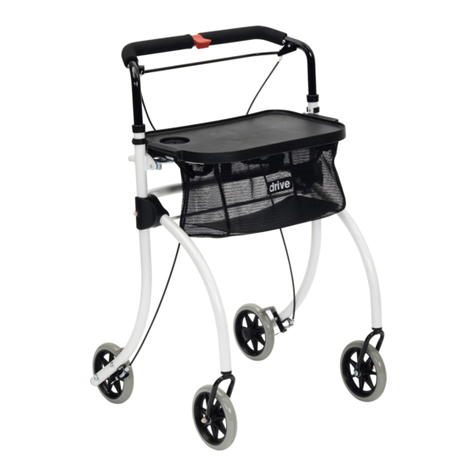
Thank you for selecting the NURMI Ergonomic Walker. Our engineers have designed the high-quality NURMI to
make your life safer and easier, and we’ve included this manual to help you use and care for this durable Otto
Bock product.
Please read the following instructions to make sure you use this product safely and for its recommended use. If
you have any further questions, or if you have any problems, please contact your specialist dealer. We hope
that the NURMI meets your expectations and helps to improve your quality of life.
Indications
(Source: Catalogue of aids and list of aids for the health insurance funds, FRG)
The NURMI Ergonomic Walker helps children and adolescents with a walking handicap to offset the reduced
load capacity or functional capacity of the lower extremities by making use of the strength and support available
in their upper extremities.
The main aim is learning the sequence of movements involved in walking and thus widening the previously
restricted range of action.
It is indicated for walking training in the case of diseases or injuries that involve a disturbance in the locomotor
system and imbalance / asynergia at the same time.
The design promotes an active upright stance when standing and walking, and in contrast to traditional walkers
presents itself as a conception for natural motion. For the user, it can considerably simplify the process of
learning to stand and to walk and to develop his/her sense of balance.
No restrictions as to the group of users have been encountered so far.
However, should any problems occur, the guidance of a medical specialist or orthopedic surgeon
should be obtained in any case.
Declaration of conformity
Otto Bock HealthCare GmbH declares as the manufacturer with sole responsibility that this product is in
conformity with the requirements of Directive 93 / 42 / EEC.
Set-up and use of the basic version
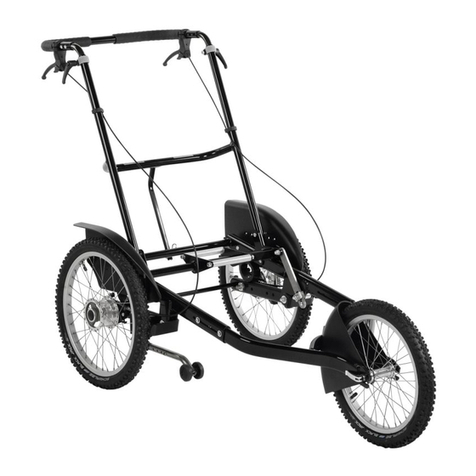
NURMI is a ”posterior walker”, which means that unlike an anterior walker, which the user pushes from behind,
it is designed to be pulled from a position in front of it (the user ‘drags’ the walker). Thus an optimum freedom of
forward movement for the legs is ensured.
Since children instinctively tend to lean and fall backwards, NURMI is equipped with reverse-roll locking devices
integrated into the rear wheels, thus providing optimal support.
The references made in these instructions to graphics and items in the illustration section are to be read as
follows: (1/A) = Fig. No. 1 / item A
Unpacking and setting up
In the original package you will find the following components:
• Basic frame, collapsed
• Grab rail, collapsed
• Any accessories ordered (partly pre-assembled)
In order to set up the NURMI Ergonomic Walker, please proceed as follows:
• Please carefully remove the transport safety snaps and any packaging material.
• Now unfold the grab rail. Place the insert tubes (1/A) in a parallel position to each other and slightly tighten the
stud screws (1/B) just as much as necessary for preventing the insert tubes from twisting.
• Then slot the grab rail into the ”Walker” (2) which remains collapsed.While sliding in the grab rail, press the
spring-loaded buttons (1/C) inside (extension stop).
Insert the grab rail into the frame until the extension stops on the left and right locks.
• Place NURMI on its rear wheels and unfold the front part of the frame as shown in illustration(3).
• Make sure that the folding locks (3/A) are locked; if necessary, press them again To make sure they engage.
• Now set the grab rail to the height which is most convenient for the patient, and then tighten the two
clamping levers (4/A).
For ease of operation, draw the clamping lever a little bit away from the screw; it may then be moved
off-load.