881 Nagasuna, Noguchi, Kakogawa, Hyogo 675-8511, Japan
Tel: [81]-(0)79-422-1122 Fax: [81]-(0)79-422-0112
Rev. 12/2014 (M)
Manufacturer:
H1
L
Printed on recycled paper
Copyright 2014 by TLV Co., Ltd. All rights reserved
c
INSTRUCTION MANUAL
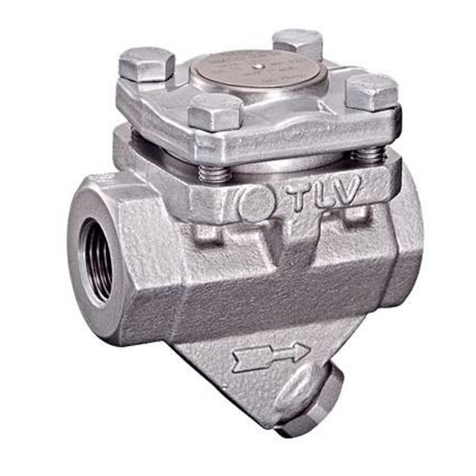
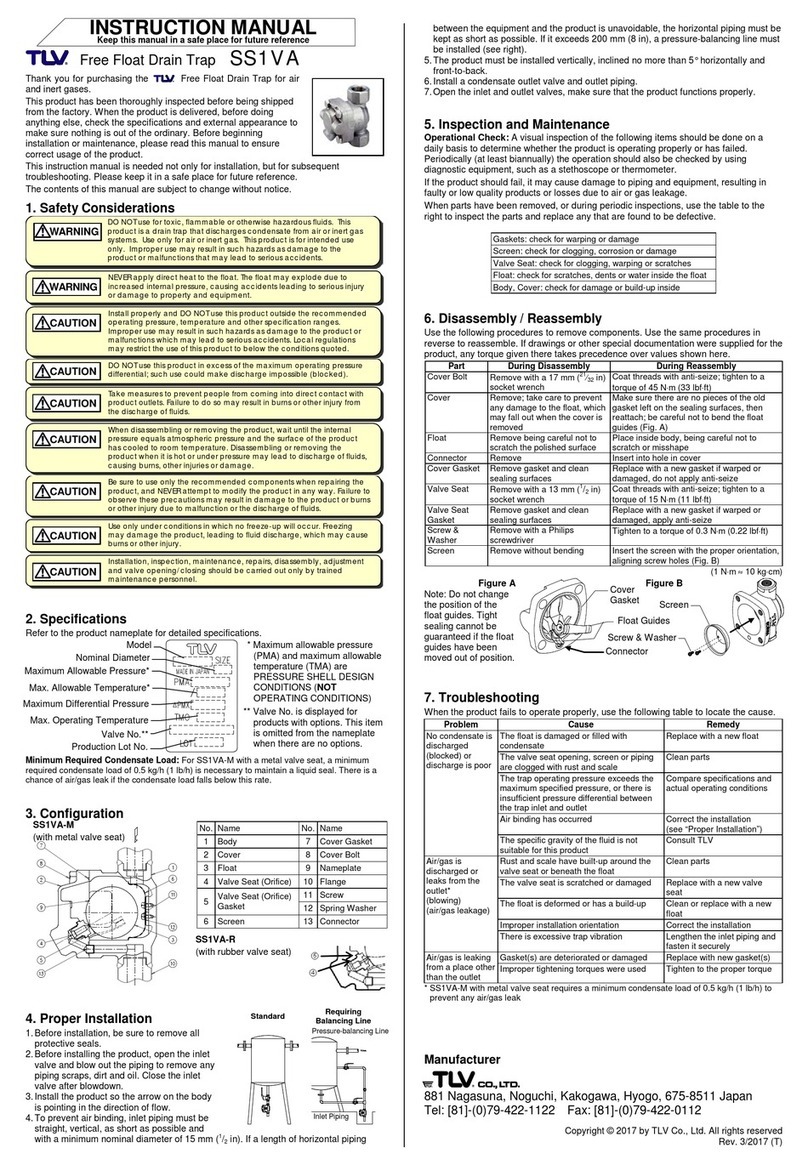
Thank you for purchasing the Radiator Trap.
This product has been thoroughly inspected before
being shipped from the factory. When the product is
delivered, before doing anything else, check the
specifications and external appearance to make sure
nothing is out of the ordinary. Before beginning
installation or maintenance, please read this manual to
ensure correct usage of the product.
This instruction manual is needed not only for
installation, but for subsequent troubleshooting.
Please keep it in a safe place for future reference.
The contents of this manual are subject to change without notice.
1. Safety Considerations
2. Specifications
* Maximum allowable pressure (PMA) and maximum allowable temperature (TMA) are
PRESSURE SHELL DESIGN CONDITIONS (NOT OPERATING CONDITIONS)
3. Configuration
4. Proper Installation
1. Before installation, be sure to remove all protective seals.
2. Before installing the product, open the inlet valve and blow out the piping to remove any
piping scraps, dirt and oil. Close the inlet valve after blowdown.
3. Install the product so the arrow on the body is pointing in the direction of condensate flow.
4. Install in the piping with the inlet horizontal and the outlet vertical.
5. Install a condensate outlet valve and piping.
6. Open the inlet and outlet valves gradually and check to make sure that the product
functions properly.
If there is a problem, determine the cause using the “Troubleshooting” section in this manual.
5. Inspection and Maintenance
Operational Check: A visual inspection of the following items should be done on a daily
basis to determine whether the product is operating properly or has failed. Periodically (at
least biannually) the operation should also be checked by using diagnostic equipment such
as a stethoscope.
If the trap should fail, it may cause damage to piping and equipment, resulting in faulty or low
quality products or losses due to leakage.
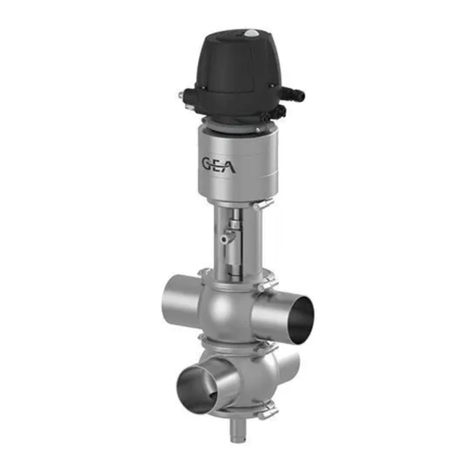
Radiator Trap RT3A
No.
Name
1
2
3
4
5
6
7
8
9
Body
Cover
Thermo-element
Valve Seat
Element Guide
Valve
Spring Holder
Return Spring
Over expansion Spring
Snap Ring
Valve Seat Gasket
Cover Gasket
Union Nipple
Union Nut
Union Gasket
Nameplate
10
11
12
13
14
15
16
No.
Name
Keep this manual in a safe place for future reference
Maximum Operating Pressure PMO
Maximum Operating Temperature TMO
Maximum Allowable Pressure PMA*
Maximum Allowable Temperature TMA*
Set Condensate Discharge Temperature
0.3 MPaG / 3.0 barg / 45 psig
144 °C / 292 °F
0.3 MPaG / 3.0 barg / 45 psig
144 °C / 292 °F
approx. 95 – 100 °C / 203 – 212 °F
Model RT3A
Use only under conditions in which no water hammer will occur. The impact
of water hammer may damage the product, leading to fluid discharge, which
may cause burns or other injury.
Use only under conditions in which no freeze-up will occur. Freezing may
damage the product, leading to fluid discharge, which may cause burns or
other injury.
Take measures to prevent people from coming into direct contact with
product outlets. Failure to do so may result in burns or other injury from
the discharge of fluids.
Install properly and DO NOT use this product outside the recommended
operating pressure, temperature and other specification ranges. Improper
use may result in such hazards as damage to the product or malfunctions
which may lead to serious accidents. Local regulations may restrict the use
of this product to below the conditions quoted.
CAUTION Do not use excessive force when connecting threaded pipes to the
product. Over-tightening may cause breakage leading to fluid discharge,
which may cause burns or other injury.
Installation, inspection, maintenance, repairs, disassembly, adjustment
and valve opening/closing should be carried out only by trained
maintenance personnel.
Be sure to use only the recommended components when repairing the
product, and NEVER attempt to modify the product in any way. Failure to
observe these precautions may result in damage to the product or burns
or other injury due to malfunction or the discharge of fluids.
When disassembling or removing the product, wait until the internal
pressure equals atmospheric pressure and the surface of the product has
cooled to room temperature. Disassembling or removing the product
when it is hot or under pressure may lead to discharge of fluids, causing
burns, other injuries or damage.
Diameter
mm (in)
15 ( )
20 ( )
2
1
/
4
3
/
L
mm (in)
80 (3 )
87 (3 )
8
1
/
8
3
/
H1
mm (in)
35 (1 )
41 (1 )
8
3
/
8
5
/
Normal: Condensate is discharged together with a small amount of flash steam. The
trap usually operates intermittently or with continuous dripping.
19 ( )
24 ( )
If removing the trap from the
piping, first remove the union
nut with a wrench (see size
right)
Remove from piping only if
necessary (see size right)
—
Remove the cover from the
body using a 24 mm ( ")
wrench (do not disassemble
the cover itself)
—
Remove from the body being
careful not to bend the push-
pin
Remove from the body being
careful not to scratch the
valve seating surface
Remove from the body
Remove from the body using
a 12 mm ( ") box wrench,
being careful not to scratch
seat surface
—
(When conducting a visual inspection, flash steam is sometimes mistaken for steam
leakage. For this reason, the use of a steam trap diagnostic instrument [such as TLV
Pocket TrapMan if appropriate] in conjunction with the visual inspection is highly
recommended.)
Parts Inspection: When parts
have been removed, or during
periodic inspections, use the
following table to inspect the
parts and replace any that are
found to be defective.
Procedure
Gaskets
Valve
Coil Springs
Thermo-element
Valve Seat
Check for warping and damage
Check for scratches, warping and wear
Check for abnormalities
Check for signs of wax leakage
Check for scratches, warping and wear
6. Disassembly / Reassembly
Use the following procedures to remove components. Use the same procedures in
reverse to reassemble.
Part
During Disassembly During Reassembly
7. Troubleshooting
There is a build-up of sticky scale between the element
guide and the body
The thermo-element is misshapen
The trap operating pressure exceeds the maximum
specified pressure or there is insufficient pressure
differential between the trap inlet and outlet
The capacity of the trap is insufficient
Steam locking has occurred
The thermo-element is leaking wax
There is a build-up of sticky scale between the element
guide and the body
The valve and/or valve seat is worn
The valve is catching due to sticky build-up
The valve seat gasket is damaged
The cover gasket is damaged
Improper cover tightening torque was used
Stress from the piping is exerted on
the union
Clean the element guide and the
inside of the body
Replace with a new thermo-element
Compare specifications and
actual operating conditions
Compare specifications and
actual operating conditions
Study and correct the piping
Replace with a new thermo-
element
Clean the element guide and the
inside of the body
Replace with a new valve and/or
valve seat
Clean the valve and valve seat
surfaces
Replace with a new gasket
Replace with a new gasket
Tighten to the proper torque
Correct the piping
No condensate
is discharged
or discharge is
poor
Steam is
discharged or
leaks from the
outlet
(blowing)
(steam
leakage)
Steam or
condensate is
leaking from a
place other
than the outlet
When the product fails to operate properly, use the following table to locate the cause.
Problem
Cause Remedy
Union Nut
Union Nipple
Union Gasket
Cover
Cover Gasket
Thermo-
element
Element Guide
(Valve)
Return Spring
Valve Seat
Valve Seat
Gasket
—
—
Replace with new if warped
or damaged
Tighten to a torque of
40 N.m (29 lbf.ft)
Replace with new if warped
or damaged
Replace with a new thermo-
element if damaged or
leaking wax
Insert into body being careful
not to scratch the valve
surface
Place inside body
Insert being careful not to
scratch seat surface; tighten
to a torque of
15 N.m (11 lbf.ft)
Replace with new if warped
or damaged
Blocked: No condensate is discharged. The surface temperature of the trap is low.
(No Discharge)
Blowing: Live steam continually flows from the outlet and there is a continuous
hissing sound of flow.
Steam Leakage: Live steam is discharged through the trap outlet together with condensate,
accompanied by a high-pitched sound.
Cover
(Contains the over-
expansion spring,
spring guide, snap ring)
Exploded View:
Cover Gasket
Thermo-element
Element Guide
(Valve)
Return Spring
Valve Seat
Valve Seat
Gasket
Union
Nipple
Body
Union Gasket
Union Nut
RT3A
Size
Distance Across Flats
mm (in)
15 ( )
20 ( )
Union
Nut
32 (1 )
38 (1 )
Union
Nipple
16
15
/
16
15
/
2
1
/
4
3
/
4
1
/
2
1
/
4
3
/
16
15
/
1 N.m ~
~10 kg.cm