TFP501
Page 3 of 6
subject to freezing temperatures, use
Table A to determine a sprinkler’s
appropriate exposed barrel length to
prevent water from freezing in the con-
necting pipes due to conduction. The
exposed barrel length measurement
must be taken from the face of the
sprinkler fitting to the surface of the
structure or insulation that is exposed
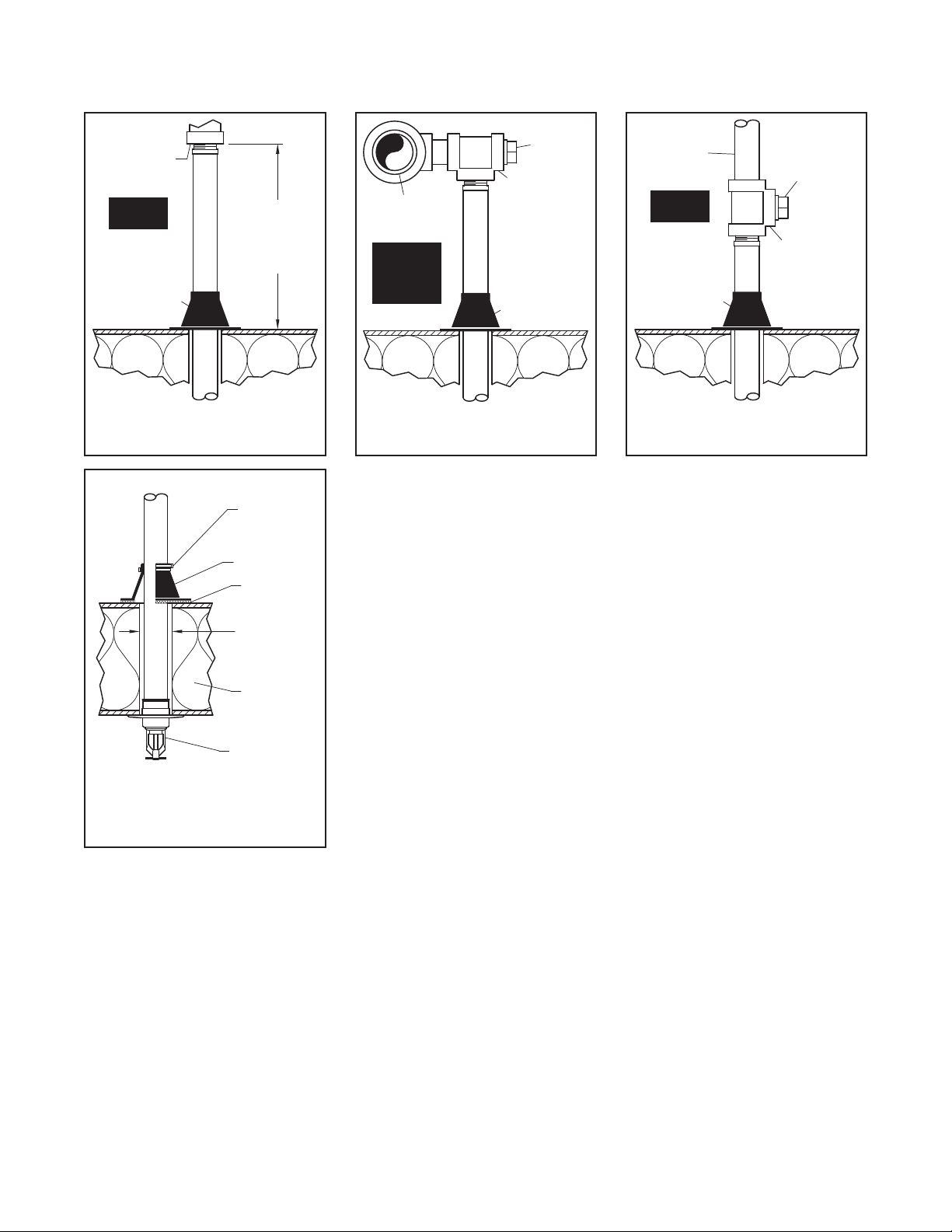
to the heated area. Refer to Figure 5 for
an example.
For protected area temperatures
between those given above, the
minimum recommended length from
the face of the fitting to the outside of
the protected area may be determined
by interpolating between the indicated
values.
Clearance Space
In accordance with VdS CEA 4001,
when connecting an area subject to
freezing and an area containing a
wet pipe sprinkler system, the clear-
ance space around the sprinkler
barrel of dry-type sprinklers must be
sealed. Due to temperature differences
between two areas, the potential for
the formation of condensation in the
sprinkler and subsequent ice build-up
is increased. If this condensation is not
controlled, ice build-up can occur that
might damage the dry-type sprinkler
and/or prevent proper operation in a
re situation.
Use of the Model DSB-2 Dry Sprinkler
Boot, described in technical data sheet
TFP591 and shown in Figures 8, can
provide the recommended seal.
Installation
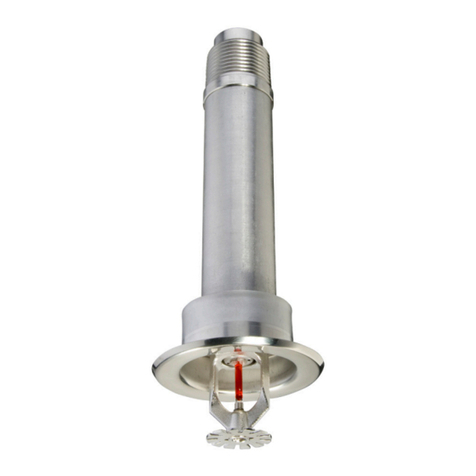
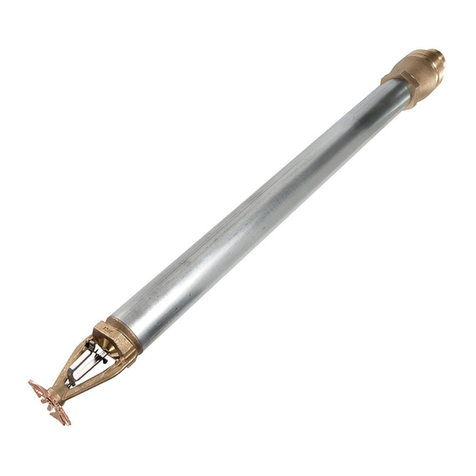
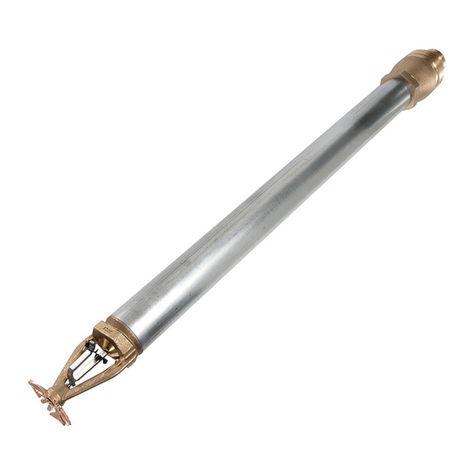
TYCO Series DS-1 5.6K Pendent, Stan-
dard Response, Standard Coverage
Dry-Type Sprinklers must be installed
in accordance with this section.
General Instructions
Series DS-1 Dry-Type Sprinklers must
only be installed in fittings that meet
the requirements of the Design Crite-
ria section. Refer to the Design Criteria
section for other important require-
ments regarding piping design and
sealing of the clearance space around
the Sprinkler Casing.
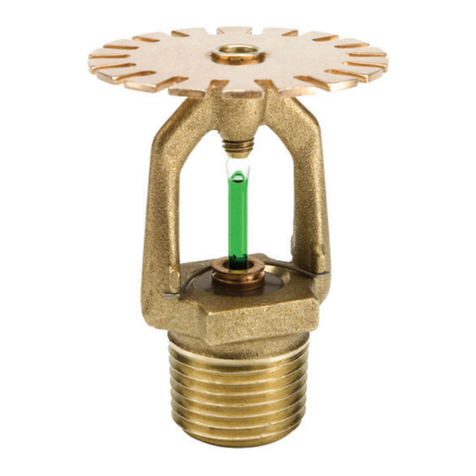
Do not install any bulb-type sprinkler
if the bulb is cracked or there is a loss
of liquid from the bulb. With the sprin-
kler held horizontally, a small air bubble
should be present. The diameter of the
air bubble is approximately 1/16 in.
(1,6 mm) for the 135°F (57°C) rating to
1/8 in. (3,2 mm) for the 360°F (182°C)
rating.
Obtain a leak-tight ISO 7-R1 sprinkler
joint by applying a minimum-to-maxi-
mum torque of 20 to 30 lb-ft (26,8 to
40,2 N·m). Higher levels of torque may
distort the sprinkler Inlet with conse-
quent leakage or impairment of the
sprinkler.
Do not attempt to compensate for
insufficient adjustment in an Escutch-
eon Plate by under or over-tightening
the Sprinkler. Re-adjust the position of
the sprinkler fitting to suit.
Note: Install pendent sprinklers only in
the pendent position. The deflector of
a pendent sprinkler is to be parallel to
the ceiling.
Step 1. With a non-hardening pipe-
thread sealant such as TEFLON applied
to the inlet threads, hand-tighten the
sprinkler into the sprinkler fitting.
Step 2. Wrench-tighten the sprinkler
using either:
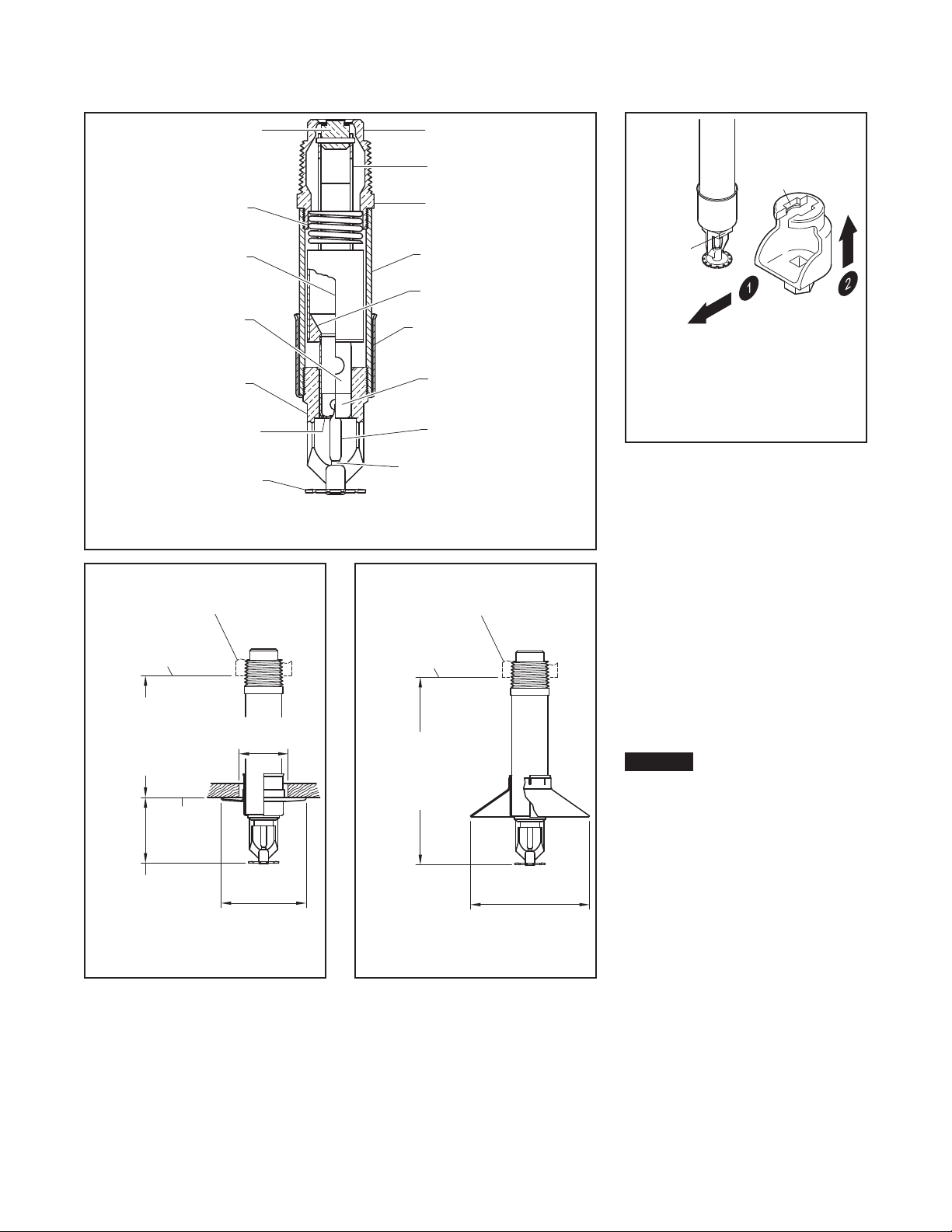
• a pipe wrench on the Inlet Band or
the Casing (See Figure 1)
• the W-Type 7 Sprinkler Wrench on
the Wrench Flat (See Figure 2)
Apply the wrench recess of the W-Type
7 Sprinkler Wrench to the wrench flat.
Note: If sprinkler removal becomes
necessary, remove the sprinkler using
the same wrenching method noted
above. Sprinkler removal is easier when
a non-hardening sealant was used
and torque guidelines were followed.
After removal, inspect the sprinkler for
damage.
Step 3. After installing the ceiling and
applying a ceiling finish, slide on the
outer piece of the escutcheon until
it comes in contact with the ceiling.
Do not lift the ceiling panel out of its
normal position.
To install the baffle plate properly, push
on until the top edge reaches the flared
edge of the escutcheon.
Ambient Temperature
Exposed to
Discharge End of Sprinkler
Temperatures for Heated Area(1)
40°F
(4°C) 50°F
(10°C) 60°F
(16°C)
Minimum Exposed Barrel Length(2),
Inches
(mm)
40°F
(4°C) 000
30°F
(-1°C) 000
20°F
(-7°C)
4
(100) 0 0
10°F
(-12°C)
8
(200)
1
(25) 0
0°F
(-18°C)
12
(305)
3
(75) 0
-10°F
(-23°C)
14
(355)
4
(100)
1
(25)
-20°F
(-29°C)
14
(355)
6
(150)
3
(75)
-30°F
(-34°C)
16
(405)
8
(200)
4
(100)
-40°F
(-40°C)
18
(455)
8
(200)
4
(100)
-50°F
(-46°C)
20
(510)
10
(255)
6
(150)
-60°F
(-51°C)
20
(510)
10
(255)
6
(150)
Notes:
1. For protected area temperatures that occur between values listed above, use the next cooler temperature.
2. These lengths are inclusive of wind velocities up to 30 mph (18,6 kph).
TABLE A
EXPOSED SPRINKLER BARRELS IN WET PIPE SYSTEMS
MINIMUM RECOMMENDED LENGTHS