10
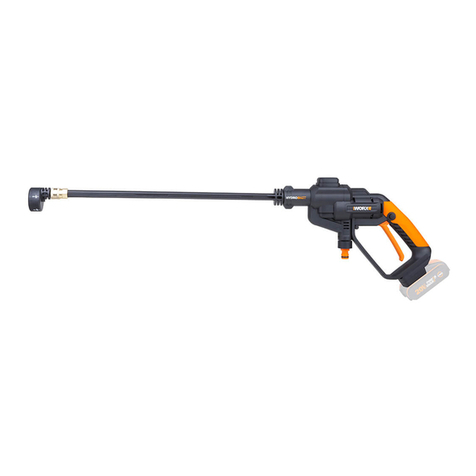
20V Sanitizing pressure washer EN
Do not burn
Remove battery from the socket before
carrying out any adjustment, servicing
or maintenance.
Waste electrical products must not
be disposed of with household waste.
Please recycle where facilities exist.
Check with your local authorities or
retailer for recycling advice.
Li-Ion battery This product has been
marked with a symbol relating to
‘separate collection’ for all battery
packs and battery pack. It will then
be recycled or dismantled in order to
reduce the impact on the environment.
Battery packs can be hazardous
for the environment and for human
health since they contain hazardous
substances.
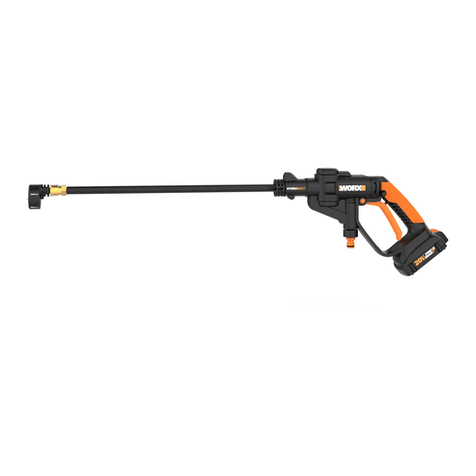
COMPONENT LIST
1. SPRAY NOZZLE AND SHORT LANCE KIT
2. LOCKOFF SWITCH
3. ONOFF SWITCH TRIGGER
4. BATTERYPACK RELEASEBUTTON
5. BATTERY PACK
6. 1L BOTTLE
7. ADAPTER
8. EXTENSION LANCE
9. HOSE
10. 5L TANK
11. SHOULDER STRAP
12. PRESSURE SETTING SWITCH
* Not all the accessories illustrated or described
are included in standard delivery.
TECHNICAL DATA
Type WP650E WP650E.9 WP651E WP651E.9 (65
- designation of machinery, representative of
battery-powered washer)
WP650E WP650E.9 WP651E WP651E.9
Voltage 20 V Max. ***
Max water flow
rate L: 7 L/h H: 8 L/h
Water
temperature Max. 50 0C
Machine weight 1.7 kg 1.3 kg 1.7 kg 1.3 kg
ACCESSORIES
WP650E WP650E.9
WP651E
WP651E.9
Spray nozzle and
short lance kit 1111
Extension lance 1111
Battery pack
(WA3551) 1/
1/
Charger
(WA3880) 1/1/
1L Bottle 11//
5L Tank //11
Shoulder strap //11
We recommend that you purchase your accessories
from the same store that sold you the tool. Refer to the
accessory packaging for further details. Store personnel
can assist you and offer advice.
OPERATING INSTRUCTIONS
NOTE Before using the tool, read the instruction
book carefully.
INTENDED USE
This tool is intended for spraying.
ASSEMBLY & OPERATION
ACTION FIGURE
BEFORE OPERATION
Installing the battery pack See Fig. A1
Removing the battery pack See Fig. A2
Checking the battery condition
NOTE: Fig. A3 only applies for the battery
pack with battery indicator light. See Fig. A3