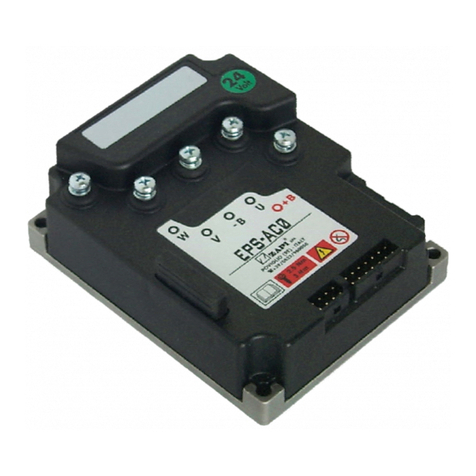
Zapi EPS-AC User manual

Page 1
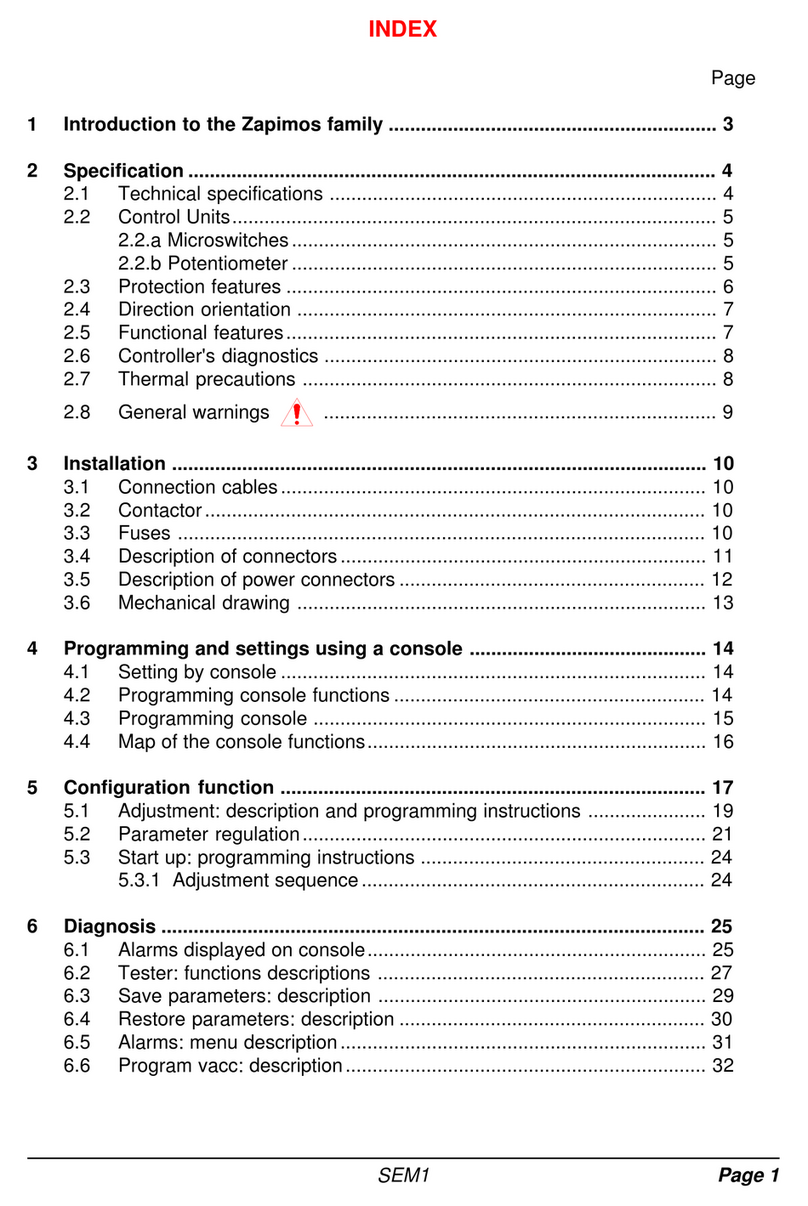
Indice
Page
Introduction .......................................................................................................... 3
1 System components ..................................................................................... 4
1.1 Steering servo motor control unit .......................................................... 4
1.2 Steer angle position potentiometer ....................................................... 5
1.3 Operator console................................................................................... 5
1.4 AC steering servo motor ....................................................................... 5
1.5 Steering handle ..................................................................................... 5
1.6 Motor shaft encoder .............................................................................. 6
2 Electrical specifications ............................................................................... 7
2.1 Battery voltage range ............................................................................ 7
2.2 Steer motor current range ..................................................................... 7
2.3 Command device specifications............................................................ 7
2.3.1 Tacho generator or stepper motor ............................................... 7
2.3.2 Automatic centering potentiometer .............................................. 8
3 Mechanical specifications............................................................................ 9
4 System description ..................................................................................... 10
4.1 Manual steering with tacho-generator or stepper motor ..................... 10
4.2 Automatic centering............................................................................. 10
5 Jumpers description ................................................................................... 11
6 Power connection diagram ........................................................................ 13
6.1 Electrical drawing ................................................................................ 14
6.1.1 Tacho-generator steering........................................................... 14
6.1.2 Stepper motor steering............................................................... 15
6.1.3 Tacho-generator steering with automatic centering ................... 16
6.1.4 Stepper motor steering with automatic centering....................... 17
6.1.5 Interface description................................................................... 18
7 One shot installation procedure ................................................................ 20
8 Description of connectors.......................................................................... 21
8.1 CNB connector.................................................................................... 21
8.2 CNA connector.................................................................................... 23
9 Setting the steering..................................................................................... 25
9.1 Tacho-generator or stepper motor controlled steering........................ 25
9.2 Automatic centering............................................................................. 25
9.3 Steer angle indicator gauge ................................................................ 26
10 Zapi hand set description........................................................................... 27
10.1 Manual mode steering option - hand set function map ....................... 28
10.2 Manual mode steering option and automatic centering -
hand set function map......................................................................... 29
10.3 Main menu "Parameters list"............................................................... 30
10.4 Parameters in set model 0 (tacho-generator or stepper motor only) .. 30
10.5 Parameters in set model 1 (tacho-generator or stepper motor and
automatic centering)............................................................................ 32
10.6 Main menu: "Tester" functions list....................................................... 33
10.7 Config menu: "Set options" functions list............................................. 35

Page 2
SIGNATURES TABLE
SECIVRES.TPEDYNAPMOCEVITUCEXETNEMEGANAM
EVITUCEXENOITCESGNIREENIGNE
REGANAMTROPXE
Publications N°: ADCZP0AA
Edition: July 2000
10.8 Config menu: "Adjustments" functions list........................................... 37
10.9 Config menu: "Set model" ................................................................... 40
10.10 Maximum current adjustment.............................................................. 40
11 EPS-AC alarm list ........................................................................................ 41
11.1 Analysis of alarms displayed on console............................................. 41
11.1.1 One blink alarms ...................................................................... 41
11.1.2 Two blinks alarms .................................................................... 44
11.1.3 Three blinks alarms.................................................................. 45
11.1.4 Four blinks alarms.................................................................... 46
11.1.5 Five blinks alarms .................................................................... 46
11.1.6 Six blinks alarms ...................................................................... 47
12 Safety controls and their use..................................................................... 49
12.1 Safety controls in tacho-generator and automatic centering steering . 49
12.2 Safety on motor wires broken ............................................................. 49
12.3 Safety on failure of the steering tacho-generator ................................ 49
12.3.1 Safety on failures of the steering stepper motor ...................... 49
12.4 Safety on the presence of current when the steering motor is at rest. 49
12.5 Safety on the presence of phase voltage when the steering
motor is at rest .................................................................................... 50
12.6 Safety on pot wires broken (for automatic centering operation).......... 50
12.7 Cross diagnosis between master and supervisor microcontroller....... 50
13 Periodic maintenance ................................................................................. 51
13.1 Testing the fault detection circuitry...................................................... 51

Page 3
INTRODUCTION
This equipment enables manually controlled power steering and automatic
centering. Manually controlled steering may use either a tacho-generator or, in a later
version, an inexpensive stepper motor fixed to the steering wheel. The automatic
centering operation requires a potentiometer mechanically fixed on the MDU (Motor
Drive Unit).
The MDU uses an inexpensive, robust and maintenance free three phases AC
induction motor.
Also, our patented system makes optional the adoption of an encoder mounted on
the steering motor shaft.
The on board CAN interface makes the communication exchange between our EPS
and other controllers placed on the truck rapid and simple, so potentially extending the
steering performance to steer equalization for traction speed, CAN management of a
wire guidance application and so on.
Configuration options, steering adjustment, measurement functions, and
toubleshooting operations are integrally supported by the ZAPI hand held
controller equipped with Eprom release number CKULTRA ZP3.01 or later.
Improved safety and operation are provided by having two microprocessor: the first
of them performs operations and a second one executes supervisor functions.
The microprocessors combined with the ZAPI hand held controller make servicing easy
and direct, reducing adjustment and troubleshooting time. Increased steering motor
performance and reduced noise levels are achieved by using MOSFET technology.

Page 4
1 SYSTEM COMPONENTS
The EPS_AC equipment consists of the following parts:
1.1 STEERING SERVO MOTOR CONTROL UNIT
It consists of a control unit using the logic marked ADCZPA0D which operates the AC
motor for both manual and automatic centering steering. There are three different
control units available:
1) A 24/36Vbatt unit provides a maximum current of 70Amps.
2) A 48Vbatt unit provides a maximum current of 70Amps.
3) A 48/80Vbatt unit provides a maximum current of 50Amps.

Page 5
1.2 STEER ANGLE POSITION POTENTIOMETER
To execute an automatic centering operation, a multiturn 5K potentiometer must be
mounted directly on the end of the output shaft of the steering gear reduction box. This
potentiometer measures the angle of the MDU directly. The full range of possible output
is approximately 0÷5Vdc. This potentiometer also provides information for the steer
angle indicator gauge mounted on the operator console.
1.3 OPERATOR CONSOLE
The control unit can support the following devices typically fixed on the operator conso-
le.
1) Key switch
2) Manual/automatic centering selection switch (AUTOSEL).
3) A status device (BUZZER).
4) A steer angle indicator gauge.
1.4 AC STEERING SERVO MOTOR
The steering system includes a three phase AC induction motor with a maximum rated
power of:
1) 40A current rating (Imax=70A) if the battery voltage is 36Vdc or less. (about 1KW
rated power motor at Vbatt=36V).
2) 30A current rating (Imax=70A) if the battery voltage is 48Vdc. (about 1KW rated
power motor).
3) 22A current rating (Imax=50A) if the battery voltage is greater than 48Vdc. (about
1.2KW rated power motor at Vbatt=80V).
The gear box should be chosen so that the complete 180° MDU rotation takes 3 to 6
seconds at the maximum steer speed.
1.5 STEERING HANDLE
This is a multi-turn steering handle or wheel attacched to a command device. There are
two option:
1) tacho-generator. This solution requires just a two wire connection. The
recommended tacho-generator is AIRPAX Part N° 24Vdc - 9904 -120 - 16206.
2) stepper motor. This solution requires either a six wire connection or an optional
three wire connection. The recommended stepper motor model is Minebea type
code AA23KM-K227-T20V.
This last device requires a frictional linkage because there is no gear box.
Mounting the command device to eliminate axial or radial loading on the input shaft is
important for reliable operation.
Note: the logic card for the tacho-generator and for the stepper motor applications are
different. So a different order code must be specified.

Page 6
1.6 MOTOR SHAFT ENCODER
This device is optional (not necessary). The Eps-Ac can receive an encoder (CNA #6,
#16, #17 and #7) directly connected to the steering motor shaft. This is an option for a
special application. E.g. fine steering speed control, safety improvement etc. A typical
manual controlled steering with automatic centering does not require an encoder; it just
requires a feedback pot.

Page 7
2 ELECTRICAL SPECIFICATIONS
2.1 BATTERY VOLTAGE RANGE
Battery voltage input ranges for different releases of the control unit:
24/36 24-36 Vdc
48 48 Vdc
48/80 48-80 Vdc
2.2 STEER MOTOR CURRENT RANGE
24/36 Imax ≤70Aac. Adjustable with the hand held controller (HARDWARE
SETTING)
48 Imax ≤70Aac. Adjustable with the hand held controller (HARDWARE
SETTING)
48/80 Imax ≤50Aac. Adjustable with the hand held controller (HARDWARE
SETTING)
2.3 COMMAND DEVICE SPECIFICATIONS
2.3.1 Tacho generator or stepper motor
We supply two command device solutions: Tacho-generator and Stepper motor.
Tacho-generator is to be AIRPAX 24VDC - part No. 9904-120-16206. Use of any other
device may provide non-optimum performance.
Stepper motor is to be Minebea type code AA23KM-K227-T20V. Use of any other
device may provide non-optimum performance.
Stepper motor - mechanical specification

Page 8
Tacho generator - mechanical specification
2.3.2 Automatic centering potentiometer
The potentiometer fixed on the steering gear box output shaft should be a 5K
conductive plastic potentiometer. A multi-turn potentiometer is suggested to ensure
negligible mechanical play.
The feedback angle potentiometer should rotate approximately ensure 80% of its total
travel, corresponding to 180 degrees of steering angle. The greater the travel, the
better the resolution and accuracy.

Page 9
3 MECHANICAL SPECIFICATIONS

Page 10
4 SYSTEM DESCRIPTION
4.1 MANUAL STEERING WITH TACHO-GENERATOR OR STEPPER MOTOR
This option uses a tacho-generator (or a stepper motor) attached to the steering wheel
to convert the steering wheel rotation into an electrical signal. The control logic sets the
steer servo-motor in motion at a speed that increases with the speed of the steering
wheel. Steering sensitivity and maximum speed are adjustable by using the ZAPI hand
held controller.
4.2 AUTOMATIC CENTERING
Through the AUTOSEL input request it is possible to turn the steering state from
manual mode to automatic centering. The automatic centering request should be edge
or level conditioned (see option AUT INP ACTIVE 10.7.7). As soon as an automatic
centering request is recognized, the steering control will start to automatically rotate the
MDU until it is straight ahead.
Table of contents
Other Zapi Controllers manuals

Zapi
Zapi 4Q User manual

Zapi
Zapi ADPZP0CC User manual

Zapi
Zapi ZAPIMOS HP 350A User manual

Zapi
Zapi COMBI SEM-1 User manual

Zapi
Zapi EPS-AC0 User manual

Zapi
Zapi SMART CONSOLE User manual

Zapi
Zapi DUALACE2 NEW GENERATION User manual

Zapi
Zapi SMART CONSOLE User manual

Zapi
Zapi ZAPIMOS H2 96V 400A User manual

Zapi
Zapi EPS-BLI HYG User manual
Popular Controllers manuals by other brands

Digiplex
Digiplex DGP-848 Programming guide

YASKAWA
YASKAWA SGM series user manual

Sinope
Sinope Calypso RM3500ZB installation guide

Isimet
Isimet DLA Series Style 2 Installation, Operations, Start-up and Maintenance Instructions

LSIS
LSIS sv-ip5a user manual

Rockwell Automation
Rockwell Automation 1769-L31 installation instructions