manuals.online logo
Brands
  1. Home
  2. •
  3. Brands
  4. •
  5. ACME
  6. •
  7. Dj Equipment
  8. •
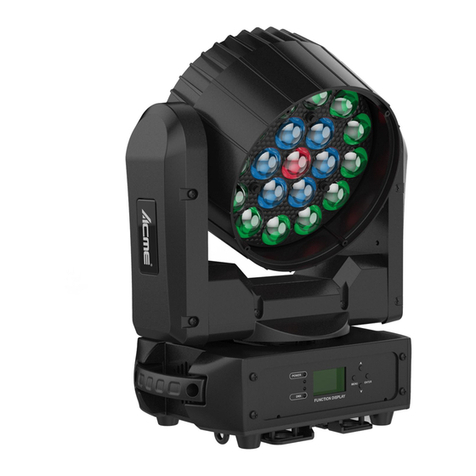
  9. ACME LED-MB50 User manual

ACME LED-MB50 User manual

This manual suits for next models

1

Other ACME Dj Equipment manuals

ACME LED?7TC User manual

ACME

ACME LED?7TC User manual

ACME Stage Blinder P4 User manual

ACME

ACME Stage Blinder P4 User manual

ACME LED-7871 User manual

ACME

ACME LED-7871 User manual

ACME LED?7TC User manual

ACME

ACME LED?7TC User manual

ACME LED-BL4B User manual

ACME

ACME LED-BL4B User manual

ACME ELLIPSOIDAL E-300 User manual

ACME

ACME ELLIPSOIDAL E-300 User manual

ACME LED WAVE 100 User manual

ACME

ACME LED WAVE 100 User manual

ACME Color Par 36 User manual

ACME

ACME Color Par 36 User manual

ACME LED-RC8 User manual

ACME

ACME LED-RC8 User manual

ACME Dotline 360 User manual

ACME

ACME Dotline 360 User manual

ACME Stage Panel 1080 User manual

ACME

ACME Stage Panel 1080 User manual

ACME E-200 MB MC User manual

ACME

ACME E-200 MB MC User manual

ACME Junior Series User manual

ACME

ACME Junior Series User manual

ACME CA-DD12 II User manual

ACME

ACME CA-DD12 II User manual

ACME Color Fusion CF-805 User manual

ACME

ACME Color Fusion CF-805 User manual

ACME MH-600A Mobile Color User manual

ACME

ACME MH-600A Mobile Color User manual

ACME BP-40 QW S DXX User manual

ACME

ACME BP-40 QW S DXX User manual

ACME Eventx 100 User manual

ACME

ACME Eventx 100 User manual

ACME LED-BR10 User manual

ACME

ACME LED-BR10 User manual

ACME ASTRO LED-256D User manual

ACME

ACME ASTRO LED-256D User manual

ACME MP-90 RGBW User manual

ACME

ACME MP-90 RGBW User manual

ACME AE-610 BEAM User manual

ACME

ACME AE-610 BEAM User manual

ACME UV-9N User manual

ACME

ACME UV-9N User manual

ACME Diamonds LS-1010 RGB User manual

ACME

ACME Diamonds LS-1010 RGB User manual

Popular Dj Equipment manuals by other brands

MAGMATIC Prisma Wash 25 user manual

MAGMATIC

MAGMATIC Prisma Wash 25 user manual

HERA PROCOLOR 60 RGBW SERIES User manual & installation guide

HERA

HERA PROCOLOR 60 RGBW SERIES User manual & installation guide

EuroLite LED TSL-600 SCAN COB user manual

EuroLite

EuroLite LED TSL-600 SCAN COB user manual

Ledj Slimline 12HEX12 user manual

Ledj

Ledj Slimline 12HEX12 user manual

Laserworld Garden GS-50RG Xmas manual

Laserworld

Laserworld Garden GS-50RG Xmas manual

Chauvet OVATION E-930VW Quick reference guide

Chauvet

Chauvet OVATION E-930VW Quick reference guide

Snow Masters Zig Oscillator user manual

Snow Masters

Snow Masters Zig Oscillator user manual

EuroLite 50530554 user manual

EuroLite

EuroLite 50530554 user manual

Beamz BUV243 user manual

Beamz

Beamz BUV243 user manual

Eagletone 6 Eyes Flower user manual

Eagletone

Eagletone 6 Eyes Flower user manual

EuroLite FLD-1508 user manual

EuroLite

EuroLite FLD-1508 user manual

Technical Pro LG8xSEA user manual

Technical Pro

Technical Pro LG8xSEA user manual

JB Systems Lounge Laser DMX Operation manual

JB Systems

JB Systems Lounge Laser DMX Operation manual

Elation FUZE WASH Z350 user manual

Elation

Elation FUZE WASH Z350 user manual

Maverick MK3 WASH Quick reference guide

Maverick

Maverick MK3 WASH Quick reference guide

Infinity TF-260C7 Fresnel manual

Infinity

Infinity TF-260C7 Fresnel manual

Chauvet EVE E-50Z Quick reference guide

Chauvet

Chauvet EVE E-50Z Quick reference guide

Eliminator Lighting E 138 manual

Eliminator Lighting

Eliminator Lighting E 138 manual

manuals.online logo
manuals.online logoBrands
  • About & Mission
  • Contact us
  • Privacy Policy
  • Terms and Conditions

Copyright 2025 Manuals.Online. All Rights Reserved.

23-
Innovation, Quality, Performance
LED BEAM 300
LED-MB50
UserGuide
Professional Entertainment Technology
1-
22-
EC Declaration of Conformity
We declare that our products (lighting equipments) comply with the
following specification and bears CE mark in accordance with the
provision of the Electromagnetic Compatibility (EMC) Directive
89/336/EEC.
EN55014-2: 1997 A1: 2001, EN61000-4-2: 1995; EN61000-4-3: 2002;
EN61000-4-4: 1995; EN61000-4-5: 1995, EN61000-4-6: 1996,
EN61000-4-11: 1994.
&
Harmonized Standard
EN60598-1: 2000+ALL: 2000+A12: 2002
Safety of household and similar electrical appliances
Part 1: General requirements
21-
6. Fixture Cleaning
The cleaning of internal and external optical lenses and/or mirrors must be carried out
periodically to optimize light output. Cleaning frequency depends on the environment in
which the fixture operates: damp, smoky or particularly dirty surrounding can cause greater
accumulation of dirt on the unit’s optics.
yClean with soft cloth using normal glass cleaning fluid.
yAlways dry the parts carefully.
yClean the external optics at least every 20 days. Clean the internal optics at least every
30/60 days.
Fresnel Lens:
Clean the lens with neutral soap and water, and then dry it with soft cloth. Be aware that
alcohol or other detergent could cause damage to lens. Please note the lens would be burnt
yellow or cracked after three-month use of average 8 hours per day, which can reduce the
output in some degree. The lens is consumable with a warranty of three months only.
Please change with genuinely new lens when necessary.
2-
TABLE OF CONTENTS
1. Safety Instruction
2. Technical Specification
3. How To Set The Unit
4. How To Control The Unit
5. Troubleshooting
6. Fixture Cleaning
3-
1. Safety Instruction
WARNING
yPlease keep this User Guide for future consultation. If you sell the unit to another user, be
sure that they also receive this instruction booklet.
yUnpack and check carefully there is no transportation damage before using the unit.
yBefore operating, ensure that the voltage and frequency of power supply match the power
requirements of the unit.
yIt’s important to ground the yellow/green conductor to earth in order to avoid electric
shock.
yThe unit is for indoor use only. Use only in a dry location.
yThe unit must be installed in a location with adequate ventilation, at least 50cm from
adjacent surfaces. Be sure that no ventilation slots are blocked.
yDisconnect main power before replacement or servicing.
yMake sure there is no flammable materials close to the unit while operating as it is fire
hazard.
yUse safety cable when fixes this unit. Don’t handle the unit by taking its head only, but
always by taking its base.
yMaximum ambient temperature is ta: 40℃. Don’t operate it where the temperature is
higher than this.
yUnit surface temperature may reach up to 85℃. Don’t touch the housing bare-hand during
its operation. Turn off the power and allow about 15 minutes for the unit to cool down
before replacing or serving.
yIn the event of serious operating problem, stop using the unit immediately. Never try to
repair the unit by yourself. Repairs carried out by unskilled people can lead to damage or
malfunction. Please contact the nearest authorized technical assistance center. Always
use the same type spare parts.
yDo not touch any wire during operation as high voltage might be causing electric shock.
Warning
yTo prevent or reduce the risk of electrical shock or fire, do not expose the unit to rain or
moisture.
yDo not open the unit within five minutes after switching off.
Please read carefully the instruction, which includes important information
about the installation, usage and maintenance.
20-
Not used.
5. Troubleshooting
Following are a few common problems that may occur during operation. Here are
some suggestions for easy troubleshooting:
A. The unit does not work, no light and the fan does not work
1. Check the connection of power and main fuse.
2. Measure the mains voltage on the main connector.
3. Check the power on LED.
B. Not responding to DMX controller
1. DMX LED should be on. If not, check DMX connectors, cables to see if link properly.
2. If the DMX LED is on and no response to the channel, check the address settings and
DMX polarity.
3. If you have intermittent DMX signal problems, check the pins on connectors or on PCB
of the unit or the previous one.
4. Try to use another DMX controller.
5. Check if the DMX cables run near or run alongside to high voltage cables that may
cause damage or interference to DMX interface circuit.
C. Some units don’t respond to the easy controller
1. You may have a break in the DMX cabling. Check the LED for the response of the
master/ slave mode signal.
2. Wrong DMX address in the unit. Set the proper address.
D. No response to the sound
1. Make sure the unit does not receive DMX signal.
2. Check microphone to see if it is good by tapping the microphone
E. One of the channels is not working well
1. The stepper motor might be damaged or the cable connected to the PCB is broken.
2. The motor’s drive IC on the PCB might be out of condition

19-
4.5 DMX512 Connection
1. If you using a controller with 5 pins DMX output, you need to use a 5 to 3 pin
adapter-cable.
2. At last unit, the DMX cable has to be terminated with a terminator. Solder a 120 ohm
1/4W resistor between pin 2(DMX-) and pin 3(DMX+) into a 3-pin XLR-plug and plug it
in the DMX-output of the last unit.
3. Connect the unit together in a `daisy chain` by XLR plug from the output of the unit to
the input of the next unit. The cable can not branched or split to a `Y` cable. DMX 512 is
a very high-speed signal. Inadequate or damaged cables, soldered joints or corroded
connectors can easily distort the signal and shut down the system.
4. The DMX output and input connectors are pass-through to maintain the DMX circuit,
when one of the units’ power is disconnected.
5. Each lighting unit needs to have an address set to receive the data sent by the
controller. The address number is between 0-511 (usually 0 & 1 are equal to 1).
6. The end of the DMX 512 system should be terminated to reduce signal errors.
7. 3 pin XLR connectors are more popular than 5 pin XLR.
3 pin XLR: Pin 1: GND, Pin 2: Negative signal (-), Pin 3: Positive signal (+)
5 pin XLR: Pin 1: GND, Pin 2: Negative signal (-), Pin 3: Positive signal (+), Pin 4/Pin 5:
4-
yThe housing, the lenses, or the ultraviolet filter must be replaced if they are visibly
damaged.
Caution
There are no user serviceable parts inside the unit. Do not open the housing or attempt
any repairs yourself. In the unlikely event your unit may require service, please contact
your nearest dealer.
Installation
The unit should be mounted via its screw holes on the bracket. Always ensure that the unit
is firmly fixed to avoid vibration and slipping while operating. And make sure that the
structure to which you are attaching the unit is secure and is able to support a weight of 10
times of the unit’s weight. Also always use a safety cable that can hold 12 times of the
weight of the unit when installing the fixture.
The equipment must be fixed by professionals. And it must be fixed at a place where is out
of the touch of people and has no one pass by or under it.
2. Technical Specification
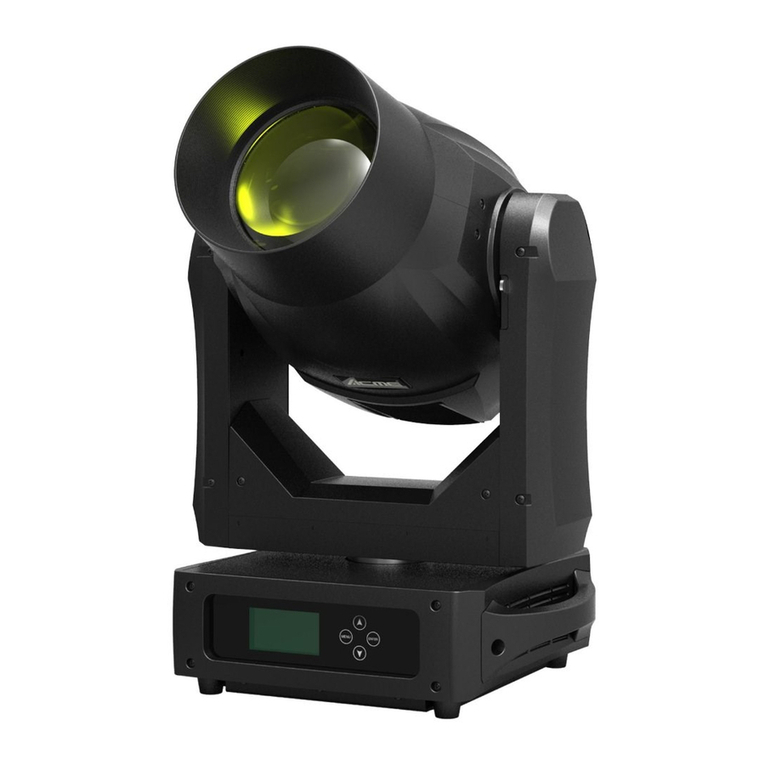
yLED BEAM 300 that creates extremely powerful beam
yThree operation modes: DMX, Master/Slave, Sound Active
yDMX channels: 15/16
yRotating Gobo wheel: 6 gobos + open
yColor Wheel: 7 colors + open
y3 facet rotating, indexable and replaceable prism
yAuto focus
yBeam angle: 4°
yOptional CA-8 easy controller or CA-9 RTX (wireless easy control kit) for instant lighting
shows
yLinear dimmer 0~100% and variable strobe
Voltage: 230V, 50Hz
Power consumption: 180W
For power supply, do not connect in series more than 2 units, use
another mains supply for the next units.
5-
Light source: 1×50W White LED
Dimension: 419.7 X 311 X 618.7 mm
ΦRotating gobo =19mm
Weight: 12.8 kg
3. How To Set The Unit
3.1 Control panel
Display
To show the various menus and the selected functions
LED
DMX On DMX input present
MASTER On Master Mode
SLAVE On Slave Mode
SOUND Flashing Sound activation
18-
GOBO:
17-
16 channel modes:
6-
Button
MENU To select the programming functions
DOWN To go backward in the selected functions
UP To go forward in the selected functions
ENTER To confirm the selected functions
Only for remote control
Connecting with CA-8/CA-9/CA-9RTX to control the unit for Stand by, Function and Mode
function.
Mains input
Connect to power supply.
Mains output
Connect to supply power for the next unit.
DMX input/output
For DMX512 link, use 3/5-pin XLR cable to link the unit together.
3.2 Main Function
To select any of the given functions, press the MENU button up to when the required one is
showing on the display. Select the function by ENTER button and the display will blink. Use
DOWN and UP button to change the mode. Once the required mode has been selected,
press the ENTER button to setup, to go back to the functions without any change press the
MENU button again. Hold and press the MENU button about one second or wait for one
minute to exit the menu mode.
The main functions are showing below:
7-
16-
15-
4.4 DMX 512 Configuration
15 channel modes:
8-
DMX Address
Select DMX Address, press ENTER button to confirm, the present address will blink on the
display. Use UP and DOWN button to adjust the address from 1to 512. Once the address
has been selected, press the ENTER button to setup, to go back to the functions without any
change press the MENU button again. Hold and press the MENU button about one second
or wait for one minute to exit the menu mode.
Channel Mode
Select Channel Mode, press ENTER button to confirm, present mode will blink on the
display. Use DOWN and UP button to select the 15 Chan (15 Channel Mode) or 16 Chan
(16 Channel Mode) mode. Once the mode has been selected, press the ENTER button to
setup, to go back to the functions without any change press the MENU button again. Hold
and press the MENU button about one second or wait for one minute to exit the menu mode.
Show Mode
Select Show Mode, press ENTER button to confirm, present mode will blink on the display.
Use DOWN and UP button to select the Show 1 or Show 2 or Show 3 or Show 4 mode.
Once the mode has been selected, press the ENTER button to setup, to go back to the
functions without any change press the MENU button again. Hold and press the MENU
button about one second or wait for one minute to exit the menu mode.
Split Color Mode
Select Split Color Mode, press ENTER button to confirm, present mode will blink on the
display. Use DOWN and UP button to select the Yes (Split Color mode) or No (normal)
mode. Once the mode has been selected, press the ENTER button to setup, to go back to
the functions without any change press the MENU button again. Hold and press the MENU
button about one second or wait for one minute to exit the menu mode.
Slave Mode
Select Slave Mode, press ENTER button to confirm, present mode will blink on the display.
Use DOWN and UP button to select the Slave 1 (normal) or Slave 2 (2 light show) mode.
Once the mode has been selected, press the ENTER button to setup, to go back to the
functions without any change press the MENU button again. Hold and press the MENU
button about one second or wait for one minute to exit the menu mode.
9-
Black Out
Select Slave Mode, press ENTER button to confirm, present mode will blink on the display.
Use DOWN and UP button to select the Yes (yes blackout) or No (no blackout) mode. Once
the mode has been selected, press the ENTER button to setup, to go back to the functions
without any change press the MENU button again. Hold and press the MENU button about
one second or wait for one minute to exit the menu mode.
Sound State
Select Sound State, press ENTER button to confirm, present mode will blink on the display.
Use DOWN and UP button to select the On (sound on) or Off (sound off) mode. Once the
mode has been selected, press the ENTER button to setup, to go back to the functions
without any change press the MENU button again. Hold and press the MENU button about
one second or wait for one minute to exit the menu mode.
Sound Sense
Select Sound Sense, press ENTER button to confirm, present mode will blink on the display.
Use DOWN and UP button to select the 0…100 mode. Once the mode has been selected,
press the ENTER button to setup, to go back to the functions without any change press the
MENU button again. Hold and press the MENU button about one second or wait for one
minute to exit the menu mode.
Pan Inverse
Select Pan Inverse, press ENTER button to confirm, present mode will blink on the display.
Use DOWN and UP button to select the Yes (pan inversion) or No (normal) mode. Once the
mode has been selected, press the ENTER button to setup, to go back to the functions
without any change press the MENU button again. Hold and press the MENU button about
one second or wait for one minute to exit the menu mode.
Tilt Inverse
Select Pan Inverse, press ENTER button to confirm, present mode will blink on the display.
Use DOWN and UP button to select the Yes (tilt inversion) or No(normal) mode. Once the
mode has been selected, press the ENTER button to setup, to go back to the functions
without any change press the MENU button again. Hold and press the MENU button about
one second or wait for one minute to exit the menu mode.
14-
4.2 Easy Controller
The easy remote control is used only in master/slave mode. By connecting to the 1/4”
microphone jack of the first unit, you will find that the remote controller on the first unit will
control all the other units in Stand by, and Mode selection.
Stand By Blackout the unit
Function 1. Sync. Strobe
2. Async strobe
3. Sound Strobe
Show
1-4
1. Press to select color
2. Hold to select gobo
Mode Sound (LED OFF) Show (LED
Slow Blinking)
LED ON
4.3 DMX Controller
By using a universal DMX controller to control the units, you will need to set DMX address
from 1 to 512 so that the units can receive DMX signal.
Press the MENU button up to when the DMX Address is showing on the display. Pressing
ENTER button and the display will blink. Use DOWN and UP button to change the DMX512
address. Once the address has been selected, press the ENTER button to setup, to go back
to the functions without any change press the MENU button again. Hold and press the
MENU button about one second or wait for one minute to exit the menu mode.
Please refer to the following diagram to address your DMX512 channel for the first 4 units:
Channel mode Unit 1
Address
Unit 2
Address
Unit 3
Address
Unit 4
Address
15channels 1 16 31 46
16channels 1 17 33 49