CLEARPOINT S040 - M032
8
english
Installation
CLEARPOINT® lters undergo stringent quality control
procedures in the manufacturing plant and are handed
over to the forwarding agent in a perfect condition. Upon
arrival of the goods, please check for any visible damage
and, where appropriate, insist on a corresponding note
on the delivery receipt. Get in touch immediately with the
forwarding agent and arrange for an assessment of the
damage. The manufacturer is not responsible for any
damage caused during transport.
Positioning:
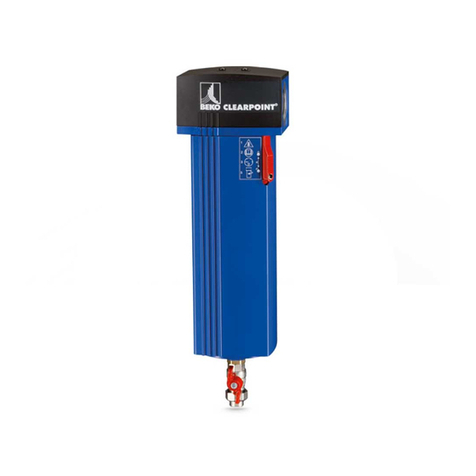
The housing should be mounted in a vertical position.
Observe the direction of ow which is indicated by an
arrow on the housing.
If the pipe network is aected by vibration, it is recom-
mended to install vibration dampers.
For replacing the lter elements it is necessary to leave
a handling space of 850 mm above the blank ange
(see page 19).
Installation:
The bottom of the lter is double-threaded. It must
therefore be ensured that the bottom is not installed with
the slide facing backwards. For correct installation, the
closed slide should face to the front.
For better lter eciency, it is recommended to install
the device at a preferably cool, but frost-protected point
along the pipe network.
The separation rates and service lives require ltration
using a prelter which is one grade coarser at each level
(exception: coarse lters C series).
The tubing in front of the lter must be clean.
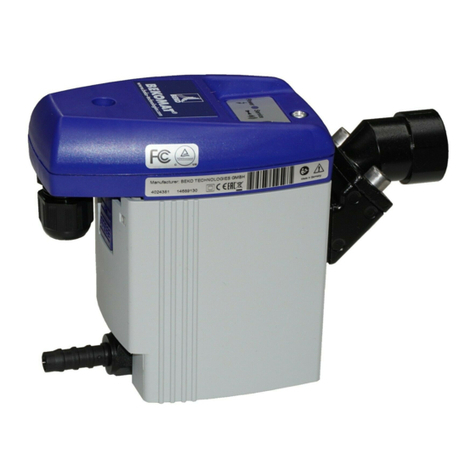
In the case of CLEARPOINT®models supplied with a
BEKOMAT®®condensate drain as a standard, please
observe the instructions in the corresponding documen-
tation. The BEKOMAT®®must be installed using in the
connection set (see page 20).
As far as the version using a oat drain is concerned,
please follow the advice regarding the commen-ce-
ment of operation on page 20.
The condensate must be disposed of in compliance with
the valid legal regulations.
Condensate treatment using an ÖWAMAT®oil-water
separator or a BEKOSPLIT®emulsion splitting plant
represents a particularly economic solution.
Function
Filter C, F, S and R(x)
Solid particles are separated by impact and inertia ef-
fect, oil and water aerosols by coalescence eect. Due
to gravity, ltered out liquid particles gather in the lower
part of the lter housing from where they are discharged
either manually or automatically. With coalescence lters
the direction of ow through the lter element is from the
inside to the outside; with dust lters the ow moves from
outside to the inside.
Activated carbon lter A
The ow through the activated carbon bed proceeds
from the inside to the outside. Oil vapours and odours
are adsorbed on the activated carbon. The carbon is
incorporated into a binding fabric which ensures the
reliable retention of dust particles.
Economic efciency of lters
Surface and depth lters
series C, F, S and R(x)
In the course of time, particles accumulate in the ltration
medium and reduce the space available for ow. Conse-
quently, the ow resistance will gradually increase, which
is indicated on the dierential pressure gauge.
It is recommended to replace the lter elements at a
dierential pressure of 0.4 bar or at least once a year,
whichever comes rst. If the element replacement is
delayed any longer, the economic eciency will suer
since the higher dierential pressure has to be com-
pensated by the upstream compressor. This will push
up the electricity consumption and lead to greater wear
on the compressor.
Activated carbon lter, series A
In order to prolong the service life of the elements, the
residual moisture of the inowing gas should not exceed
80 %. The capacity of the elements will be exhausted
after 6 months at the latest so that the element should
then be replaced.
The nominal diameters of the pipes should be as uni-
form as possible in order to avoid creating additional
ow resistance. Reduced pipe sections should only be
installed where required for the partial-ow outlets (ring,
connecting or supply lines).