EN - 8 SE-1000
NOTES
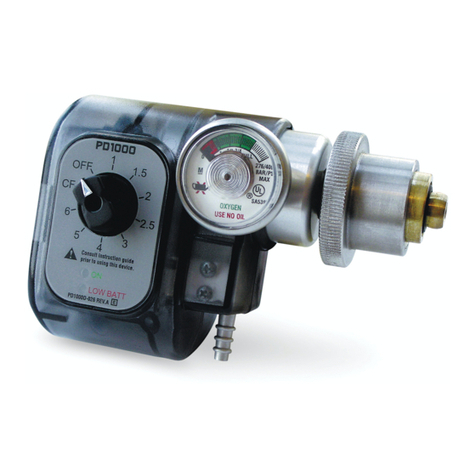
• When this rotary selector is set to “OFF,” the unit is not using battery power and will not pulse. When the
selector is set to one of the numbers, the unit is on and awaiting inspiration through the nasal cannula at
which time it will dose on every breath. The volume of the oxygen delivered varies according to which
prescriptionowsettingischosen.Thenalsettingontherotaryswitchis“CF”;thisisthecontinuous
owposition.Inthispositionoxygenwillowfromthecannulattingatthedefaultcontinuousowrate.
• Continuousowmodeisnotpoweredbythebatteriesandcanbeusedregardlessofthebatterylevel.
In the event of a device failure or dead batteries, the user must manually switch the unit to continuous
owfordeliveryofoxygen.Thedevicewillnotautomaticallyswitchtocontinuousow.Theoxygen
cylinderwillnotlastaslongincontinuousowmodeasitwouldinPulseDosemode.Unlessthereisa
problem with the unit, such as dead batteries, the unit should be used in PulseDose mode.
• WhenoperatedwithinthespeciedOperatingTemperatureRange,thereisno“warmup”period
required.ShouldthedevicebeoutsidethespeciedOperatingTemperatureRange,allowtheunitto
stabilize within the Operating Temperature Range prior to use.
• AmaskshouldnotbeusedinthePulseDosedeliverymodeasitmaynotttothefacewellenoughto
allow the conserving device to sense inhalation efforts. Also, the therapeutic effect of PulseDose would
not be realized, as the dose of oxygen would be diluted in the mask prior to inhalation.
• Apediatricorlow-owcannulashouldnotbeusedinPulseDosedeliverymode.Thereduceddiameter
of the cannula causes too much back pressure and will affect the oxygen volume delivered.
• PulseDose delivers oxygen in a very short “puff.” It does not deliver oxygen during the entire inhalation.
The length of time that PulseDose delivers oxygen will not vary from breath to breath. The time is set in
correlation to the oxygen dosage set on the conserving device (patient’s prescription setting).
• PulseDose is designed to prevent the delivery of pulses more than every 1 1/2 seconds. If the breath
rate is greater than 40 BPM, this feature prevents delivery of excessive oxygen by not dosing on every
breath.
• IfusingNiMHbatteries,carefullymonitorwhenthelowbatteryindicatorashesred.Itisrecommended
that a spare fully-charged set of alkaline batteries be kept in reserve and installed when the change
battery indicator is constant red.
• Always follow the Use and Care instructions supplied with the batteries being used. Batteries should be
removed when the device will not be used for a week or more.
• The PD1000 series is Latex free. Review the individual material lists for the tubing and cannula used in
conjunction with the DeVilbiss products.
TYPICAL QUESTIONS AND ANSWERS
Q. How does PulseDose work? How does it know when I’m inhaling?
A. When inhaling, your diaphragm moves down and causes a drop in pressure in the lungs. Air flows in
through the nose and mouth to equalize the pressure. This negative pressure is also present at the nose
and mouth during inhalation. This pressure signal travels through the nasal cannula to a pressure sensor
in the PulseDose conserving device. An electronic circuit then opens an electrical valve to deliver a
precisely metered dose of oxygen. When the valve is closed, the sensor is ready to detect the next
inhalation.
Q. The pulse seems so short. Am I really getting enough oxygen?
A. Yes. PulseDose delivers an internally controlled precise burst of oxygen at a relatively high flow rate at
the leading edge of each inhalation. This assures that the oxygen delivered flows deep into the lungs for
maximum benefit. PulseDose requires less oxygen to deliver the same therapeutic benefit as continuous
flow oxygen delivery.
Q. I can’t hear the pulse. Is PulseDose working?
A. If the pulse can’t be heard, simply look at the green PulseDose indicator to see that the device is being
triggered by inhalation. For further assurance, hold the end of the cannula in front of your lips while
inhaling through your mouth and feel the pulse. PulseDose does not monitor the supply of oxygen.