_______________________________________________________________________________________________________________________________
European Safety Systems Ltd. Impress House, Mansell Road, Acton, London W3 7QH www.e2s.com Tel: +44 (0)208 743 8880
Document No. D204-00-001-IS Issue 7 16-12-2022 Sheet 2 of 6
EMC: Class A & B (all locations including open
decks and bridge)
Enclosure: Class A, B & C – IP56 (all locations except
submerged applications and bilges)
3) Type Approval Standards
The beacon carries an EC Type Examination Certificate and
IECEx Certificate of Conformity, and have been certified to
comply with the following standards:
EN60079-0:2012+A11:2013 / IEC60079-0:2011 (Ed 6):
Explosive Atmospheres - Equipment. General requirements
EN60079-1:2014 / IEC60079-1:2014 (Ed 7):
Explosive Atmospheres - Equipment protection by flameproof
enclosures "d"
4) Installation Requirements
The beacon must only be installed by suitably qualified
personnel in accordance with the latest issues of the relevant
standards:
EN60079-14 / IEC60079-14: Explosive atmospheres -
Electrical installations design, selection and erection
EN60079-10-1 / IEC60079-10-1: Explosive atmospheres -
Classification of areas. Explosive gas atmospheres
The installation of the beacon must also be in accordance
with any local codes that may apply and should only be
carried out by a competent electrical engineer who has the
necessary training.
The equipment must not be installed with any obstruction to
the flanged flameproof joint any closer than permitted as per
EN/IEC60079-14, table 13.
5) Special Conditions of Use
On completion of the installation the flameproof joint surfaces
should be inspected to ensure that they are clean and that
they have not been damaged during installation. Flameproof
joints are not permitted to be repaired.
When fitting the flameproof cover ensure the cover is sitting
flat and correctly positioned on the base. Insert the M6 x 40
cover bolts and fully tighten down (tightening torque 8.8Nm),
ensuring no gap is visible between the cover and base of the
enclosure.
The metallic enclosure has a non-conductive coating. These
may generate an ignition-capable level of electrostatic
charges under certain extreme conditions. The user should
ensure that the equipment is not installed in a location where
it may be subjected to external conditions that might cause a
build-up of electrostatic charges on non-conducting surfaces.
Additionally, cleaning of the equipment should be done only
with a damp cloth.
The M12 Cap fitted to the top side of the unit is not a user
serviceable part and must not be removed during installation
and maintenance.
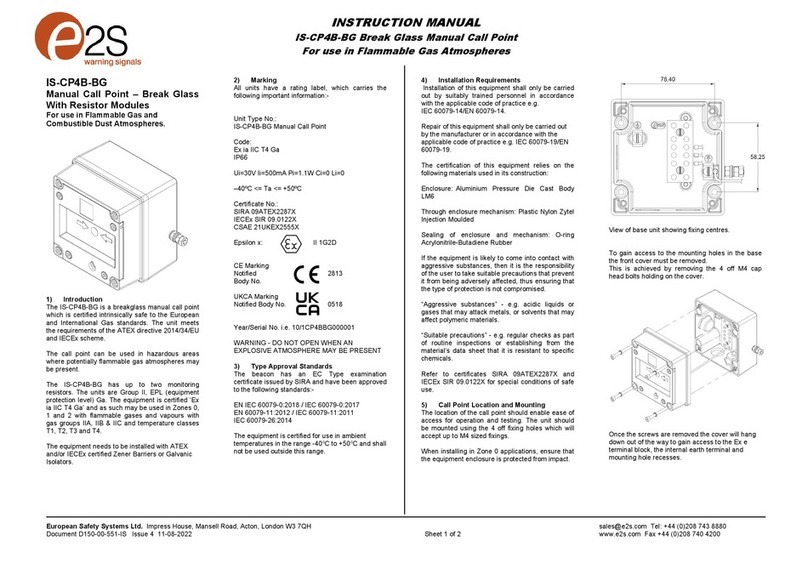
6) Location and Mounting
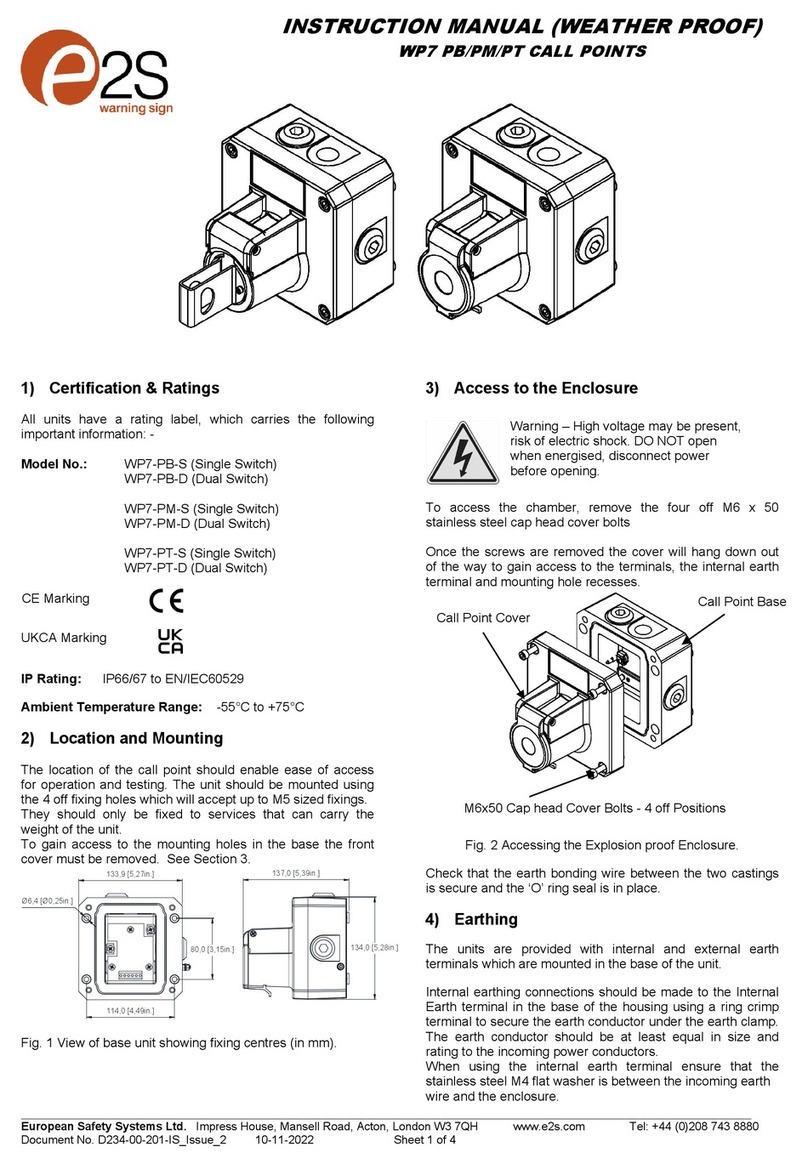
The location of the call point should enable ease of access
for operation and testing. The unit should be mounted using
the 4 off fixing holes which will accept up to M5 sized fixings.
They should only be fixed to services that can carry the
weight of the unit.
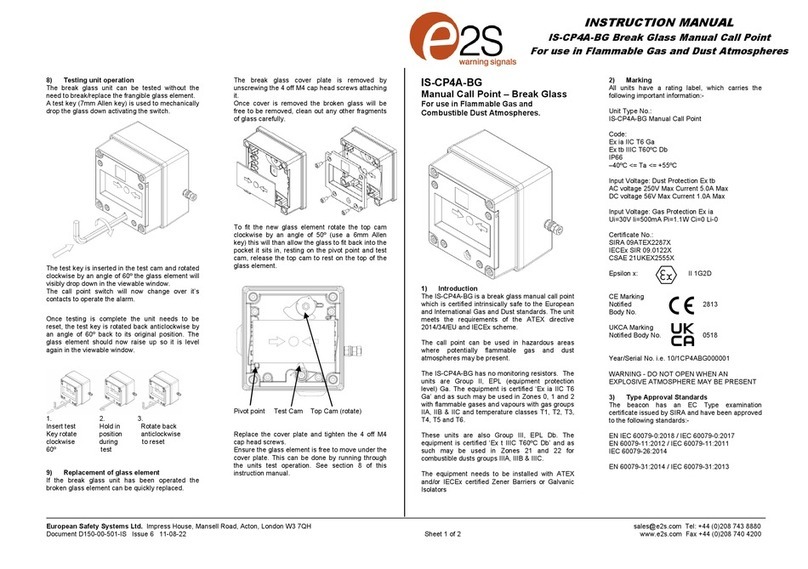
To gain access to the mounting holes in the base the front
cover must be removed. See Section 7.
Fig. 1 View of base unit showing fixing centres (in mm).
7) Access to the Flameproof Enclosure
To access the Ex d chamber, remove the four off M6 x 40
hexagon socket head screws and withdraw the flameproof
cover taking extreme care not to damage the flameproof
faces in the process. M6 cover screws are Class A4-70
stainless steel and only screws of this category can be used
for the enclosure.
On completion of the installation, the flameproof joints should
be inspected to ensure that they are clean and that they have
not been damaged during installation.
Once the screws are removed the cover will hang down out
of the way to gain access to the terminals, the internal earth
terminal and mounting hole recesses.
Warning – Hot surfaces. External
surfaces and internal components may
be hot after operation, take care when
handling the equipment.
Warning – High voltage may be
present, risk of electric shock. DO NOT
open when energised, disconnect
power before opening.