10 11
OperatOr, safety, and general maintenance manual:
giO electric bicycles, scOOter type e-bikes and 3 wheeler
cancelled manually.
Battery level Indicator: The LCD, LED, or analog meter
that indicates the battery power level is located either on
the handlebar or gauge cluster, usually on the right side.
The LCD type models indicate in the form of bars, and 3
bars would indicate a full charge. When the LED lights
are all on in the green, yellow, and red areas it indicates
a full charge, and the analog meter indicates in a similar
way. As the battery power is consumed the LCD bars or
green and yellow lights will systematically start flickering
and will eventually go out, indicating in the red area only,
or showing 1 bar or less. This indicates a low charge level
remaining and that it is time for a recharge. Once the
controller detects that the battery power level is too low,
power to the motor may also be automatically cut off, and
this will occur without warning. The motor may continue to
work intermittently in this mode, but it will eventually stop
completely until the battery is recharged. During this time
it is not recommended to continue to operate the throttle
as equipment damage may occur.
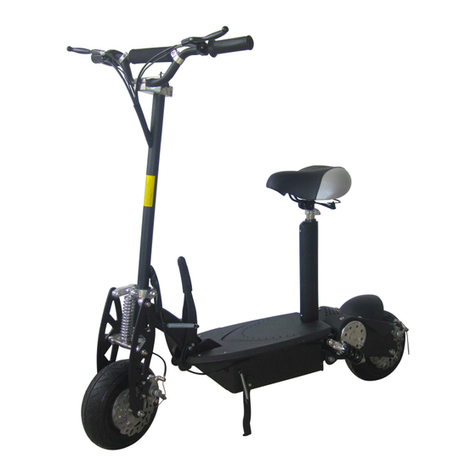
a) Basic electric bicycles have 1 kickstand, and scooter
type e-bikes usually have 2. A side-stand and a centre
stand. Either one can be used, but extra care should be
taken on soft or uneven ground, or when using the side
stand. It may easily retract in heavy wind or if the vehicle
is bumped and may allow the bike to fall over. The safest
method is to always use the centre stand. It is stronger and
more stable.
Foot-pegs: Some models have retractable rear foot-
pegs. They are generally intended for rear passengers
and are designed to fold in for safety if bumped or when
not being used. Simply push the button to deploy, or push
them back in to stow.
a) In rough terrain, during heavy loading, or in the kind
of traffic where you frequently start and stop, the battery
level may lower quickly, but it should increase again as you
continue riding.
It is not recommended to use the throttle when the
charging light is lit. Turning the key switch on and off
during this time may damage the battery.
For maximum mileage range, we suggest operating the
electric bicycle in a low power mode.
In combination with the motor, we recommend pedaling
from a standing start and when going uphill.
When riding downhill you should release the throttle.
Whenever parking a 3-wheeled mobility vehicle, please
use the parking brake.
Do not ride an electric bicycle without reading this
manual first!
Do not lend your electric bicycle to people who are
unfamiliar with them.
Please observe all your local traffic laws and other
general social courtesies. Especially when approaching
others from behind.
Never ride without proper brakes, and be especially
careful in slippery or wet conditions. Always watch the
road ahead of you, and be ready to brake early, steadily,
and safely to avoid brake lockup. Please use the parking
brake whenever parking a 3-wheeled mobility vehicle.
Always wear a well fitted helmet of the correct rating,
and never without the strap properly secured.
Leather gloves and high-visibility protective clothing are
always recommended when riding.
Whenever passing parked vehicles it is best to allow 4’
incase someone opens a car door.
Always turn lights on when riding at night or in low
visibility conditions. Some models work automatically
when necessary.
Be extra careful on rough roads as strong vibrations can
damage the tires, wheels, or electronics.
Many e-bikes come with a locking rear hub. It may have
a green flap to keep water and dirt out. To lock the rear
wheel hub, simply insert the key and rotate it 360 degrees.
To unlock, reverse this procedure. There are also key locks
for the main power key switch, seat, rear storage box, and
auxiliary wheel lock. It is a good idea to use them.
Some electric bicycles have an alarm system. If so, this
will be activated by the master power key switch (check
with dealer) or a key fob remote. Push the locked button
to enable, the unlocked button to disable. It will also chirp
to let you know whenever the main power key switch is
turned on or off.
a) Wheels, tires, and brakes.b) Key switch and handle-
grips. If loose or not working, replace immediately.c) Motor
should be clean and dry. Clean with a damp rag. Avoid
using a power washer or garden hose.
To protect tires and wheels avoid driving through
obstacles or on rough roads.
Pedal when climbing for long distances or steep
inclines.
Park the bicycle smoothly.
To avoid inadvertently applying power when parking,
always shut off the emergency kill switch as soon as you
stop to get off the bike, and before you release the brakes
or deploy the kickstand.
Try to always use the centre stand.
d) Avoid parking the electric bicycle in, or exposing the
battery to the hot sun for long periods of time.
To protect the paint, always take care when pulling
into bike stands, or when securing any bicycle locks, and
always avoid parking the electric bicycle in moist or high
temperature conditions.
Please use the parking brake when parking a 3-wheeled
mobility vehicle.
: Always dispose of old batteries
through an approved battery recycler, and keep children
and pets away from batteries. Do not break or burn
the battery. The battery acid or lithium-ion substrates
contained inside are highly corrosive and flammable and
may cause severe injuries or explosion. If this should
occur, rinse with plenty of water and call emergency
services immediately.
7.1 Charger
Both our lithium-ion and lead-acid-gel batteries as well as
their respective chargers are purpose built for GIO electric
bicycles, and are not interchangeable. Use of any other
chargers may result in serious damage to all components.
The polarity, as well as the input and output voltages of the
charger supplied with your bike at the point of the original
sale is of the correct rating and type, and this information
should be located on a label on the bottom of the charger.
They are CE certified (UL and CSA pending)
How to use the charger correctly:
NOTE: Unless the riding distance was very short, it is
generally advisable to fully recharge the battery after
each ride. This will insure the longest possible battery
life, because if the battery is left in a low state of charge
for long periods of time the battery life will be diminished.
Please use only the correct charger supplied, and only
according to the following directions.
Charging the battery on the bike
After making sure that the master power key switch is off,
connect the output plug from the charger to the charging
receptacle on the bike. Many (but not all) models have
an indicator light on the charger that should turn green
when plugged in to the bike. Then plug the charger into
the correct voltage power outlet and the light should turn
red which would indicate that it is charging. It is normal
for the charger to get warm, and always be sure it is well
ventilated, unobstructed and kept dry at all times. More in
Chapters 7.2 c), and 7.4 a), and b).
Certain models have charge-level indicator lights
in addition to the ones on the charger. The GIO electric
bicycle usually has them near the right handle-grip, and
some lithium-ion scooter type e-bikes may also have
another meter in the battery compartment under the seat.
More in Section 10.4 a).
Both types indicate as follows:
A- Red: The battery needs or is charging
B- Orange: The battery is partially charged
C-Green: The battery is fully charged and in maintenance
mode
Charging the battery off the bike
Unlock the battery and remove it from the bike. Then
follow instructions 7.2 a), and c).
Lithium-ion bikes have 2 battery packs. So they
would have to be charged in pairs.
Disconnecting the charger
Depending on how discharged the battery is, it may take
several (2-6, but not more than 12) hours to achieve a
full charge. At this point the charging indicator light will
turn green and the charger should be disconnected. First
remove the plug from the local power source and then
disconnect it from the bike.
When charging a battery separate from the bicycle,
always place the battery on a cool, flat surface. Concrete
floors are not recommended for lengthy periods, and never
place the battery on its side or upside down. Also, never
put anything on top of the charger when charging and keep
it dry at all times.
Avoid dropping the battery or charger.
Never allow children to insert objects into the charger or
plugs. There are high voltages inside.
Please keep charger out of reach of children.
Never submerse the charger in liquids, or expose
them directly to rain.7.4 Important notes:a) Use only the
appropriate lead-acid-gel or lithium-ion type battery
charger supplied. Other chargers are likely to cause
significant damage to the equipment or serious injury to
you.
When both ends of the charger are plugged in (and
the battery is charging) the indicator light on the charger
will turn red. It is designed to turn green once the battery
is fully charged. If it does not do so after 12 hours, it is
likely some problem has developed. To avoid overcharging
or other damage, immediately unplug the charger and
contact your local dealer.
The battery management charger has a high-tech CPU
chip which automatically optimizes the battery life. It
constantly monitors and precisely adjusts the battery state
of charge by modulating the voltage.