5
Important safety information
• Our products in compliance with EN 179 and EN 1125 guarantee a very high quality and safety
standard. In order to ensure that this high standard is maintained, the doors must remain in faultless
condition during and after assembly. The door must be tested for correct, smooth, and unimpeded
opening and may not show any signs of warpage.
• With the use of profile seals and door seals, it must be ensured that they do not impair the use of the
door as intended and/or the proper function of the panic door lock.
• Before the panic door lock is installed on a fire-proof or smoke protection door, it should be
determined whether the panic door lock is suitable for this special door.
• Fasteners differing from those included in the scope of supply may be necessary for fastening a panic
lock on various types of doors. In the process, a permanent and solid fixing means should be chosen by
the installer according to the requirements.
• Panic door locks are not suitable for use on swing doors unless they have been specially designed by the
manufacturer for this purpose.
• Panic door locks should normally be installed at a height of 900 mm to 1100 mm above the surface of
the finished floor with the door closed. If the majority of the door users are small children, a lowering
of the actuation bar height should be taken into consideration.
• If a door closer is installed, it should be ensured that the actuation of the door is not rendered
unnecessarily difficult for children or physically impaired and elderly persons.
• The lock with striking plate should be fastened such that secure engagement is assured. It should be
ensured that protrusion in the engaged position of the latch and bolt does not prevent the door from
moving freely.
• The provided striking plates should be installed as indicated in the manual such that conformity with
the tested standard element is assured.
A plate with the inscription ‚Turn the handle to open‘ (EN 179), or a pictogram
should be affixed on the inside of the door, directly above the fitting or on the fitting
itself, if it has a sufficiently large and level surface for the necessary inscription.
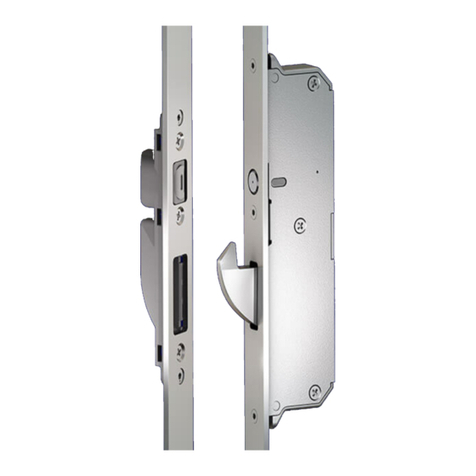
The bolt of the lock must always be able to engage in the striking plate freely and
without friction, even if pressure is exerted on the door. Fasten the striking plate
in the frame. The contour of the striking plate must be adapted to the door situa-
tion as necessary. (see the contour for the striking plate recess)