SPECTRO-UV600 SERIES User’s Guide
SPECTRO-UV600 Overview
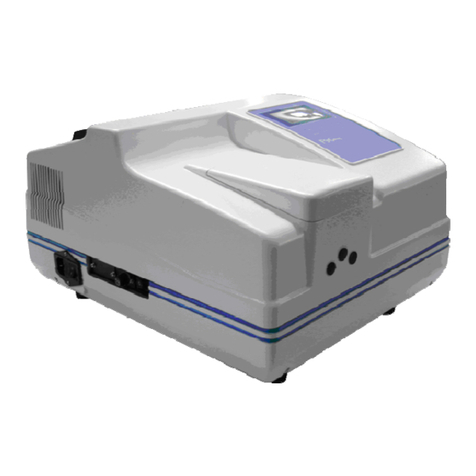
SPECTRO-UV600 series is a double-beam UV-VIS spectrophotometer developped by
us and consists of three models (SPECTRO-UV690/UV670/UV650). SPECTRO-UV600
which performs qualitative, quantitative or structral analysis of material according to
the selected absorption of the light within a certain wavelength range by the
molecule or ion of the material, is mainly used in pharmacy, medical health,
chemistry, environmental protection, geology and teaching.
Main features:
Double-beam UV-VIS spectrophotometer. Through the reference light path, the
influence of light source fluctuation can be effectively reduced.
Use deuterium lamp and tungsten lamp as light source to provide 190nm to
900nm wavelength. The lamp interchange is realized through the rotation of the
condenser lens driven by the step motor.
Set the lamp interchange wavelength via the Ultra UV software and the range is
from 320nm to 380nm.
SPECTRO-UV690 and SPECTRO-UV670 provide 6 bandwidth options
(0.1nm/0.2nm/0.5nm/1nm/2nm/4nm) for your various measurement
requirements.
SPECTRO-UV690 is configured with double monochromators to effectively
reduce the stray light.
Use plane diffraction grating with high resolution as the monochromator grating.
The main monochromator of SPECTRO-UV690 is driven by the lead screw
structure, thus providing high precision.
Use chopper mirror for light splitting. The sample light path and the reference
light path are all complete and the light energy is high. Driven by the motor, the
chopper mirror transmits the sample light beam and the reference light beam
into the sample compartment and receiving compartment separately, thus only
one receiver is required and the measurement error due to the difference in
receiver nature can be excluded.
Use cuvette with variable optical path lengths as the sample cell. Glass cuvette
and quartz cuvette are available.
Configured with single cell. You can purchase the 8-series cell (option) to
measure multiple samples in one measurement.
Use photomultiplier with high sensitivity as the reciever.
Low stray light to ensure the accuracy and effectiveness of the measurement.
Provide up to ±0.3nm wavelength accuracy and 0.1nm wavelength repeatability.