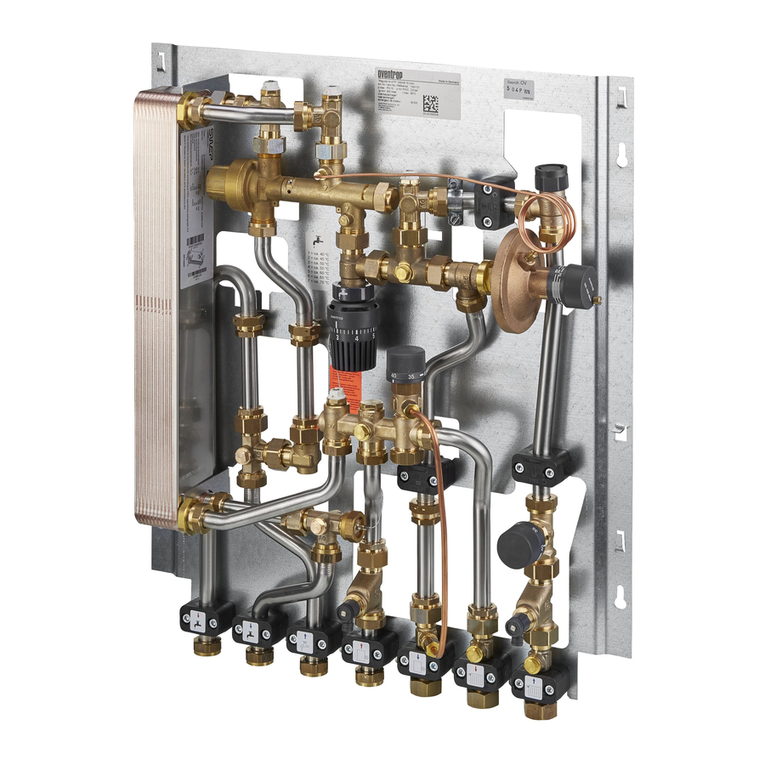
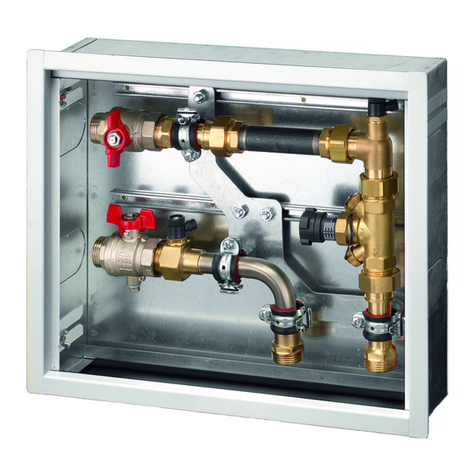
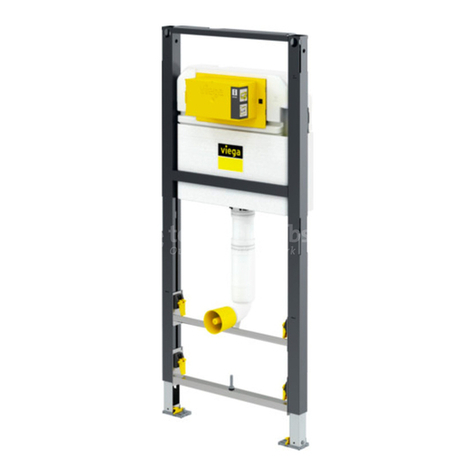
Regudis W-HTE
Safety-related information
• Maintenance
• Removal and disposal
Due to their professional training and experience as well
as knowledge of the relevant standards, specialist sanitary,
heating and air-conditioning tradespeople are able to carry
out work on heating, cooling and potable water
installations.They must be able to recognise possible
dangers independently.
Operator
The following work may be carried out by the operator:
• Operation of the product
The operator must be instructed in the operation of the
product by specialist tradespeople.
2.6.2 Danger to life due to electric current
Work on the power supply may only be carried out by a
specialist electrician. Opening the connection box is only
necessary for installing accessories.
!
Disconnect the station from the power supply at
all poles and secure it against being switched on
again.
!
Check that no voltage is present.
!
Only install the product in dry indoor areas.
2.6.3 Danger to life due to legionella
formation
!
Ensure the following:
• The temperature of the potable water in the cold
water pipe must not exceed 25 °C.
• The water in the potable water circuit must be
completely replaced after 72 hours at the latest.
• When using the potable water circulation module, the
hot water temperature must be at least 60 °C.The
temperature difference between the hot water outlet
of the heat exchanger and the return of the circulation
pipe at the station must not exceed 5°C.
Observe the relevant regulations (e.g. DVGW
worksheet W).
2.6.4 Risk of scalding due to hot water
Due to adjustment or defect of the actuator, the hot water
temperature at the draw-off points can rise up to the
heating water temperature in the buffer storage cylinder.
!
If there is a risk of scalding in accordance with
DIN EN 806 and DIN 1988 due to high heating
water temperature in the buffer storage cylinder,
you must install scald protection at all draw-off
points.
!
If the heating water temperature in the buffer
storage cylinder is low, resulting in a low hot
water temperature without risk of scalding
at the draw-off points,you must instruct the
system operator to ensure the low heating water
temperature in the buffer storage cylinder all year
round.
2.6.5 Risk of injury from pressurised
components
!
Only carry out work on the heating circuit or
the potable water circuit when the system is
depressurised.
!
Adhere to the permissible operating pressures
during operation.
!
Install a safety valve that cannot be shut off in
the potable water heating installation (regulation
according to DIN EN 806-2).
2.6.6 Risk of burns due to unintentionally
escaping hot media
!
Only carry out work on the heating circuit or
the potable water circuit when the system is
depressurised.
!
Allow the product to cool down before working
on it.
!
Check that the product is not leaking after work
is complete.
!
Wear safety goggles.
2.6.7 Risk of burns on hot components and
surfaces
!
Allow the product to cool down before working
on it.
!
Wear suitable protective clothing to avoid
unprotected contact with hot fittings and plant
components.
2.6.8 Risk of injury due to weight of the
product
!
Always wear safety shoes during installation.
2.6.9 Risk of injury from improper work
Stored energy, angular components, points and corners on
and in the product can cause injuries.
!
Ensure there is sufficient space before starting
work.
!
Handle open or hard-edged components with
care.
!
Keep the working area tidy and clean to avoid
sources of accidents.
2.6.10 Damage to property due to unsuitable
location
!
Do not install the product in rooms prone to
frost.
!
Do not install the product in rooms with
corrosion-enhancing ambient air.
!
Observe the notes on corrosion protection in the
appendix.
9134403082-V09.03.2022