3
Für folgende Fälle sind die Tabellen-
werte abzumindern bzw. zu erhöhen:
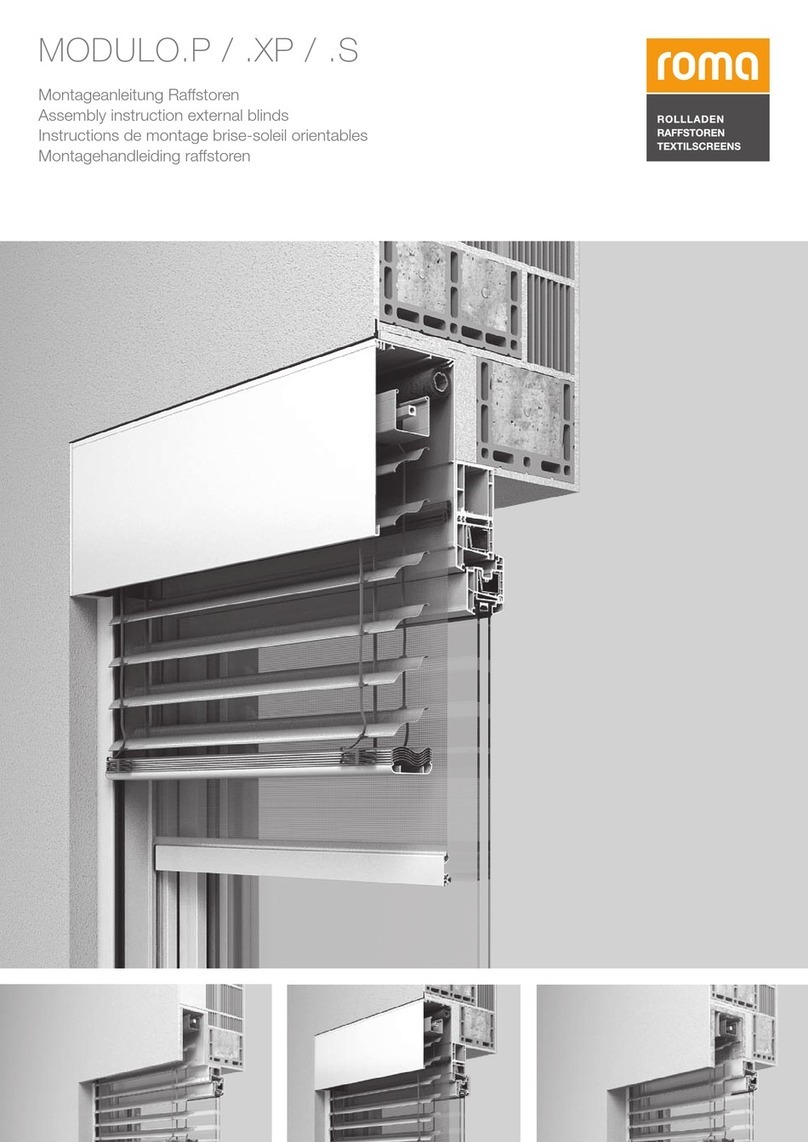
Für Raffstoren wird die Verwendung von
Windgrenzwerten je nach Produktart
empfohlen. Werden die Grenzwerte
erreicht, muss die Anlage eingefahren
werden. Die Werte der Tabelle gelten
für einen Fassadenabstand der Lamelle
bis ≤ 100 mm.
Bei größeren Breiten sind eine oder
mehrere zusätzliche Seilführungen
dringend erforderlich.
Achtung bei Schnee und Eis:
Das Benutzen bei Vereisungen der Anlage
bzw. bei vereisten Führungsschienen führt
zu einer Beschädigung der Anlage.
The values in the table must be
reduced or increased in the following
cases:
The use of wind limits according to
product type is recommended for external
venetian blinds. If the limits are reached,
the system must be raised. The values in
the table apply to a slat distance from the
façade ≤ 100 mm.
One or several additional cable guides
are absolutely essential for larger
widths.
Caution in case of snow and ice:
Using the installation when it is iced up or
when the guide rails are covered with ice
can lead to damage.
Les valeurs du tableau doivent être
revues à la baisse ou à la hausse dans
les cas suivants :
Les limites de charge au vent à utiliser pour
les brise-soleil dépendent du type de produit.
Une fois la limite de charge au vent atteinte,
le brise-soleil doit être remonté. Les valeurs
indiquées dans le tableau s’appliquent à une
distance ≤ à 100 mm.
Pour des largeurs plus grandes, un,
voire plusieurs guidages par câble
supplémentaires sont absolument
nécessaires.
Attention en cas de neige et de gel :
L’utilisation de l’installation en cas de gel ou
de givre, notamment lorsque les coulisses
sont gelées, conduit à l’endommagement de
l’installation.
In de volgende gevallen dienen de
tabelwaarden verlaagd resp. ver-
hoogd te worden:
Voor Raffstoren wordt de toepassing van
wind grenswaarden per product aanbe-
volen. Worden de grenswaarden bereikt
dan dient het systeem omhoog gedaan
te worden. De waarden in de tabel gelden
voor een afstand van gevel naar lamel
tot < 100 mm.
Bij grotere breedten zijn een of mee-
dere windzekeringen noodzakelijk.
Let op bij sneeuw en ijs:
het gebruik tijdens vorst leidt tot bescha-
diging van het systeem.
Windgrenzwerte
[DE] Allgemeines und Richtlinien [EN] General information and guidelines
[FR] Généralités et directives [NL] Algemeen en richtlijnen
ROMA CDL Windgrenzwerte in m/s
Breite (mm)
Höhe (mm) 1000 1500 2000 2500 3000 3500 4000 4500 5000
1000 22 22 20 20 20 20 20
1500 22 22 20 20 20 16 16
2000 22 22 20 20 20 16 16
2500 22 22 20 20 20 16 16
3000 22 22 20 20 20 16 16
3500 20 20 20 16 16 16 16
4000 20 20 20 16 16 16 16
4500 20 20 20 16 16 16 13
5000
Windwächterpositionierung
Grundlegend müssen die Windbela-
stungen von Raffstorenanlagen an jedem
Bauvorhaben individuell beurteilt werden.
Korrekturen von Windgrenzwerten am
Windwächter werden beispielsweise
aufgrund unterschiedlicher baulicher
Gegebenheiten oder der Lage des
Grundstücks nötig.
Wichtig ist, dass die gemessenen Werte
des Windwächters identisch mit den
Windwerten an der Anlage sind.
Es ist darauf zu achten, dass der
Windwächter:
• an der windbelastetsten Stelle und
ortsnah bei den betroffenen Raffstoren
montiert wird
• vollkommen frei und nicht im Wind-
schatten steht (fern von Satelitenschüs-
sel u.a.)
• mindestens 0,5 m von Dachoberkante
befestigt wird
• am besten an einem Dachvorsprung,
einer Dachkante oder ähnlichem
montiert wird
• keine Windverwirbelungen beispielswei-
se durch Pfosten oder Stangen misst
Ab bestimmten Elementbreiten
sind zusätzliche Seilführungen als
Windsicherung dringend erforderlich.
In jedem Fall sind bauliche Gegeben-
heiten und sonstige widrige Umstän-
de (wie z.B. windexponierte Lage,
Windseite etc.) zu berücksichtigen.
Wind monitor placement
The wind loads to which external venetian
blind systems are exposed must be
fundamentally assessed on an individual
basis for each installation site. Correc-
tions to wind limits defined by the wind
monitor may be required due to differing
structural conditions or the location of the
property.
It is particularly important that the values
measured by the wind monitor match the
actual wind values that the installation is
exposed to.
Please make sure that the wind monitor:
• is mounted in the place most exposed
to winds and close to the external
venetian blinds concerned
• is entirely unobstructed and not placed
on the leeward side (far from satellite
dish, etc.)
• is fastened at least 0.5 m from the
roof line
• is preferably mounted on a roof
projection, roof edge or similar
• does not measure any wind turbulence
that may be due to posts or poles, for
instance
From certain element widths
upwards, additional cable guides
are absolutely essential as wind
protection. In all cases, structural
conditions and other adverse circum-
stances (such as location exposed to
wind, windward side, etc.) must be
taken into account.
Positionnement du capteur de vent :
De manière générale, les résistances
au vent des brise-soleil doivent être
examinées au cas par cas, en fonction de
chaque construction.
Il est nécessaire de rectifier les valeurs
limites de vent du capteur en raison des
contraintes techniques de la construction
ou de la situation du terrain, par exemple.
L’important est que les valeurs mesurées
par le capteur de vent correspondent aux
valeurs de vent réelles.
Il convient de s’assurer que le capteur de
vent est
• posé à l’endroit le plus exposé au vent
et à proximité du brise-soleil
• totalement dégagé et pas abrité du
vent (mais éloigné d’une antenne
parabolique, par exemple),
• fixé au minimum à 0,5 m du haut du
toit
• monté de préférence au niveau de
l’avancée du toit, d’une arête de toit ou
équivalent
• et qu‘il ne mesure pas les tourbillons
du vent occasionnés par des poteaux
ou des mâts.
À partir de certaines largeurs
d’éléments, plusieurs guidages
par câble supplémentaires sont
absolument nécessaires pour une
meilleure protection contre le vent.
En tout état de cause, il convient
de tenir compte des contraintes
techniques de la construction et
autres circonstances défavorables
(comme par exemple endroits et
côtés exposés au vent, etc.)
Positionering van de windautomaat:
De windbelasting van de Raffstoren
dient per geval ter plaatse te worden
beoordeeld. Correcties van de wind
grenswaarden op de windmeter zijn
nodig, bijv. als gevolg van verschillende
fysieke voorwaarden of de locatie.
Het is belangrijk dat de gemeten waarden
van de windmeter overeenkomstig zijn
aan de windwaarden van het systeem.
Het is belangrijk om ervoor te zorgen dat
de windmeter:
• aan de met wind belaste zijde en in de
buurt van de Raffstoren gemonteerd
wordt
• volkomen vrij en niet in de windscha-
duw staat (ver van satelietschotel e.d.)
• ten minste 0,5 m vanaf de bovenrand
van het dak bevestigd wordt
• onder overstek, aan de dakrand of
soortgelijk gemonteerd wordt
• geen wind turbulentie, bijvoorbeeld
door palen e.d.
Vanaf bepaalde element-breedtes,
zijn extra staaldraden als windze-
kering noodzakelijk. In ieder geval
moet men letten op de bouwkundige
situatie en andere ongunstige
omstandigheden (zoals bv. windzijde,
locatie, bovenwindse zijde, enz.).