8
BEFORE STARTING THE UNIT
GENERAL LOCATION
Select a location that oers a solid, level surface
capable of supporting the system. A clean, dry,
heated equipment room with drainage is ideal.
Proximity to the water supply, electrical supply
and cleaning areas are also important. Security,
lighting and easy access for service should also be
considered.
Installation should be done by a licensed plumber.
Local codes may require the use of a backflow
preventer on the inlet supply line. If a backflow
preventer is in place, an SRA (surge relief assembly)
option may be required. When the trigger gun is
released there is a pressure spike between the unit
and the backflow preventer that may cause issues
with the hoses on the supply side of the system.
PORTABLE SYSTEMS / WHEEL KITS
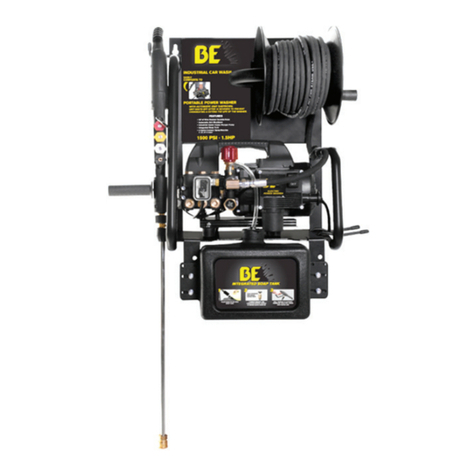
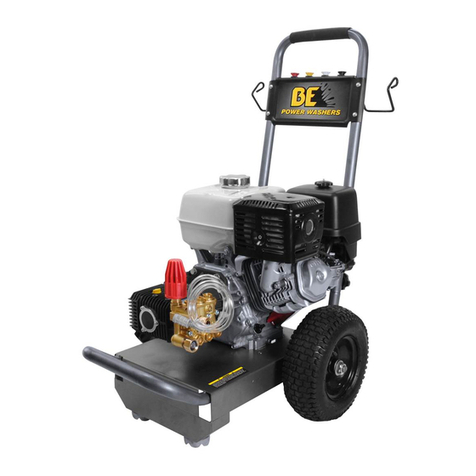
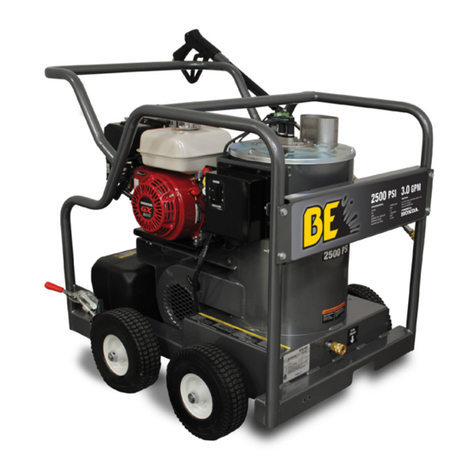
Before using portable systems or systems with
optional wheel kits (PCA and HD-PCA options),
be sure that the machine is on a level surface and
cannot move when in use. Larger portable systems
and wheel kits include locking swivel casters that
should be in the locked position prior to beginning
any cleaning operation.
Water Supply
The correct water supply is important to the life
of your pressure washer. Sediment, scale or other
debris, air, and insucient water volume or high
temperature can all cause expensive damage and
premature failure of the system. Your pressure
washer will require a clean, constant, cold water
supply equal to or greater than the rated discharge
volume of the system as specified at the front of
this manual. Changes in volume and pressure can
have a direct impact on one another and may cause
system interruption or failure.Select a water supply
that will be uninterrupted by other water consuming
devices. A minimum supply pressure of 30 PSI
should be maintained with the system operating at
full discharge flow. Consult the factory if the water
supply pressure exceeds 70 PSI. If warm or hot water
is to be used, the inlet requirements may change.
Consult the manufacturer for details. A shut o valve
should be fitted on the water supply, prior to the
system inlet, for ease of service to the system. Do
not use black iron pipe on the water supply. Rust and
scale can develop and can contaminate and damage
the pressure wash system.
New Water Supply Pipe
Before connecting the pressure washer to a new
water supply pipe, the piping must be flushed
thoroughly to remove any filings or debris that may
be present due to soldering or threading processes.
Testing the Water Supply
If the volume of a water supply is questionable,
a simple test may be conducted. Using an empty
container of equal volume to the discharge rate of
the pressure washer (GPM), place the discharge
end of the water supply hose into the container
and fill for one minute. A larger volume container
with a mark indicating the pre-measured level of
the discharge volume of the pump may also be
used. If the container cannot be filled in the one-
minute period, an alternate supply will have to be
considered.
Tank Feeding
With the high speed of most of today’s positive
displacement (high pressure) pumps, a proper
water supply is critical to the life expectancy of
the pump. While many pump manufacturers will
show a negative pressure value (NSPH) in their
pump specifications, the preference is to provide a
pressurized feed. Consult your dealer or the factory
if your application requires the system to be supplied
from a water supply tank or similar supply.
WARNING
This system must be protected from freezing at all times. Do not install the equipment in areas where it
may be exposed to temperatures below 0°C (32°F).