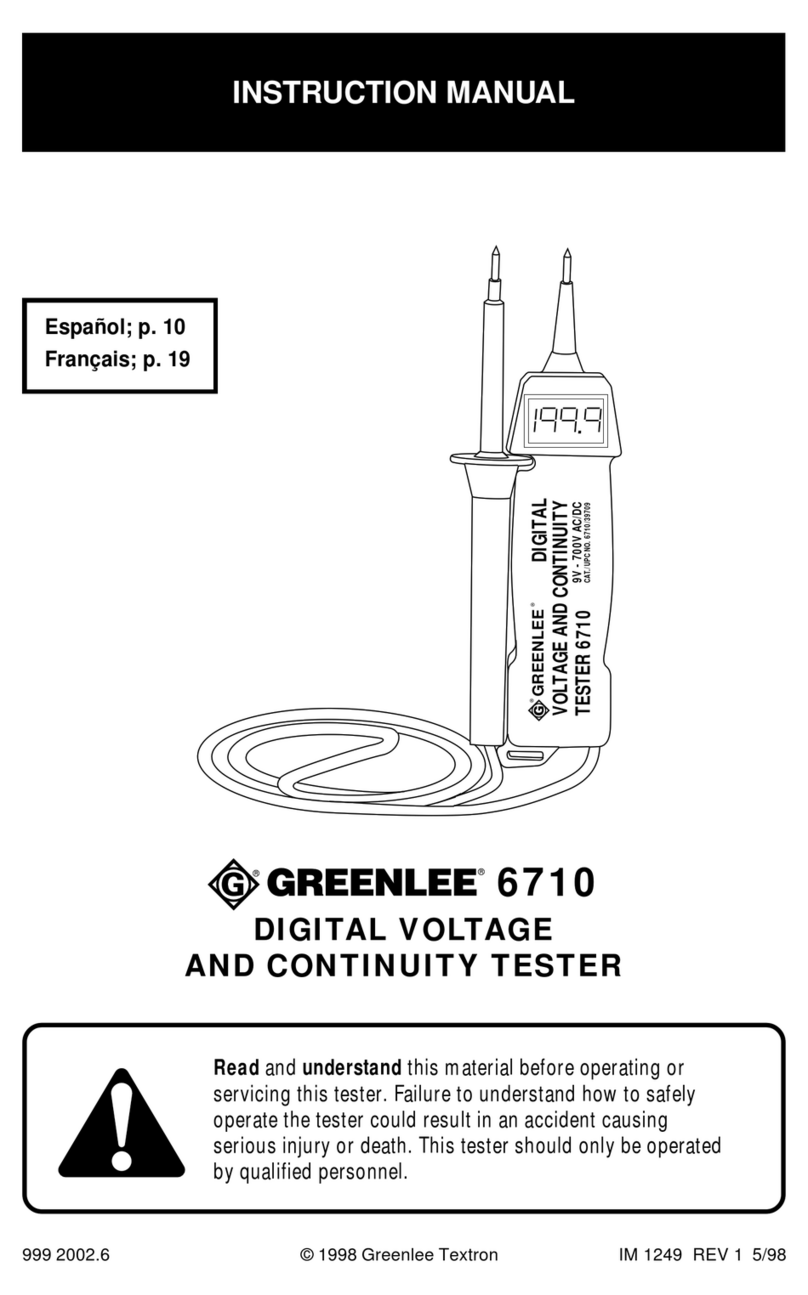
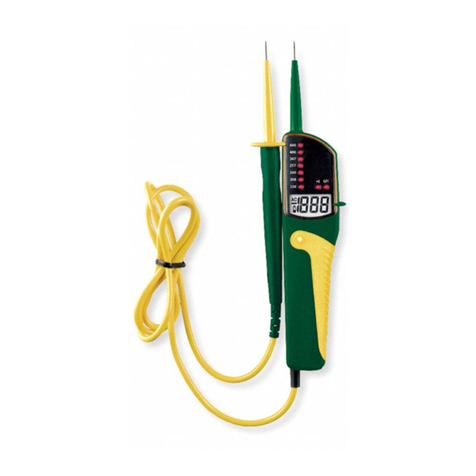
6711 Digital VoltageTester
6
WARNING
WARNING
CAUTION
OPERATION
PREPARATION FOR MEASUREMENT
• Visually examine the tester for external damage before each use.
• Do not use tester if wet or damaged.
Electric shock or damage to tester may result.
1. Check the tester for external damage caused by transport or improper use. Do not use tester if wet or
damaged.
2. Replace or repair tester if:
• The tester shows obvious damage.
• The tester does not carry out the desired measurements.
• The tester has been stored for too long under conditions in excess of those listed in the Specifications
section.
• The tester has a discharged or missing battery.
3. Check the Battery
Touch the test probes together. If no sound is audible, the batteries must be replaced. Follow the
Maintenance instructions for Battery Replacement.
Note: Voltage measurements do not require a battery. However, a good battery must be installed in the
tester to perform a Phase Test or a Continuity Check, or the function of the backlight.
Note: Always test on a known live circuit prior to use.
AC VOLTAGE MEASUREMENTS
• Contact with live circuits can cause serious injury or death.
• Do not touch probe ends while testing live circuits.
• Do not exceed rated voltages.
Electric shock or damage to tester may result.
• The tester has a built-in load, therefore, the operation and recovery time is specified as follows:
Voltage Range Operating Time Required Recovery Time
9 … 50V continuous use N/A
50 … 300 V approx. 10 minutes 10 minutes
300 … 700 V approx. 30 seconds 10 minutes
Please note that the recovery time depends on the ambient temperature.
1. Unsnap the Secondary Test Probe from the tester.
2. Touch both test probe tips to the circuit under test. The tester switches on automatically for voltages
greater than 15 to 20 VAC. The voltage and an “AC” will be displayed. The buzzer will sound. For accurate
measurements when measuring voltages less than 15 to 20 V, the “Voltage-Test” button must be pressed.
Note: In order to avoid tripping a GFCI when performing a voltage test between Line and Ground, first test
between Line and Neutral, then perform the Line to Ground measurement.
DANGER