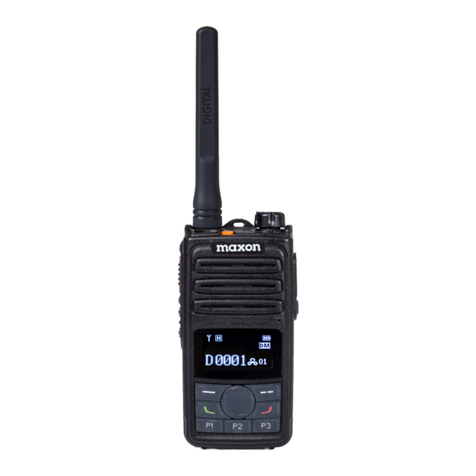
Maxon SP-310 User manual

Operating
Instructions
SP-300 Series
Synthesized Scanning Radio
(Models SP-310, SP-320, SP-330 & SP-340)

About Your SP-300 Series Radio
Maxon's SP-300 Series radios feature 4/16 channel operation with
superior performance and reliability. Operation and functions for
Maxon's SP-300 Series radios are described in this manual.
We urge you to thoroughly read this manual before operating the
radio.
Application of some of the functions described in this manual
is determined by the system you use. Your Maxon Dealer will
program your radio so that you have the greatest number of
functions possible relative to your needs.
Should you have questions regarding the operation of the radio,
please consult your Maxon Dealer.
About Maxon / Topaz3
Maxon is a world respected name in professional FM two-way radio
equipment operating in the UHF VHF and 800 MHz frequencies;
personal two-way communication devices, including the popular
FRS (Family Radio Service) and GMRS radios; and a variety of
wireless communication products(two-way voice messaging handsets,
Wireless Local Loop terminals, etc.)
Topaz3 is the exclusive supplier of Maxon products to North America.
For more specific product information, visit our website:
www.topaz3.com

Table of Contents
Safety Information.....................................................................
Unpacking Information............................................................
SP-300 Series Features.............................................................
Description of Radio Components.........................................
Antenna Installation..................................................................
Installing and Removing the Battery Pack............................
Attaching and Removing the Belt Clip..................................
Battery Charging and Care......................................................
SP-300 Series Operation.........................................................
Power On - Volume................................................................
Transmit..................................................................................
Receive....................................................................................
PowerOff................................................................................
Status Indicators and Audible Alert Tones...........................
Scan Modes..............................................................................
Normal Channel Scan..........................................................
Priority Channel Scan...........................................................
Other Scanning Features.........................................................
Look Back...............................................................................
Scan Channel Delete.............................................................
CTCSS/DCS Scanning...........................................................
Normal Scan TX.....................................................................
Priority Scan TX.....................................................................
Priority Only TX.....................................................................
Receive Only Scan................................................................
Licensing and Service Information.........................................
Recycling / Disposal of Batteries...............................................
Software Copyrights..................................................................
Maintenance..............................................................................
Warranty Statement.........................................
1
2
3
3
4
5
5
5
6
6
6
6
7
7
8
9
9
9
10
10
10
10
10
10
10
10
11
11
12
12
inside back cover

Safety Information
The Federal Communications Commission (FCC), with its action in
General Docket 93-62, November 7, 1997, has adopted a safety
standard for human exposure to Radio Frequency (RF) electromag-
netic energy emitted by FCC regulated equipment. Maxon subscribes
to the same safety standard for the use of its products. Proper operation
of this radio will result in user exposure far below the Occupational
Safety and Health Act (OSHA) and Federal Communications
Commission limits.
WARNING - DO NOT hold the radio in such a manner that the
antenna is next to, or touching, exposed parts of the
body, especially the face or eyes, while transmitting.
WARNING - DO NOT allow children to operate transmitter-
equipped radio equipment.
CAUTION - DO NOT operate the radio near unshielded electrical
blasting caps or in an explosive atmosphere unless it
is a type especially designed and qualified for such use.
CAUTION - DO NOT press and hold the transmit switch (P-T-T)
when not actually wishing to transmit.
NOTE: This radio operates in FCC regulated frequency bands. All
radios must be licensed by the FCC before use. Because this radio
contains a transmitter, Federal law prohibits unauthorized use or
adjustments of this radio.
2

Unpacking Information
Remove and carefully inspect the contents of your package(s) for the
following items:
Radio
Battery Pack
Antenna
Spring Belt Clip
Operating Instructions
If any items are missing, please contact your Dealer or Maxon.
SP-300 Series Features
•Wideband frequency separation
•1/5 Watts programmable output power
•Programmable 12.5/25 kHz channel spacing
•Channel scan
•Priority channel scan
•Look back channel
•CTCSS/DCS tone signalling
•Busy channel lockout
•Time-out timer
3

4
23
4
5
6
7
8
9
10
1
Description of Radio Components
Front view:
1) Antenna Receptacle
2) Channel Selector Knob
3) On/Off - Volume Control
4) Busy/TX/BT Indicator (top plate of radio)
5) Accessory Connector
6) Speaker
7) Microphone
8) Option Button
9) Monitor Button
10) Push-To-Talk (PTT) Button
Not shown
Belt Clip
Battery Latch
Battery
Battery Charge Contacts

Antenna Installation
Attach the antenna by turning clockwise into the antenna receptacle
on top of the radio.
Installing and Removing the Battery Pack
Hold the radio face down in your hand. To attach the battery
pack, pick up the pack by the sides and hold it so that the latch is
facing upward. Place the bottom of the battery pack into the base
of the radio at approximately a 45oangle. Gently push battery into
the radio back until the battery latch snaps firmly into place.
Remove the battery pack by holding the radio face down
in your hand. Press down and hold the battery latch. Holding the
latch with your finger gently pull battery out and away from radio.
Attaching and Removing the Belt Clip
The belt clip attaches to the radio's battery pack. To attach the belt
clip, hold the clip and slide it into the recessed area at the top of the
pack. A click will verify the clip is securely positioned. To remove
the clip, press and hold the release tab toward the clip while gently
pulling the belt clip assembly off the radio.
5

6
Battery Charging and Care
To ensure maximum performance from your radio, the battery pack
must be fully charged before initial use. For continued performance,
periodically discharge the battery completely and then fully recharge
the pack. Proper care and charging will extend life of your battery
pack.
Maxon offers two chargers for use with the SP-300 Series radio.
Each model is sold separately and is available through your original
purchasing Dealer.
The QPA-1135 Pedestal Charger provides a slow overnight charge
of 12-16 hours. The charger has a single well which charges a radio
with battery attached.
The QPA-1130 Desktop Charger provides quick charging in 1.5 hours
and normal "slow" charging. The charger has two wells, one will
accommodate a radio with battery attached; the other is for a battery
removed from the radio.
Refer to the instructions accompanying each of these Maxon chargers
for more information.
SP-300 Series Operation
Power On-Volume
Turn the radio on by rotating the on /off - volume control clockwise
until you hear a click and the self test "alert" tone.
Transmit
CAUTION
OPERATION OF THE TRANSMITTER WITHOUT
A PROPER ANTENNA INSTALLED MAY RESULT IN
PERMANENT DAMAGE TO THE RADIO
1) Press the monitor button to monitor the channel for activity. To
avoid interrupting another user, make sure the channel is clear
before you begin transmitting.

7
NOTE: Federal Communications Commission Rules and Regulations
require that you monitor a channel for activity before transmitting.
NOTE: The tri-color LED located on the top panel can help with
channel monitoring. It will glow amber if RF activity is present; or
green if the transmission has a CTCSS or DCS tone that matches a
tone programmed for receive in your radio. When this LED is not
illuminated, the radio is indicating a "clear" channel.
2) When the channel is clear, hold the radio upright with the
antenna vertical and the front microphone area about 2-3 inches
from the mouth, keeping the antenna away from the face and eyes.
Press and hold the P-T-T bar on the side of the radio, and speak
slowly and clearly into the microphone area.
NOTE: The LED will glow red when transmitting. This indicator
should be on continuously while the P-T-T bar is being pressed
and the radio is transmitting. Should the red LED be "flashing", the
battery needs to be recharged and transmission will cease. Recharge
the battery before attempting more than one transmission.
Receive
When you have finished transmitting, release the P-T-T bar to
receive.
Power Off
When finished transmitting, receiving, monitoring, etc., turn the
radio off by rotating the on/off-volume control fully counter-
clockwise, to the detent position.

Status Indicators and Audible Alert Tones
Your SP-300 Series has a sophisticated microprocessor control which
provides a series of audible alert tones.
Upon initial power up, a quick melody indicates that the self-test of
the microprocessor functions has been completed satisfactorily. A
series of tones may be sounded with any of the following conditions:
•Attempt to transmit on a channel set for receive only
•Attempt to transmit on a channel that is already in use when busy
channel lockout has been programmed into the radio *
•Transmitting time has exceeded time-out timer programmed length *
•Low battery condition
•Selecting a channel with no programmed frequency
*Indicates a function that is initially programmed into the radio by your
Maxon Dealer.
NOTE: All audible tones can be programmed off for silent operation.
8
STATUS DESCRIPTION LED COLOR AUDIBLE TONE
NORMAL Power On - Ready N/A Melody
Busy Amber N/A
Correct Call Green N/A
Transmit Red N/A
Busy Lock Amber, Flashing Single Tone
IN SCAN Scan is initiated Green, Flashing N/A
WARNING Time-Out Timer N/A Single Tone
Battery Low Red, Flashing Four Tone, Repeated
ERROR EEPROM Error Red, Flashing Single Tone, Repeated
PLL Error Red, Flashing Double Tone, Repeated
Filtering Error Red, Flashing ThreeTone,Repeated
This manual suits for next models
3
Table of contents
Other Maxon Radio manuals
Maxon
Maxon PM100 User manual
Maxon
Maxon HCB-30C User manual
Maxon
Maxon SD-171E Operator's manual
Maxon
Maxon SM-2000E Series User manual
Maxon
Maxon SP-200 Series User manual

Maxon
Maxon SL-70W Series User manual
Maxon
Maxon SP-130 Series User manual
Maxon
Maxon CM10 User manual
Maxon
Maxon TM-4800 User manual
Maxon
Maxon MCB-30 User manual
Maxon
Maxon SL100 User manual

Maxon
Maxon SP210U2 User manual
Maxon
Maxon SP-220 Series Operator's manual

Maxon
Maxon SM5402 User manual
Maxon
Maxon RSS-119 User manual

Maxon
Maxon EM-4800 User manual
Maxon
Maxon MBR-400 User manual
Maxon
Maxon SM-3000 Enduro series Instruction Manual
Maxon
Maxon MBR-400 User manual
Maxon
Maxon SM-2402 User manual