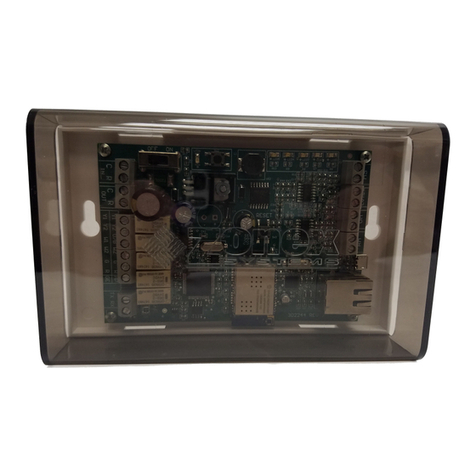
DIP-1C INSTALLATION
DIP-1C Section B-9
General installation guidelines
DIP-1C Module
-It is recommended to install the unit in a hallway to limit the DIP-1C exposure
to noxious gases.
-In order to avoid condensation problems inside the module, it is
recommended to install the DIP-1C on an inside wall. If it is not possible, use
spacers to have an air gap between the wall and the DIP-1C.
-It is required to install the DIP-1C side up with the cable entry holes facing
down.
-The enclosure is watertight, but do not spray water or immerse the DIP-1C in
water. Cover it carefully with plastic when cleaning the room.
-The DIP-1C should be installed in easy access location but away from
damaging elements (heat, cold, water, direct sunlight, …).
-Do not drill the face, the side, the top or the rear of the module.
-Do not install the DIP-1C near high voltage equipment, power supply or
transformer.
Electrical Cables
-All electrical cables must be installed according to local wiring codes.
-All cable shields must be connected to the DIP-1C power ground only, except
for the cable connected to the optional PC interface and to the ventilation
controllers. The shield is needed to protect the DIP-1C and the modules
against any electromagnetic interference generated by lightning or nearby
operating machinery.
-Never use the shield as a conductor.
-Connect only one end of the shield to the ground of the DIP-1C.
-Use separate conduit for the low voltage cables (communication) and the high
voltage cables. There must be at least 1 foot (30 cm) between low voltage
and high voltage conduits.
-If a low-voltage cable has to cross over a high voltage cable, make this
crossing at 90°.
-All cable connections must be soldered or done with approved sealed
connectors.
-Communication cables must be 820’ (250m) or less.
-It is prohibited to use overhead cables outside the building.