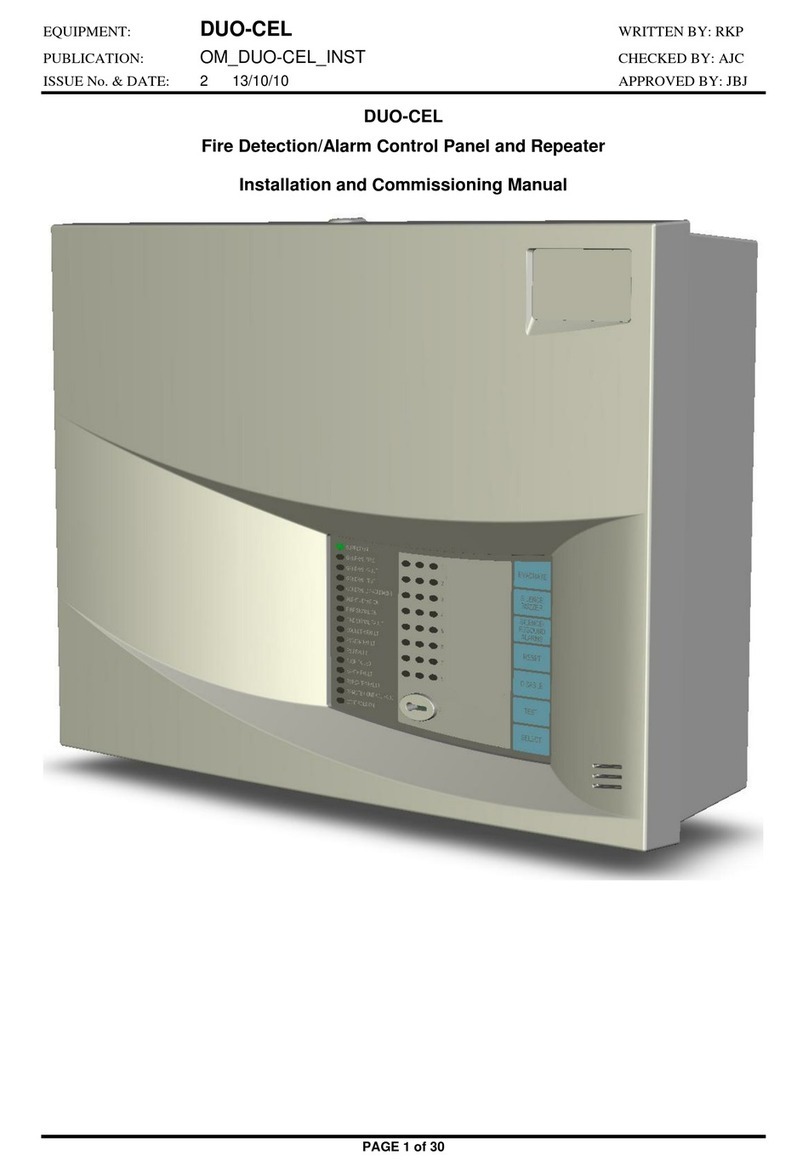
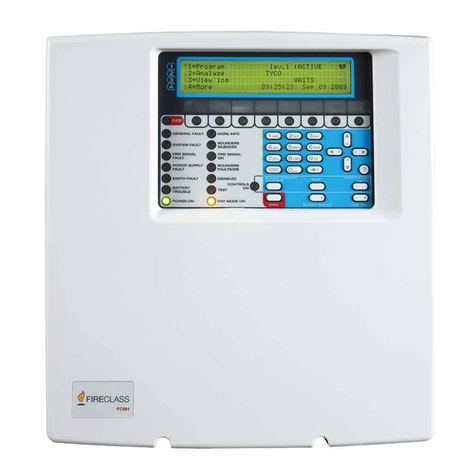
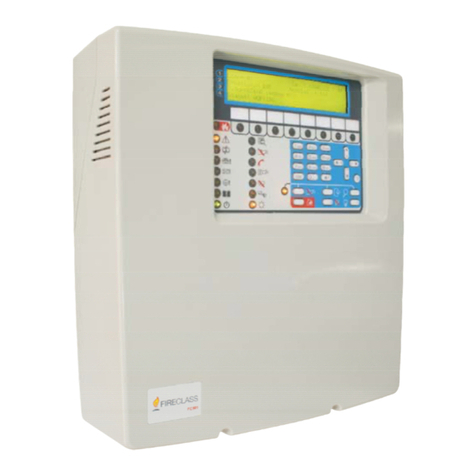
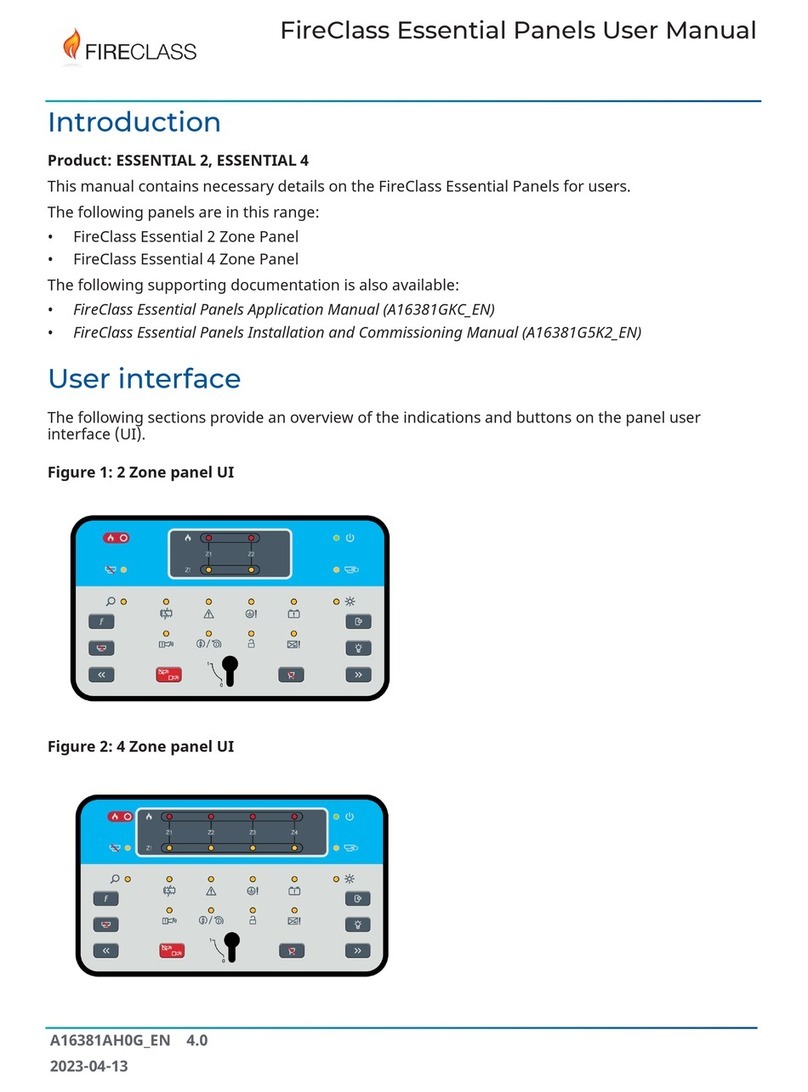
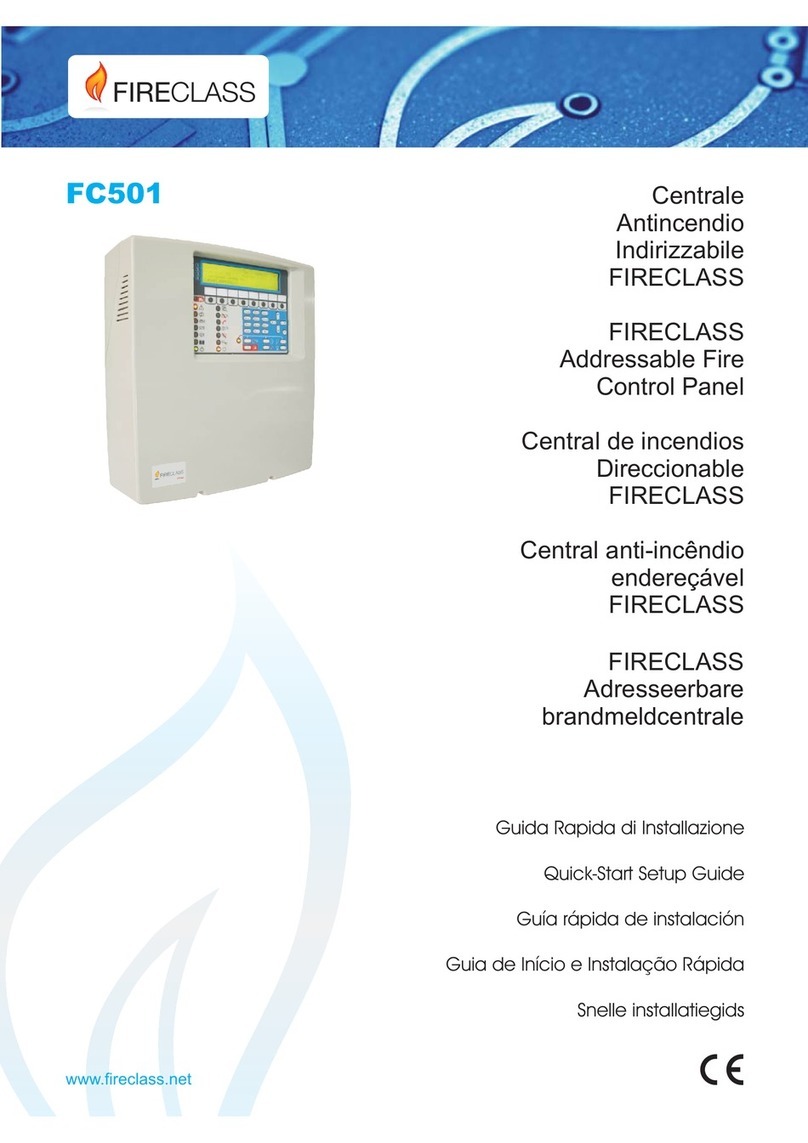
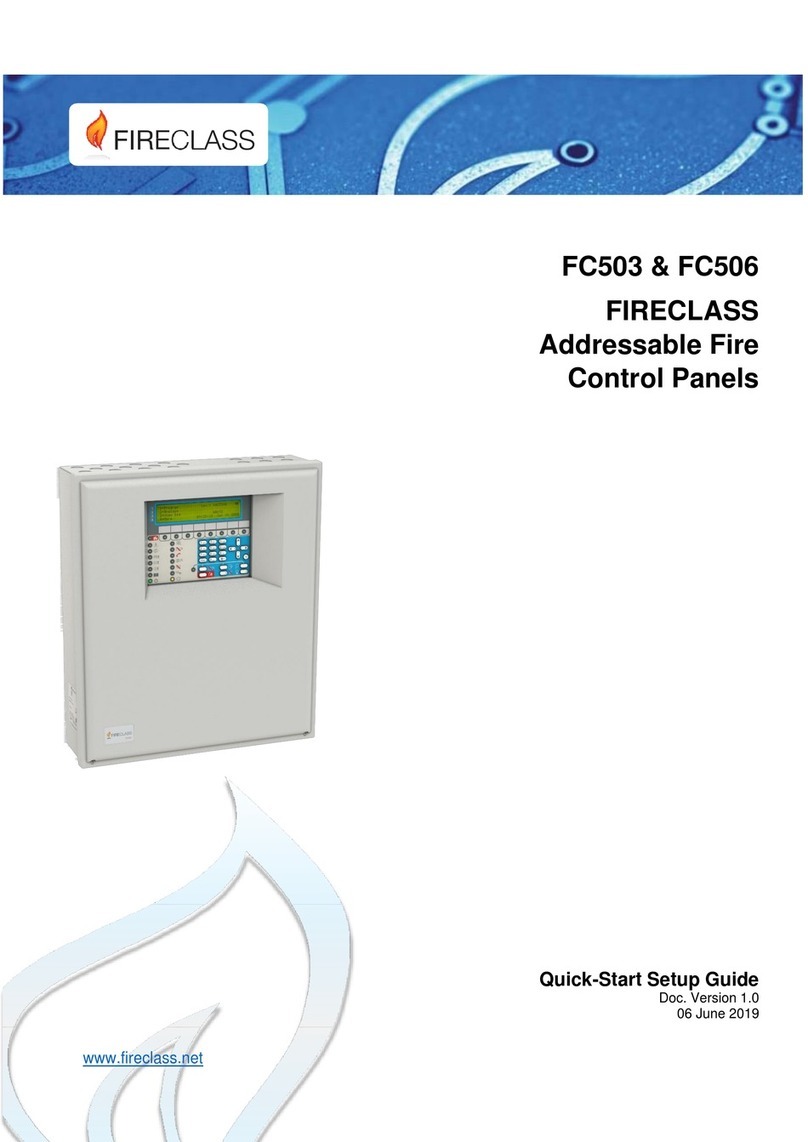
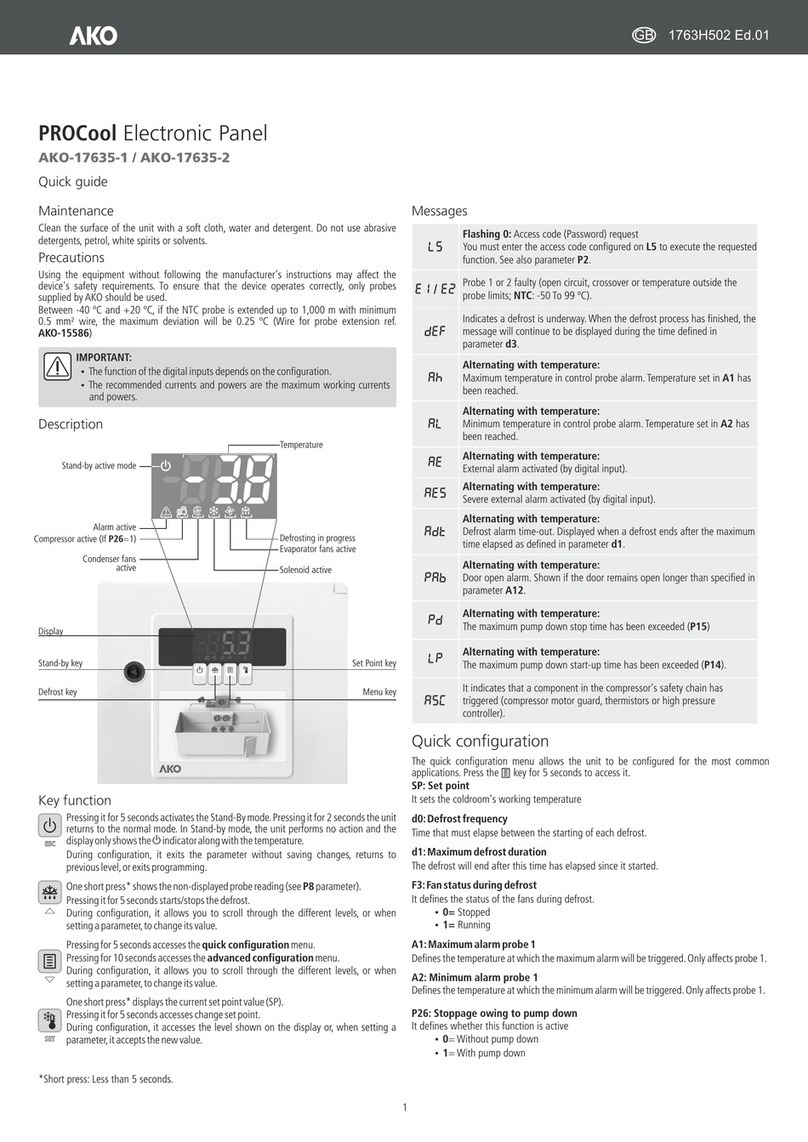
FireClass FC501 Series User manual

FC501 Addressable Fire Control Panels
Installation Manual
FC501 Addressable Fire Control
Panels
You have the option to program the fire control
panel manually, or through a USB key, or by using
the Software FireClass FC500 (FC501_FC503_FC506)
Console release 01.00.01 or higher. Use control
panel FW version 1.14 or higher.
Johnson Controls assumes no responsibility for
damage to products resulting from improper
application or misuse.
Installation of this control panel must take place
strictly in accordance with the instructions in this
manual and in compliance with the local laws and
bylaws in force.
The FC501-L, FC501-H and FC501-HK fire control
panels comply with the essential requirements of
standards EN54-2, EN54-4 and EN54-21.
Note: The FC501-L, FC501-H and FC501-HK fire
control panels support several addressable
devices such as detectors, modules, and
manual call points. This manual includes the
instructions for the programming of the fire
control panels. For further information on
these devices and their accessories, visit http://
www.fireclass.com and log into the Reserved
Area, under Installation Manuals.
The manufacturer reserves the right to change the
technical specifications of these products without
prior notice.
Box contents
The control panel is contained in a box. See the
contents of the box in the list below:
• A plastic cabinet and plastic cover with an
assembled motherboard and power supply
switching.
• The Quick Start Guide.
• A transparent plastic bag containing a USB
consisting of the installation manual, user
manual, the PC Programming manual, two 3.9
kOhm resistors, a 320 mm red and a black cable
with a faston terminal to connect batteries with
the main board, and a 320 mm black cable with
two faston terminals to connect batteries.
Proceed carefully to unpack the contents and
dispose recyclable materials in accordance with local
laws.
Waste Electrical and Electronic
Equipment (WEEE) Directive
In the European Union, you must dispose of this
product separately to household waste at an
appropriate facility to enable recovery and recycling.
Keywords and symbols
In this manual, symbols used in the margin indicate
warnings. These symbols are explained in Table 1.
Table 1: Keywords and symbols
Keyword Symbol Explanation
DANGER Imminent
danger.Death or
severe injury when
disregarded.
WARNING Potentially dangerous
situation. Death or
severe injury possible
when disregarded.
CAUTION Potentially dangerous
situation. Minor
injury possible when
disregarded.
120.615.010_FC-FC501-P-I 9.0

Introduction
FC501 fire control panels
The FC501 fire control panels follow Johnson
Controls’ highest standards of quality and
performance.
The FC501 series consists of the following models.
FC501-L: Analogue addressable Fire Control Panel
with one loop incorporating three sub-loops. The
panel can support up to 128 addressable devices
and 32 zones. The user interface uses icons to
identify function buttons and indicators.
Powered: BAW50T24 switching power supply (1.8 A
@ 27.6 V). Suitable batteries include two 12 V/ 7 Ah
or two 12 V/ 12 Ah.
FC501-H: Analogue addressable Fire Control Panel
with one loop incorporating three sub-loops.
The panel can support up to 128 addressable
devices and 32 zones. The user interface uses
text descriptions to identify function buttons and
indicators.
Powered: BAW75T24 switched mode power supply
(2.7 A @ 27.6 V). Suitable batteries include two 12 V/
12 Ah or two 12 V/ 38 Ah.
FC501-HK: Analogue addressable Fire Control Panel
with one loop incorporating three sub-loops. The
panel can support up to 128 addressable devices
and 32 zones. The user interface uses icons to
identify function buttons and indicators.
Powered: BAW75T24 switched mode power supply
(2.7 A @ 27.6 V). Suitable batteries include two 12 V/
12 Ah or two 12 V/ 38 Ah.
In this manual, the term FC501 is used to describe
the characteristics common to all versions while the
version name is used to describe the differences
between the versions listed above. The components
of these Control panels operate as intended when
the external ambient conditions comply with the
requirements of class EN 60721-3-3:1995.
The FC501 control panel has a 4-line, 40 characters
per line LCD module with a backlight, which
provides written information regarding the system
status and for programming the control panel.
Accessory items
FC500 repeater
Use this fully functional repeater panel to connect to
FC500 control panels with four wires. The repeater
panel provides all the visible and audible warnings
generated by the control panel. The repeater
panel also allows end users to manage the system
remotely up to 1000 m with double twist unshielded
cable. The FC501 control panel supports a maximum
of four repeater panels.
FC500-MFI
This is a programmable, multifunctional module
for connecting to a real time printer. In addition,
you can connect a standard interface with terminal
blocks to remotely control and supervise a set of
inputs and outputs to manage the control panel.
FC500IP
FC500IP is a module that connects the control panel
to a LAN. See Installing the FC500IP board.
FireClass FC500 (FC501_FC503_FC506)
Console
This is a user-friendly software application. It uses
Microsoft Windows 7 and higher. The console offers
easy ways to program the control panel and also
provides event log functions.
Description
Inputs
The three loops manage up to 128 devices.
Outputs
This section describes how the control panel
outputs operate.
Supervised outputs
With this output, the control panel can detect and
signal short circuits and power supply interruptions.
Disabled outputs
You can disable this type of output by using a
specific key.
Silenceable outputs
To stop this type of output, you can use the Silence/
Resound Sounders key. You can silence the outputs
for an indefinite period during Day Mode or for a
programmed silence time during Night Mode.
Operating features
You can program the control panel to provide
WARNING or DELAY TO ALARM status before ALARM
status.
Warning
The WARNING display signals the WARNING status.
If a detector exceeds its warning threshold, the
control panel generates a warning. The input
module also generates a warning state; a useful
FC501 Addressable Fire Control Panels Installation Manual2

feature for implementing the Systems Supervision
capability. The Warning status signals are:
• Control panel buzzer; 2 seconds of sound at
440 Hz and then a 2 second pause.
• A WARNING message on the LCD display
• The WARNING output points if you enable the
Delay to Alarm option.
Delay to Alarm
If a zone generates an alarm during Day Mode, the
control panel starts the Delay to Alarm Time. The
Delay to Alarm status signals are:
• Control panel buzzer; 0.5 seconds of sound at
880 Hz and then a 0.5 second pause.
• Blinking on the Delay to Alarm LED for the first
eight zones only.
• Message ALARM+DLYTIME on the LCD display.
• Activation of the respective outputs, if the user
enables the Delay to Alarm option.
Note: If the control panel detects alarm
conditions during Night Mode or from a
callpoint, the control panel generates an
instant alarm.
Take the following actions during the Delay to Alarm
status; see Access to signaling and commands.
•Access Level L1: to activate an Evacuation
Alarm, press and hold the Evacuate Key.
•Access Level L2: to stop the Silence disable
outputs and interrupt the Delay to Alarm Time,
press the Silence key.
When the Silence LED is on during Silence status,
press the Silence key to release the Silenceable
outputs, or press the Reset key to restore standby
status.
If the control panel operates in Night Mode, the
control panel exits from Silence status automatically
when the programmed Silence time expires.
Alarm
When the Delay to Alarm time expires, the control
panel generates an alarm. The Alarm status signals
are:
• Control panel buzzer; 0.2 seconds of sound at
3300 Hz and then 0.2 seconds of pause.
• Alarm LED is on.
• An alarm message on the LCD display.
• Activation of the Fire and SC1 outputs.
• Activation of other outputs including SC2, OC1,
or OC2 if programmed.
During the Alarm status, the following can occur:
• At Access Level L2 you can stop the Silenceable
outputs by pressing the Silence key.
• At Access Level L2 you can press the Reset key
and Silence Buzzer.
Note: Refer to Access to signaling and
commands for further information.
During the Silence status when the Silence LED is
on, use the Silence key to release the Silenceable
outputs. The Reset key restores the standby status.
When the programmed Night Mode Silence time
expires, the control panels exits Silence status.
Day and night mode
The control panel can operate in Day or Night Mode.
See the relevant section in the Programming from
the Panel chapter.
If you silence the system in Day Mode, the Silence
status remains until you unmute the system,
provided that no other alarm incidents occur. If you
silence the system during Night Mode, the Silence
status remains until the Night Mode Silence time
expires.
At default, the system is set to Day Mode. During
Day Mode, silenced alarms are not unmuted
automatically.
Fault
This control panel can detect and signal the faults
shown in Table 2.
Table 2: Description of Faults
Message Problem
Mains fault The control panel is not
powered from the mains
Unusable Base Detector head is not
fitted correctly or
missing from the base
correctly or missing
from the base
Battery The control panel’s
batteries charger is not
working correctly
Low battery The control panel
batteries are empty
Earth Leakage to earth
24A Output Shorted 24A Output
FC501 Addressable Fire Control Panels Installation Manual 3

Table 2: Description of Faults
Message Problem
24R Output Shorted 24R Output
Firmware main contr. Checksum fault
Not programmed dev Loop device without
address
Loop return open Loop negative signal
open
Loop signal open Loop positive signal
open
Loop local short Local short on loop
controller
Loop right short Right side loop short
Loop left short Left side loop short
No answer Loop device does not
answer
Dirty level Smoke detector only;
the dirty threshold has
been exceeded
Short circuit Short circuit on input
module
Open circuit Open circuit on input
module
Power supply Main fault
Wrong value A loop device has an
incorrect value
Stuck output An output module relay
is not switched
Same address Several loop devices
have the same address
Wrong Type Different loop device
from that programmed
in the panel
IP Communicator Communication lost with
IP controller
IP receiver Communication lost with
IP receiver
PSTN communicator The communication with
PSTN controller is lost
Telephone line Telephone line fault
LOG Full LOG fault
PSTN Action not Ack. A PSTN action not
acknowledged
SC X short SC x = (1 or 2) short
circuit
Table 2: Description of Faults
Message Problem
SC X open SC x = (1 or 2) open
terminal
Prog.data main cont Data programming
checksum fault
Prog.data tel.board Aux Controller data
programming checksum
fault
Loop Communication Communication loop
fault controller
Display communication Communication fault on
display controller
LOOP x NOISY The devices on the loop
x = (1, 2 or 3) do not
communicate properly
with the panel. Check
the quality of wiring.
REPEATER COMMUNIC. A repeater on the RS485
does not respond
MFI x COMMUNIC. (x from 1 to 4)
PRINTER x FAULT (x from 1 to 4)
PRINTER x ABSENT (x from 1 to 4)
MFI x SERIAL CHANN. (x from 1 to 4)
MFI x INy SHORT (x from 1 to 4; y from 1
to 5)
DEFAULT DATA The fire panel resets to
default data
Fault conditions signals are as follows:
• Control panel buzzer; 1 second of sound at 660
Hz and a 1 second pause.
• The Fault LED and relative Fault LED is on.
• A Fault message on the LCD display.
• Activation of the Fault output.
• Activation of other outputs including SC2, OC1
or OC2 if programmed.
The Fault output and any additional programmed
fault outputs automatically return to standby status
when the fault conditions clear.
Under certain circumstances, fault conditions may
clear spontaneously. If this occurs, the memory
stores the event until you reset the control panel.
Blinking on the Fault LED indicates stored fault
events.
FC501 Addressable Fire Control Panels Installation Manual4

Silence
This control panel provides a Silence key that can
restore the Silenceable outputs to Standby status.
When the Silence LED is on, this indicates the Silence
status.
The Silence status remains until one of the following
occurs:
• You press the Silence key again
• The programmed Night Mode Silence time
expires when the control panel operates in
Night Mode.
• A new alarm condition is detected.
Note: You need access level L2 or L3
permissions to mute the silenceable outputs
manually.
Disabled
This control panel can disable the devices on
the loop, SC2 output, OC1 and OC2 outputs, the
software zones, the RS485 network devices such as
the repeaters and the MFI modules.
DISABLED zones cannot generate alarms or
warnings of any kind, and DISABLED outputs cannot
be activated.
When the Disabled LED is on, this indicates the
Disabled status.
Note: The Disable facility is available at access
level L2 or L3.
Reset
Resetting the control panel restores the outputs to
standby status, clears the memory, and disconnects
the power supply to terminal 24R for 2 seconds.
Note: You need access level L2 or L3
permissions to reset the panel.
Interface
Visual signaling
The system status signals on the control panel LEDs
are as follows:
• Green indicates that the power is ON.
• Amber indicates specific operating modes,
for example Day or Night Mode, and Fault
conditions.
• RED indicates alarm conditions.
Memory
The control panel indicates Fault events with a
blinking FAULT LED until the system resets, even if
the event clears before the reset.
Audible Signaling
The buzzer signals the control panel status as
shown in Table 3.
Note: When the control panel mutes an alarm
and detects a new fault, the control panel
resounds the previous silenced alarm.
Table 3: Audible Signaling
Status Sound Pause Frequency
SYSTEM
FAULT (Main
processor fail)
2.5 s 2.8 s 1300 Hz
SYSTEM FAULT
(Programming
data
corrupted)
1 s 1 s 660 Hz
Warning 2 s 2 s 440 Hz
Delay to Alarm 0.5 s 0.5 s 880 Hz
Alarm 0.2 s 0.2 s 3300 Hz
Fault 1 s 1 s 660 Hz
LAMP TEST:
This key allows you to test the control panel buzzer
and the LEDs.
Access to indicators and commands
There are four access levels, in compliance with Fire
Safety Regulations.
Access Level L1 Viewing:
All users can view the control panel status without a
password.
Access Level L2 Operating the system (PIN code
entered):
Password code users can operate the system at user
level.
Access Level L3 Programming and Opening the
Control Panel (Password Code entered):
This level of access is for installers. Therefore, only
qualified, authorised users are allowed to open
the control panel door. This requires removal of
the cover screws, for maintenance or to replace a
battery.
Access Level L4 Repairing or replacing the PCB:
FC501 Addressable Fire Control Panels Installation Manual 5

Only the manufacturer can repair or replace the
PCB. This requires removal of the cover screws.
Users and installers features
The panel can recognize and manage up to eight
users and two installers. At each login of any user or
installer, the panel logs the login event and the user
or installer label, see Table 4. The panel also logs the
return to access level L1 to indicate the end of the
user or installer session.
Table 4: Users and installers passwords
Users and installers Default password
USER 1 11111
USER 2 Not set
USER 3 Not set
USER 4 Not set
USER 5 Not set
USER 6 Not set
USER 7 Not set
USER 8 Not set
INSTALLER 1 00000
INSTALLER 2 Not set
By default, only USER 1 works with its default
password. The other users are unavailable.
By default, only INSTALLER 1 works with its default
password. INSTALLER 2 is not available.
Only the INSTALLER 1 can make available USER 2 to
USER 8, and the INSTALLER 2.
The INSTALLER 2 can also modify all passwords.
For more information, see 2 Key - Add and modify
passwords, 0 Key - Add and modify installer
passwords, and refer to the console instructions.
Each installer and each user can modify their own
password.
If INSTALLER 1 forgets its password, they can enter a
new password using the following procedure:
1. Open the control panel, and remove the
jumper J5 on the main board.
2. Access the installer menu screen.
3. Access the programming screen of the installer
password and enter the new password.
4. The system stores the new password as the
current password for INSTALLER 1. The user
interface returns to the main screen, indicating
local programming, followed by a panel reset.
5. Replace the J5 jumper to restore the normal
program menu screen functionality.
Power supply and batteries
The power supply system of the FC501 control
panels complies with EN54-4.
All models are powered by the mains.
• The FC501-L has a switching power supply
which supplies up to 1.8 A at 27.6 V.
• The FC501-H has a switching power supply
which supplies up to 2.7 A at 27.6 V.
• The FC501-HK has a switching power supply
which supplies up to 2.7 A at 27.6 V.
All models can house two 12 V batteries. When
these are connected in series, they can supply 24 V
to the control panel and peripherals in the event of
a power cut.
For suitable batteries, refer to Table 33.
Note:
If necessary, the FC501-H and FC501-HK control
panel can be connected to two 12 V, 38 Ah
batteries in an external cabinet. See Mounting
the 38 Ah battery cabinet.
This control panel can detect, signal and store in
memory the following power faults:
• Shorted 24A or 24R outputs
• Low battery
• Battery fault
• Battery disconnected
• Battery trouble
• Earth fault
• Mains failure power supply fault
The battery fault may be signaled with a delay up
to 1 minute. The mains fault is signaled when the
programmed delay expires.
The control panel monitors the batteries status at all
times, through static tests and dynamic tests.
Static Test: The static test monitors the battery
charge during mains failure. In the event of low
battery voltage, below 22.8 V, the Low Battery LED
turns ON. If this occurs, you must restore the mains
power before the batteries empty, otherwise, the
system will shutdown.
Dynamic Test: The dynamic test monitors the
operating capacity of the batteries. If the batteries
do not meet the test requirements, the No Battery
LED turns ON. If this occurs, you must replace the
FC501 Addressable Fire Control Panels Installation Manual6

backup battery immediately, otherwise the system
will be unable to function in the event of mains
failure.
Note:
In case of mains failure and batteries failure,
the control panel non-volatile memory holds
the programmed data.
Description of the control keys
Table 5 describes the control panel and repeater
keys. For more information about the SILENCE/
RESOUND SOUNDERS key, see SILENCE/RESOUND
SOUNDERS key. For more information about the
RESET key, see RESET key.
Table 5: Description of the control panel and repeater keys
Key Description
SILENCE/ RESOUND
SOUNDERS
Restores the Silenceable outputs and the loop devices to
standby status.
Note: The silence status remains until you press the SILENCE key
again in day mode; or until the night mode silence time expires in
night mode; or until the system detects a new alarm condition.
RESET Resets the fire detectors and restores all outputs to standby
status
INVESTIGATION
DELAY
Refreshes the delay to alarm time
Note: If you press this key during delay to alarm, the remaining
delay to alarm time increases with the programmed investigation
delay.
EVAC Activates the evacuation
Note: If you press this key, the system generates an alarm.
SILENCE BUZZER Silences the local buzzer on the control panel
Note: The buzzer operates every time a new event is activated.
LAMP TEST Tests the buzzer and the LEDs
Note: If you press this key when the control panel is functioning
as intended, all LEDs will be on and the buzzer emits a continu-
ous beep.
HELP Explains the information on the LCD display in the different
screens
Note:
An embedded help feature is present on the panel LCD
display.
The HELP key is disabled on the repeater.
SILENCE/RESOUND SOUNDERS key
This control panel provides a Silence key that can
restore the Silenceable outputs to Standby status.
When the Silence LED is on, this indicates the Silence
status.
The Silence status remains until one of the following
occurs:
• You press the Silence key again
• The programmed Night Mode Silence time
• The programmed Night Mode Silence time
expires when the control panel operates in
Night Mode.
• A new alarm condition is detected.
RESET key
You can only enable the Reset key at access level
L2 with a PIN as the fire panel returns to standby
status after the Alarm, Delay to Alarm, Warning and
Fault conditions stop. At the end of the Reset time,
the system reprocesses any Alarm, Delay to Alarm,
Warning or Fault signal that Reset operations did
not clear.
FC501 Addressable Fire Control Panels Installation Manual 7

When Reset is running, the command keys are
inoperative.
Any repeater connected to the panel can perform
a reset of the panel. It is necessary to use a PIN to
access level L2 or higher.
Description of status LEDs
Table 6 describes how the control panel and repeater LEDs operate. During standby status, only the green
POWER ON LED and the DAY MODE LED should be on if the control panel is in day mode.
Table 6: Description of control panel and repeater status LEDs
LED Description
FIRE (Red) ON indicates the alarm status. In the event of an alarm, the control
panel activates the not-disabled alarm outputs.
GENERAL FAULT
(Amber)
ON indicates the presence of a fault on the loop or RS485 or
outputs. The following LEDs or the screen display indicates the
type of fault. OFF indicates no fault.
SYSTEM FAULT (Amber) ON indicates a blocked control panel. **
The LCD display on the panel displays "SYSTEM FAULT LATCHED"
on the screen indicating the watchdog on the panel was reset or
the panel was reset manually. Remove this fault before proceeding
to use the panel.
Indicates the control panel restart. ***
IMPORTANT: Maintenance required.
Flashing indicates that the control panel programming data is
corrupted. ***
Note: Further notes are included beneath this table.
FIRE SIGNAL FAULT
(Amber)
ON indicates that the communicator is disabled.
Blinking indicates that the communicator is faulty.
POWER SUPPLY FAULT
(Amber)
ON indicates a mains failure (230 V).
Blinking indicates a Switching Power supply fault.
During this condition, the control panel is powered by the
batteries.
EARTH FAULT (Amber) ON indicates a voltage leakage to Earth.
Important: Check wiring insulation.
BATTERY TROUBLE
(Amber)
ON indicates that the batteries are empty or faulty. If this condition
persists, the batteries are unable to function as intended in the
event of a power cut.
Important: New batteries are required.
POWER ON (Green) ON indicates that the panel is supplied with power. OFF indicates
a mains failure whereby both mains and battery power is lost (the
battery disconnect threshold is 19.2 V). Power must be restored
before the batteries reach the disconnect threshold.
MORE INFO (Amber) ON indicates that there is hidden information with lower priority.
View List shows the hidden information.
OFF indicates no hidden information is available.
FC501 Addressable Fire Control Panels Installation Manual8

Table 6: Description of control panel and repeater status LEDs
LED Description
SOUNDERS SILENCED
(Amber)
ON indicates that the silenceable outputs and loop device have
been forced into standby by means of the SILENCE/ RESOUND
SOUNDERS key. In day mode, the silence status remains until
the SILENCE/RESOUND SOUNDER key is pressed again. In night
mode, the silence status remains until the night mode silence time
expires or until the system detects a new alarm or a new trouble
condition.
FIRE SIGNAL ON (Red) ON indicates that the transmission was successful.
Blinking indicates that the transmission is in progress. On the
control panel screen, the connection type, such as PSTN, GSM, or
LAN network, is displayed.
SOUNDERS FAULTS/DIS
(Amber)
ON indicates that the output is disabled or outputs configured to
"act as SC1" are disabled.
Blinking indicates that the SC1 is in fault or outputs configured to
"act as SC1" are in fault.
OFF indicates that all the main sounder outputs (EN54-1, TYPE "C"
outputs) function properly.
DISABLED (Amber) ON indicates that at least one control panel item is disabled.
TEST (Amber) ON indicates the test conditions on at least one zone.
DAY MODE (Amber) ON indicates that the control panel is operating in day mode.
OFF indicates that the control panel is operating in night mode.
1-8 SOFTWARE ZONES (Red) ON indicates that the corresponding software zones are in Alarm
status *.
Blinking indicates that the corresponding software zones are in
Delay to Alarm status.
CONTROLS ON (Amber) ON indicates that the control panel is at least at level 2 so the
SILENCE/RESOUND SOUNDERS, RESET and INVESTIGATION
DELAY keys are enabled.
Note: * The zone outside the 1 to 8 range does not have a related LED, its alarm status is displayed only
by the LCD.
Note: For SYSTEM FAULT (Amber), note the following:
• When the control panel is switched on for the first time, this LED blinks until a reset has been
performed.
• ** indicates that the buzzer sounds the system fault pattern; *** indicates that the buzzer sounds
the fault pattern.
• The buzzer turns ON and the System fault LED also turns ON if one of the below conditions occurs:
- The system resets itself (watchdog reset) when any internal logical fault occurs.
- System is powered ON after a complete panel shut down.
FC501 Addressable Fire Control Panels Installation Manual 9

Parts identification
Control panel parts
Figure 1: Control panel parts: External view
Callout Description
1 Control panel cover
2 Knockouts for cables ducted externally (18)
3 Display
4 Two screws to close the cover on the panel
5 Knockout for connection of control panel with battery cabinet (accessory item)
FC501 Addressable Fire Control Panels Installation Manual10
Other manuals for FC501 Series
2
Table of contents
Other FireClass Control Panel manuals
FireClass
FireClass FC600 User manual
FireClass
FireClass 500 User guide
FireClass
FireClass FC503 User manual
FireClass
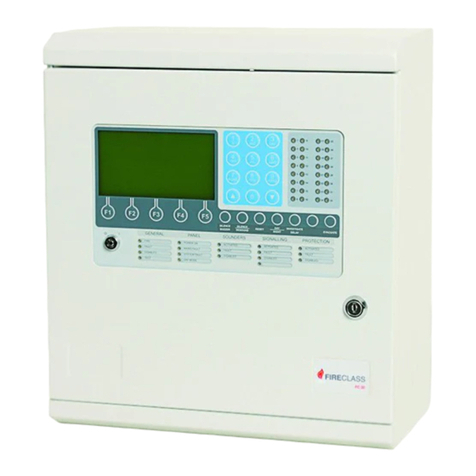
FireClass FC32-1 Owner's manual
FireClass
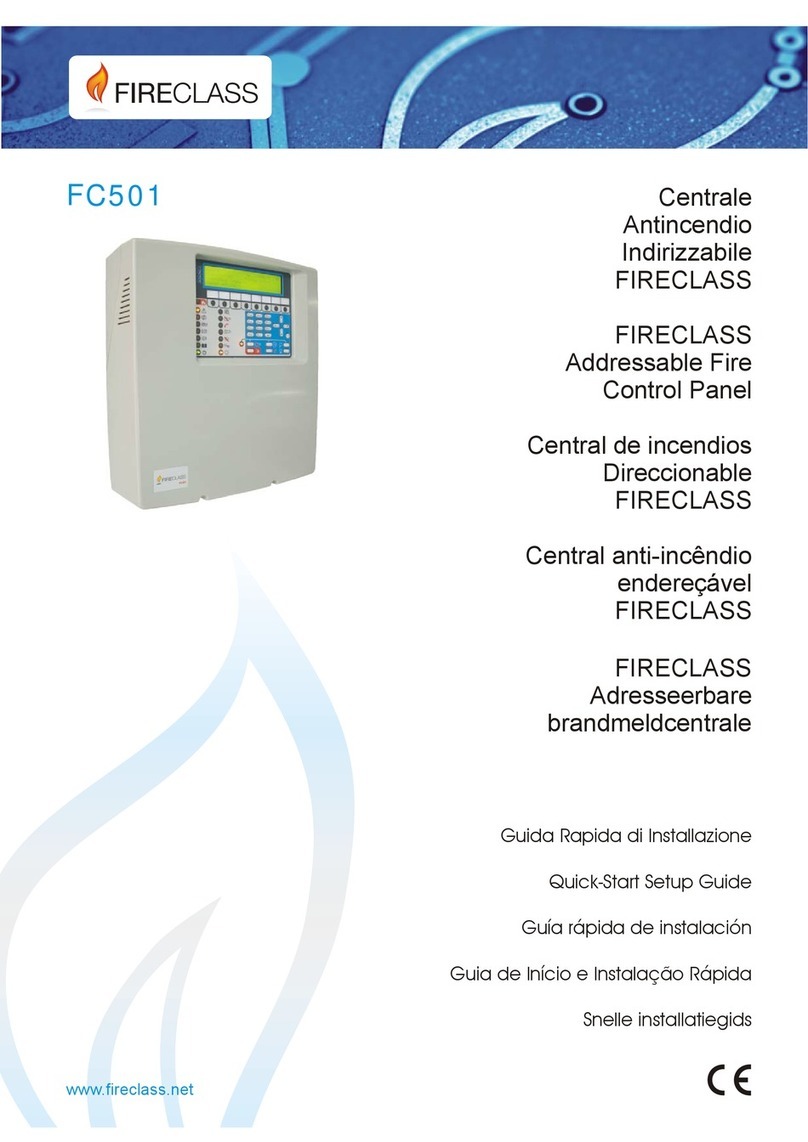
FireClass FC501-L Technical manual
FireClass
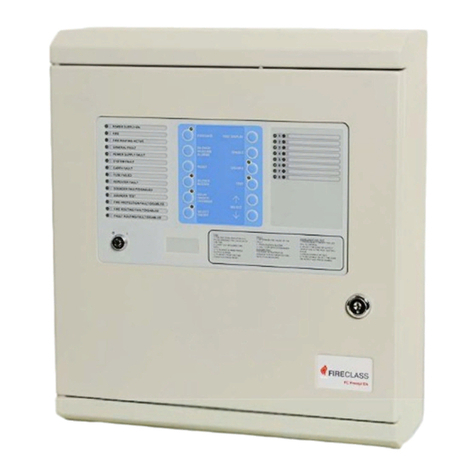
FireClass Precept EN Panel User guide
FireClass
FireClass FC500 Owner's manual

FireClass
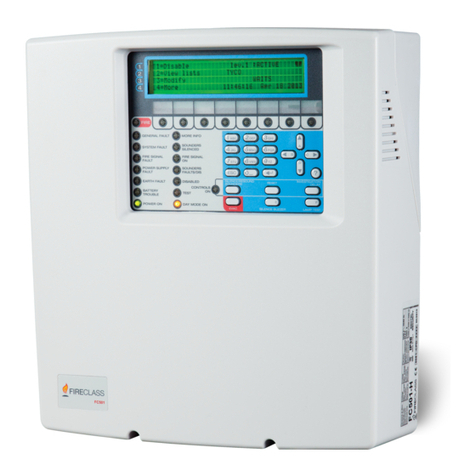
FireClass FC501-HK User manual
FireClass
FireClass FC-P-S Installation and user guide
FireClass
FireClass FC503 Owner's manual