Introduction
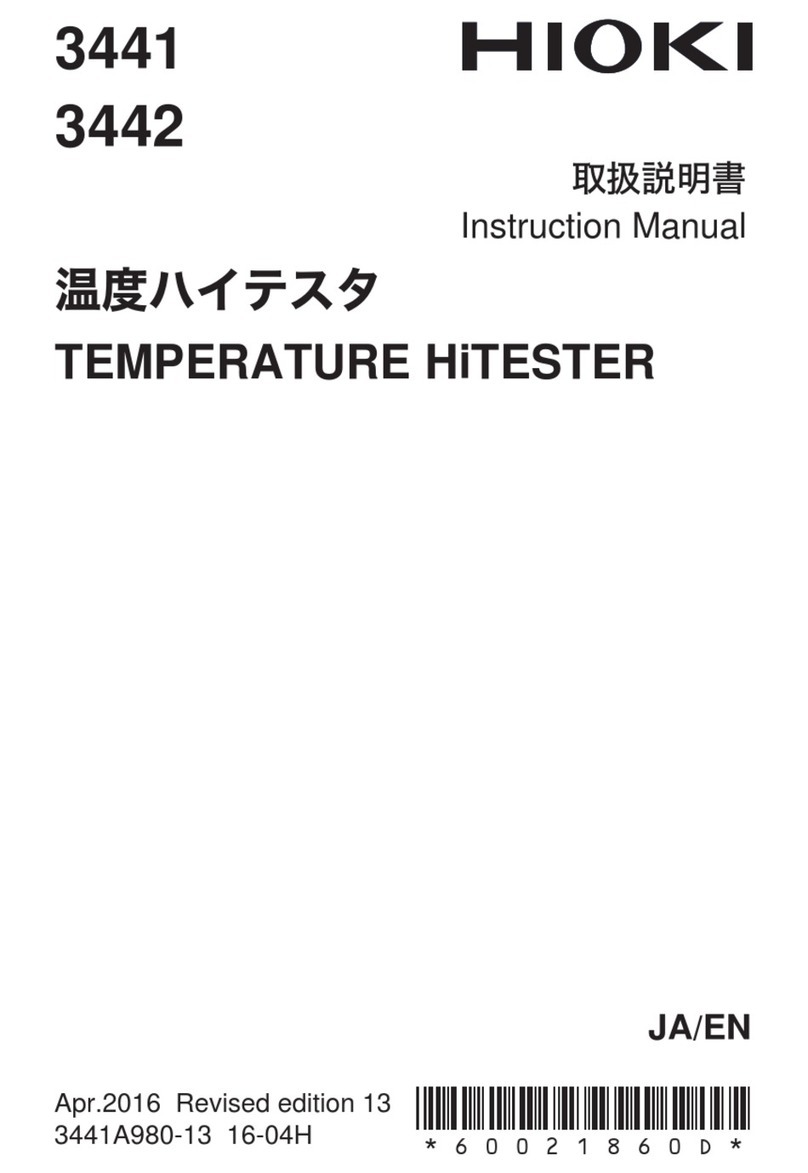
Thank you for choosing the Hioki 9465-10/9465-11 Pin Type Lead. To ensure
your ability to get the most out of this product over the long term, please read
this manual carefully and keep it available for future reference.
The latest edition of the instruction manual
The contents of this manual are subject to change, for
example as a result of product improvements or changes to
specications. The latest edition can be downloaded from
Hioki’s website.
https://www.hioki.com/global/support/download/
Overview
The 9465-10/9465-11 Pin Type Lead is a four-terminal pin-type lead
assembly that can be used for various maintenance works, including that of
emergency batteries and electric vehicles (EV) involving equipotential tests,
that require its pins to be brought into contact with dicult-to-access objects
to be measured.
Use of the coaxial pin with a maximum outside diameter of 2.9 mm allows
you to perform measurement using a hole for inspection made on a battery
connector cover.
Inspection and Maintenance
Initial Inspection
When you open the package, carefully inspect the product to ensure
that everything is in good condition, and that no damage occurred during
shipping. If the product seems to have been damaged or does not work as
specied, contact your authorized Hioki distributor or reseller.
Maintenance and Service
• To clean the product, wipe it gently with a soft cloth moistened with water or
mild detergent. Never use solvents such as benzene, alcohol, acetone, ether,
ketones, thinners or gasoline, as they can deform and discolor the case.
• If the product seems to be malfunctioning, contact your authorized Hioki
distributor or reseller.
• Pack the product so that it will not sustain damage during shipping, and
include a description of existing damage. We cannot accept responsibility
for damage incurred during shipping.
Safety Information
This manual contains information and warnings essential for safe operation
of the product and for maintaining it in safe operating condition. Before using
it, be sure to carefully read the following safety precautions.
DANGER
Mishandling this product during use could result in injury
or death, as well as damage to the product. Be certain that
you understand the instructions and precautions in the
manual before use. Hioki disclaims any responsibility for
accidents or injuries not resulting directly from product
defects.
Safety Symbol
In this manual, the symbol indicates particularly important
information that the user should read before using the product.
The following symbols in this manual indicate the relative importance of
cautions and warnings.
DANGER Indicates that incorrect operation presents an extreme
hazard that could result in serious injury or death to the user.
CAUTION Indicates that incorrect operation presents a possibility of
injury to the user or damage to the product.
IMPORTANT
Indicates information or content that is particularly
important from the standpoint of operating or maintaining
the product.
Precautions for Use
Observe the following precautionary information to ensure that the product
can be used safely and in a manner that allows it to perform as described in
its specications.
DANGER
•To prevent an electric shock, be careful to avoid shorting
live lines with the pin type leads tip.
•Do not use the product to measure circuits that exceed
its ratings or specications. Damage to the product or
overheating can cause bodily injury.
•To prevent an electric shock and short-circuit, turn o all
power before connecting leads.
CAUTION
• To avoid breaking the leads, do not bend or pull them.
• To avoid damage to the product, protect it from physical shock when
transporting and handling. Be especially careful to avoid physical
shock from dropping.
• The ends of the leads are sharp. Be careful to avoid injury. Attach the
protective sleeves when the product is not in use.
To avoid damage, do not contact the
9465-10/9465-11 Pin Type Lead tip
against the battery at a tilted angle. NO
OK
Procedure
Preliminary Checks
Check the product for any damage that may have occurred during storage or
shipping, and perform functional checks before use. If you nd any damage
to the product, please contact your authorized Hioki distributor or reseller for
repair.
Points to check include the pin operation and whether the pin and cable lock
are loose. As loose screwing of the cable lock and other components can
result in damage, be sure to tighten them securely before use.
DANGER
Conrm that the insulation on the using the test leads are
undamaged and that no bare conductors are improperly
exposed before use. If you nd any damage to the product
that leads to an electric shock, please contact your
authorized Hioki distributor or reseller for repair.
1
Make sure the device to which connect the pin type lead is powered
o.
2
Connect the pin type lead to the input terminal of the
device.
Plug the mark on the red lead into the red marked jack
on the device, and plug the mark on the black lead into
the black marked jack on the device.
3
Perform zero adjustment.
Be sure to use the 9454 Zero Adjustment Board or the Z5038 0 ADJ
Board. See the instruction manual for details of connectable devices.
4
Connect the 9465-10/9465-11 to an object under measurement.
Attach the protective sleeves when not in use.
IMPORTANT
Measurement values when using four-terminal measurement
(Dierences in measurement values due to measurement leads used)
Depending on the object under measurement, such as a lead-acid battery,
measurement values may vary due to the measurement lead used. Since
these dierences in measurement values are due to the shapes and
dimensions of the leads used in four-terminal measurement, measurement
values taken using any lead represent the true values for that lead only.
When judging battery wear using changes in resistance values with time,
be sure to use measurement leads having the same dimensions.
Reference example (measurement of an MSE-200 valve-regulated
stationary lead-acid battery)
Note: Resistance values vary according to the materials and structure of
the terminals of the object under measurement.
Measurement lead (Distance between the
current-impression pin and the voltage
measurement pin)
Measurement values using
the BT3554 Battery Tester
9465-10/9465-11 Pin Type Lead (0.65 mm) 0.538 mΩ
9772 Pin Type Lead (2.5 mm) 0.490 mΩ
See the BT3554 Battery Tester manual for detailed technical descriptions.
Explanation
Dierences in measurement values are physical phenomena resulting from
dierences in the distances (dimensions) between current-impression pins
and voltage-measurement pins. The greater the battery terminal resistance
in comparison to the battery’s internal resistance, the more marked these
dierences become. The following diagram shows how dierences in voltage
detected result from dierences in distance when measuring a lead-acid
battery.
+ terminal
A B
V (voltage detected): A > B
− terminal
Model 9465-10/9465-11
(Pin distance: 0.65 mm)
Model 9772
(Pin distance: 2.5 mm)
+ terminal− terminal
Lead-acid battery
Equipotential line
Potential gradient
Equipotential line
Potential gradient
Lead-acid battery
Specications
Maximum rated line-to-
ground voltage
30 V AC rms, 42.4 V AC peak, 60 V DC
Rated current 2 A AC/DC continuous
Operating temperature
and humidity range
0°C to 40°C (32°F to 104°F), 80% RH or less
(non-condensing)
Storage temperature
and humidity range
−10°C to 50°C (14°F to 122°F), 80% RH or less
(non-condensing)
Operating environment Indoor use, altitude up to 2000 m (6562 ft.)
Length 9465-10: Approx. 1900 mm (74.8 in.)
9465-11: Approx. 3900 mm (153.5 in.)
Weight 9465-10: Approx. 180 g (6.3 oz.)
9465-11: Approx. 200 g (7.1 oz.)
Accessory Instruction manual
Option Model 9465-90 Tip Pin
To purchase optional equipment, please contact your authorized Hioki
distributor or reseller. Optional equipment is subject to change with no
advance notice. Check Hioki’s website for the latest information.
Part Names
The illustration shows the 9465-10.
Conductive contact pin (coaxial pin)
Grip Cable lock
SENSE connector
SOURCE connector
Cable
Protective sleeves are placed on pin for protection
during transport. Remove the sleeves before use.
φ1.27
φ2.9
1 13.5
φ2.7
Pin base
Enlarged view of pin
(Unit: mm)
Replacing the Tip Pin (Option)
When the tip conductive contact pin is broken or worn, it can be replaced.
Please order the 9465-90 Tip Pin which is a combination of the conductive
contact pin and the pin base (resin part).
1
Turn o the power of the device and remove the measurement lead.
2
Unscrew the cable lock to unlock the cable.
(The cable is locked by screwing the cable lock.)
Model 9465-90 Tip Pin
Model 9465-10/9465-11 (1) (2) To prevent broken wires;
do not pull the cable, and do not twist
the cable.
3
Hold the pin base so that the cable won’t rotate, and then rotate
the grip to loosen it.
(1) Hold the pin base tightly.
(3)
(2) Beware of injury.
The tip has a sharp point.
4
Hold the transparent tube and pull the pin base to remove the tip pin.
Pin base Transparent tube
5
Attach the new 9465-90 Tip Pin. While pressing the tip pin against
a hard plate etc. so that the tip pin does not pop out, push it into
the transparent tube.
6
Assemble the pin type lead in the reverse order of disassembling.
Do not pull or twist the cable.
• Have the bush stick out about 1 mm from
the collet not to break the cable.
• Be careful not to push the bush too deeply.
Collet Bush
7
To avoid broken wires and contact failures, after tightening the
cable lock, gently tug and twist the cable to check it is rmly held.
8
Check the performance.
Measure an object under measurement with a known resistance. Make
sure that the measured resistance is correct before using the pin type
lead.
PIN TYPE LEAD
Instruction Manual
Nov. 2023 Revised edition 6
9465E980-06
9465-10
9465-11
EN
3 4
1 2