[t5.ADJUST
PRESSER FOOT (Fig.17,18)
1.
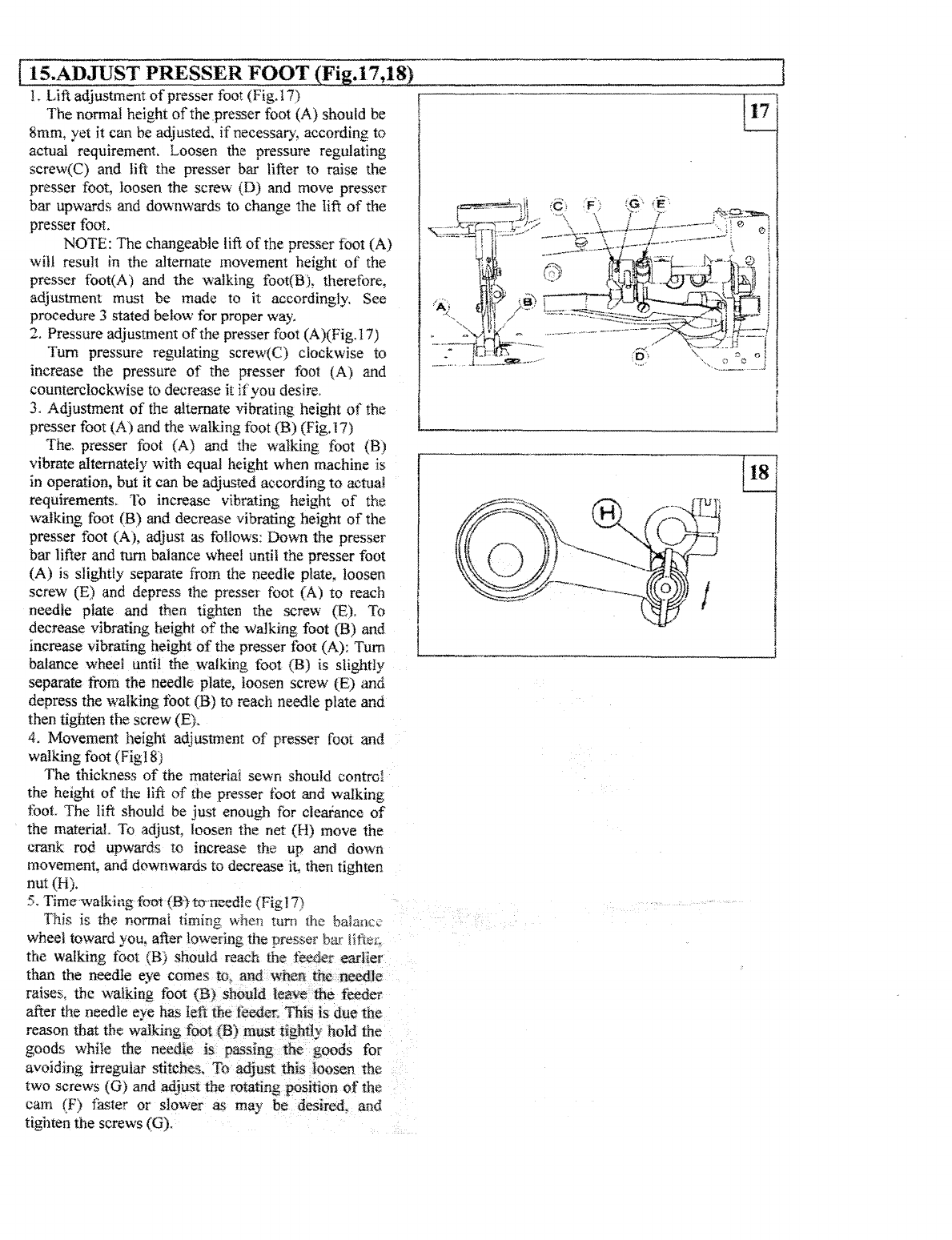
Lift adjustment
of
presser foot (Fig.17)
The
normal height
of
the presser foot (A) should be
8mm, yet
it
can be adjusted.
if
necessary. according to
actual requirement. Loosen the pressure regulating
screw(C) and lift the presser bar lifter
to
raise the
presser foot, loosen the screw
(D)
and move presser
bar upwards and downwards to change the lift
of
the
presser foot.
NOTE: The changeable lift
of
the presser foot (A)
will result
in
the alternate movement height
of
the
presser foot(A) and
the
walking foot(B), therefore,
adjustment must be made
to
it accordingly. See
procedure 3 stated below for proper way.
2. Pressure adjustment
of
the presser foot (A)(Fig.17)
Tum
pressure regulating screw(C) clockwise to
increase the pressure
of
the presser foot
{A)
and
counterclockwise
to
decrease it
lfyou
desire.
3.
Adjustment
of
the aliemate vibrating height
of
the
presser foot
(A)
and the walking foot
(B)
(Fig.17)
The. presser foot {A) and
the
walking foot
(B)
vibrate altemateiy with equal height when machine is
in operation. but it can
be
adjusted according
to
actual
requirements.
To
increase vibrating height
of
the
walking foot (B) and decrease vibrating height
of
the
presser foot (A), adjust as follows:
Down
the presser
bar lifter and turn balance wheel until the presser foot
(A)
is
slightly separate from the needle plate, loosen
screw (E) and depress the presser foot (A)
to
reach
needle plate and then tighten the screw (E). To
decrease vibrating height
of
the walking foot (B) and
increase vibrating height
of
the presser foot (A):
Tum
balance wheel until the walking foot (B) is slightly
separate from the needle plate, loosen screw (E)
and
depress the walking foot (B)
to
reach needle plate
and
then tighten the screw (E).
4. Movement height
adjusm1ent
of
presser foot and
walking foot (Fig
18)
The
thickness
of
the materia! sewn should control
the height
of
the lift
of
the presser toot and walking
toot
The
lift should be
just
enough for clearance
of
the materiaL To adjust, loosen the net (H) move
the
crank rod upwards to increase the up and down
movement, and downwards to decrease it, then tighten
nut (H).
5. Time walking foot
(B}toneedle
{Fig17)
This is the normal timing when turn the balance
wheel toward you, after lowering the presser bar
the walking
toot
(B) should reach the earlier
than the needle eye comes to,
and
when me needle
raises, the walking toot
(B)
should
me
feeder
after the needle eye has left the feeder. This is
due
the
reason that the walking foot
(B)
must tightly hold
the
goods while the needle
is
passing the·. goods for
avoiding irregular stitches. To adjust this loosen the
two screws
(G)
and adjust
the
rotating position
of
the
cam (F) faster
or
slower
as
may
be
desired,
and
tighten the screws (G).
From the library of: Superior Sewing Machine & Supply LLC