5
For All Product Applications
User weight range (including all clothing,
tools, and equipment) is 59-140kg.
Anchorage point in PFAS must be rated to
withstand minimum 12kN load and be
EN 795:2012 or 1997+A1:2000 approved.
The jobsite CP must ensure that there are
sufficiently strong and accessible anchorage
points in the working environment. Anchorages
should be overhead when possible and the area
beneath and around them should be clear of
obstruction and sharp edges. Always attach to
an anchorage that is as close to the point of work
and as high above head as possible without
restricting free movement. The user should be
aware at all times of which attachment points
to use; if not immediate obvious they must seek
confirmation from the CP. Always ensure that the
means of attachment to the anchorage is secure
before beginning work.
May be used in Rescue/Confined Space
applications. Rescue systems function to
safely recover a worker from a confined
location or after exposed to a fall. There are
various configurations of Rescue systems
depending on the type of rescue.
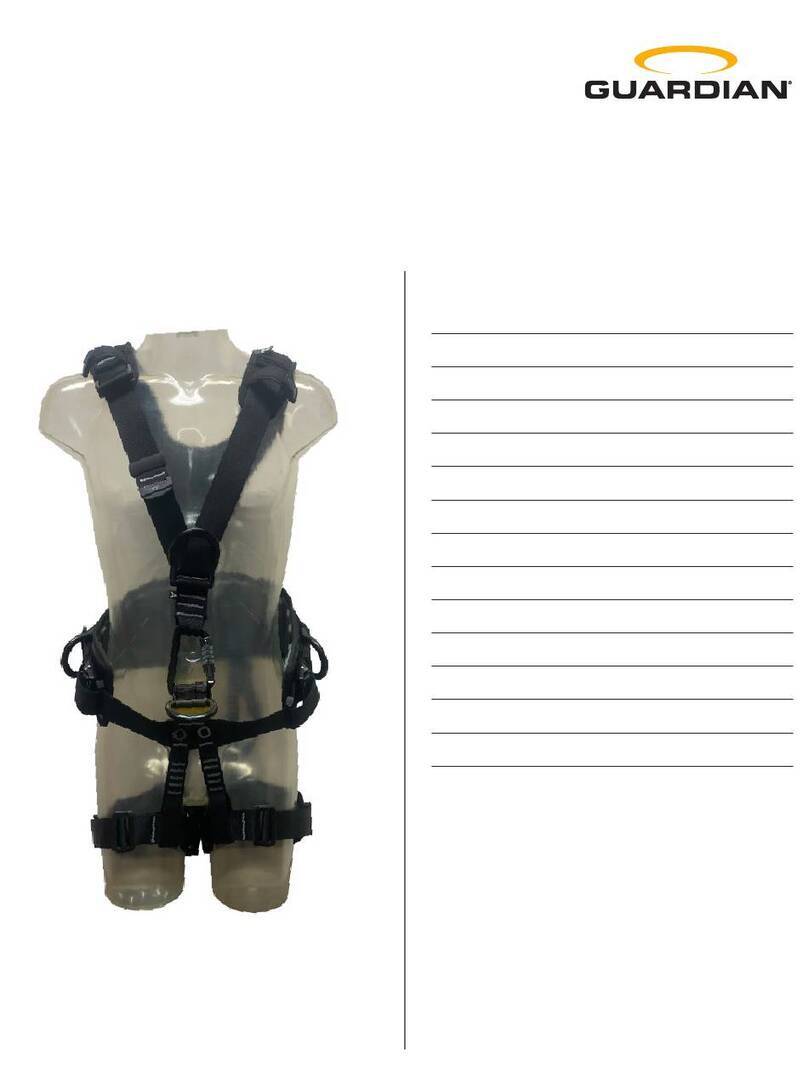
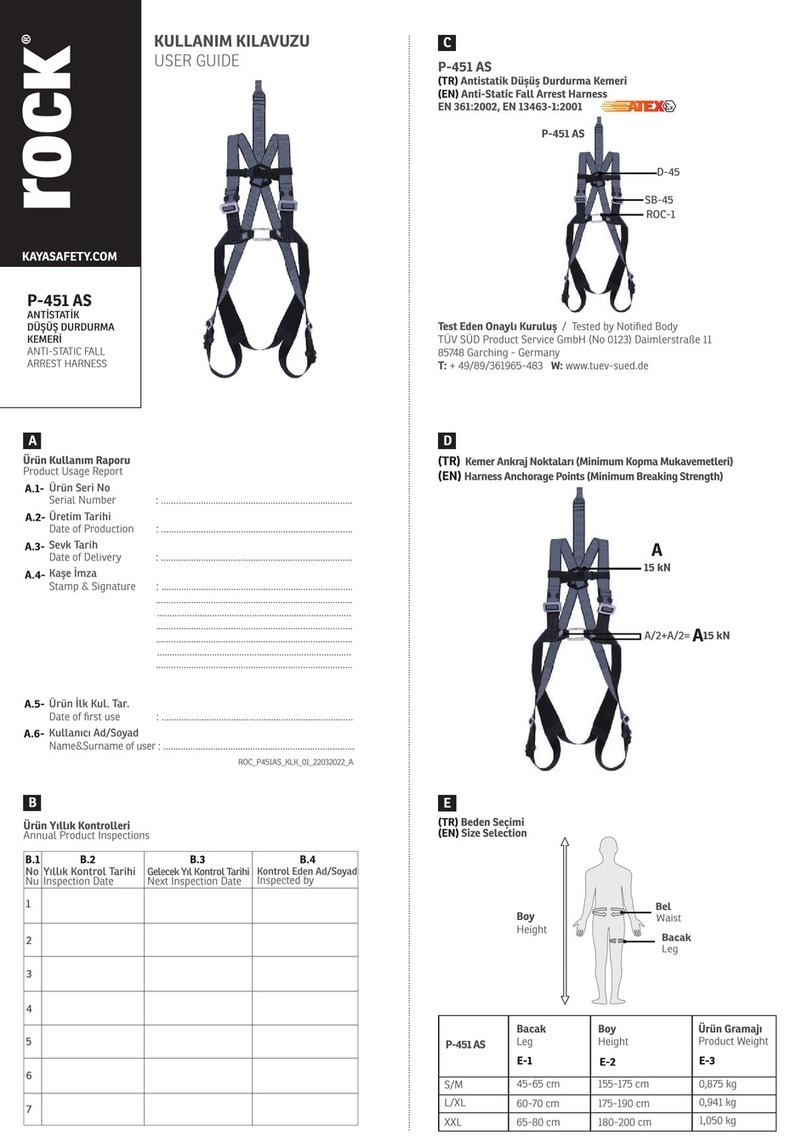
D-ring: Dorsal, Chest, Rescue D-ring (model
dependant)
Product Specific Applications
May be used to support a MAXIMUM 1 in
a Personal Fall Arrest System (PFAS)
for use in Fall Arrest applications only
when used in combination with an energy
absorbing device rated to reduce fall arrest
forces to no greater than 6kN. Maximum free fall
is 2m, or 4m if used in combination with
equipment explicitly certified for such use.
Certified fall arrest connection points are clearly
marked with an “A.” The Dorsal D-ring should
always be the primary attachment point,
although connection to Sternal D-ring is
permitted in cases where free fall is suiciently
limited, such as for Work Positioning, Ladder
Climbing, or Rescue.
D-ring: Dorsal
May be used in Restraint applications.
Restraint systems prevent a worker from
reaching the leading edge of a fall
hazard. Always account for fully deployed length
of lanyard/SRL. No free fall is permitted.
Restraint systems may only be used on surfaces
with slopes up to 4/12 (vertical/horizontal).
D-rings: Dorsal, Side
May be used in Work Positioning
applications. Work Positioning systems
allow a worker to be supported while in
suspension and work freely with both hands. No
free fall is permitted. Anchor point must be at or
above side D-rings. Always consider the need
for a backup fall arrest system if the potential
exists for exposure to a fall.
D-ring: Side (pairs only)
Waist belt should not be used if there is
a foreseeable risk of the user becoming
suspended or being exposed to unintended
tension by the waist belt. When using a work
positioning system, the user normally relies
on the equipment for support, therefore it is
essential to consider the need of using a backup
fall arrest system. For work positioning, always
use an anchor point positioned at or above waist
level.
English
Competent Person Definition
The job site safety supervisor, referred to in this manual as
the Competent Person (CP), must be a highly trained and
experienced person who is assigned by the employer to
be responsible for all elements of the fall safety program;
this includes, but is not limited to, program regulation,
management, and application. The CP must be proficient
in identifying existing and predictable fall hazards, and
must have the authority to stop work to eliminate hazards or
otherwise promote safe and compliant work practices.
Authorised Person Definition
A person who is assigned by their employer to work around
or be subject to potential or existing fall hazards.