manuals.online logo
Brands
  1. Home
  2. •
  3. Brands
  4. •
  5. marklin
  6. •
  7. Toy
  8. •
  9. marklin 39189 User manual

marklin 39189 User manual

Other marklin Toy manuals

marklin Baureihe 96 User manual

marklin

marklin Baureihe 96 User manual

marklin BR E 44 User manual

marklin

marklin BR E 44 User manual

marklin S88 AC User manual

marklin

marklin S88 AC User manual

marklin 37902 User manual

marklin

marklin 37902 User manual

marklin TVT User manual

marklin

marklin TVT User manual

marklin 69572 User manual

marklin

marklin 69572 User manual

marklin BR 220 User manual

marklin

marklin BR 220 User manual

marklin M2 User manual

marklin

marklin M2 User manual

marklin 36607 User manual

marklin

marklin 36607 User manual

marklin 21011 User manual

marklin

marklin 21011 User manual

marklin 39101 User manual

marklin

marklin 39101 User manual

marklin 72883 User manual

marklin

marklin 72883 User manual

marklin 37613 User manual

marklin

marklin 37613 User manual

marklin 37636 User manual

marklin

marklin 37636 User manual

marklin 37419 User manual

marklin

marklin 37419 User manual

marklin 72205 User manual

marklin

marklin 72205 User manual

marklin 29169 User manual

marklin

marklin 29169 User manual

marklin 39010 User manual

marklin

marklin 39010 User manual

marklin 30080 User manual

marklin

marklin 30080 User manual

marklin 5994 User manual

marklin

marklin 5994 User manual

marklin 37271 User manual

marklin

marklin 37271 User manual

marklin 5998 User manual

marklin

marklin 5998 User manual

marklin 37903 User manual

marklin

marklin 37903 User manual

marklin 36795 User manual

marklin

marklin 36795 User manual

Popular Toy manuals by other brands

FUTABA GY470 instruction manual

FUTABA

FUTABA GY470 instruction manual

LEGO 41116 manual

LEGO

LEGO 41116 manual

Fisher-Price ColorMe Flowerz Bouquet Maker P9692 instruction sheet

Fisher-Price

Fisher-Price ColorMe Flowerz Bouquet Maker P9692 instruction sheet

Little Tikes LITTLE HANDIWORKER 0920 Assembly instructions

Little Tikes

Little Tikes LITTLE HANDIWORKER 0920 Assembly instructions

Eduard EF-2000 Two-seater exterior Assembly instructions

Eduard

Eduard EF-2000 Two-seater exterior Assembly instructions

USA Trains EXTENDED VISION CABOOSE instructions

USA Trains

USA Trains EXTENDED VISION CABOOSE instructions

Modellbau Laffont Z1601 Assembly instructions

Modellbau Laffont

Modellbau Laffont Z1601 Assembly instructions

NOCH 12905 instruction manual

NOCH

NOCH 12905 instruction manual

Eduard Ki-61-Id quick start guide

Eduard

Eduard Ki-61-Id quick start guide

Viessmann Vollmer 45616 Mounting instruction

Viessmann

Viessmann Vollmer 45616 Mounting instruction

Vollmer 42004 Mounting instruction

Vollmer

Vollmer 42004 Mounting instruction

Phoenix Model CLASSIC-EP instruction manual

Phoenix Model

Phoenix Model CLASSIC-EP instruction manual

H-KING Sopwith Camel British WW1 Fighter instruction manual

H-KING

H-KING Sopwith Camel British WW1 Fighter instruction manual

MODSTER Predator 4x4 Crawler user manual

MODSTER

MODSTER Predator 4x4 Crawler user manual

DHK Hobby 8136 User instruction manual

DHK Hobby

DHK Hobby 8136 User instruction manual

THUNDER TIGER Raptor 50 V2 kit manual

THUNDER TIGER

THUNDER TIGER Raptor 50 V2 kit manual

Timberkits Skateboarder instructions

Timberkits

Timberkits Skateboarder instructions

Hangar 9 Funtana 125 Assembly manual

Hangar 9

Hangar 9 Funtana 125 Assembly manual

manuals.online logo
manuals.online logoBrands
  • About & Mission
  • Contact us
  • Privacy Policy
  • Terms and Conditions

Copyright 2025 Manuals.Online. All Rights Reserved.

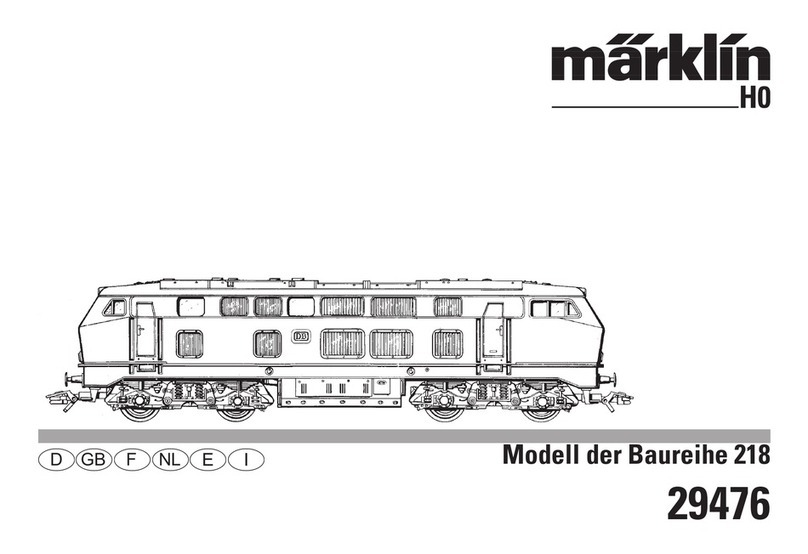
Modell der BR 210
39189
2
Information zum Vorbild
Ausgehend von der Baureihe V 160 führte die Entwicklung über
einen Zeitraum von 15 Jahren und mehreren Varianten zum
Bau der Serienlokomotiven der Baureihe 218. Zur Zeit ihrer
Auslieferung im Jahr 1971 repräsentierten sie die modernste
Konzeption einmotoriger Großdiesellokomotiven für den Einsatz
vor schweren Reise- und Güterzügen. All die Erfahrungen, die
man mit den Baureihen 215 und 216 gesammelt hatte, konnten
bei der BR 218 verwertet werden.
Neu war jetzt der Einbau einer hydrodynamischen Bremse,
wodurch die Höchstgeschwindigkeit auf 140 km/h angehoben
werden konnte und eine elektrische Zugheizung statt der
bisherigen Dampfheizung. Der neue 12-Zylinder-Motor von MAN
und Maybach-Mercedes erbrachte mit 2500 PS ausreichend
Leistung für den Generator der Heizung und den hydraulischen
Antrieb der Lokomotive. Ein Hilfsmotor war somit nicht mehr
nötig. Lieferanten der BR 218 waren die Firmen Krupp, Krauss-
Maffei und Rheinstahl.
Die zuverlässige BR 218 wird in ganz Deutschland vor Güter- und
Reisezügen bis hin zum Intercity eingesetzt, sowohl einzeln als
auch in Doppeltraktion. Zahlreiche Farbvarianten gab und gibt es
von purpurrot über ozeanblau-beige bis zu orientrot mit weißem
„Lätzchen“ auf der Stirnseite, heute in verkehrsrot mit weißem
Querbalken. Daneben als einzige die 218 217-8 in TEE-Farben
und 10 Loks in den Farben der City-Bahn Köln-Gummersbach
orange-kieselgrau.
Die Baureihe 210 entstand als Variante der BR 218, bei der
zusätzlich eine Gasturbine mit 1200 PS eingebaut wurde. In den
Jahren 1980/81 wurden die Turbinen jedoch wieder ausgebaut.
Information about the Prototype
Starting with the class V 160, the development of the class 218
regular production locomotives proceeded over a time period
of 15 years and several variants to the construction of regular
production locomotives. At the time they were delivered in 1971,
they represented the most up-to-date concept for single-mo-
tor large diesel locomotives for use with heavy passenger and
freight trains. All of the experience gathered with the classes
215 and 216 was utilized in the class 218.
The installation of hydrodynamic brakes as new, which allowed
the maximum speed to be raised to 140 km/h / 88 mph, as was
electric train heating instead of the previous steam heat. The
new 12-cylinder motor from MAN and Maybach-Mercedes
produced 2,500 horsepower, sufficient for the generator for the
heating and for the hydraulic drive system for the locomotive. An
auxiliary motor was no longer necessary. Builders of the
class 218 were the firms Krupp, Krauss-Maffei, and Rheinstahl.
The reliable class 218 is used all over Germany for freight and
passenger trains up to and including Intercity express trains,
individually as well as in multiple unit operation. There were
and are numerous color variations from crimson red to ocean
blue / beige to Chinese red white “bibs“ on the ends, at present
in “traffic“ red with white rectangles. In addition to that, there
is road number 218 217-8 as the only unit in TEE colors and 10
locomotives in the colors of the City-Bahn from Cologne to Gum-
mersbach in orange / gravel gray.
The class 210 was derived from the class 218, which had a gas
turbine with 1,200 horsepower added to it. The turbines were
removed again however in the years 1980/81.
3
Informations concernant la locomotive réele
Après 15 ans et de nombreuses variantes, le développement
de la série V 160 finit par aboutir à la construction en série des
locomotives de la série 218. En 1971, date de leur livraison, elles
représentaient la conception la plus moderne de locomotives
diesel monomoteur de grande taille pour la traction de lourds
trains voyageurs et marchandises. Toutes les expériences
accumulées avec les séries 215 et 216 pouvaient être mises à
profit pour la BR 218.
Les nouveautés : un frein hydrodynamique permettant
d’atteindre une vitesse maximale de 140 km/h et un chauffage
électrique remplaçant celui au gaz existant jusqu’alors. Avec
ses 2500 ch, le nouveau moteur à 12 cylindres de MAN et
Maybach-Mercedes fournissait une puissance suffisante pour
le générateur du chauffage et la transmission hydraulique de
la locomotive. Un moteur auxiliaire devenait ainsi superflu. Les
fournisseurs de la BR 218 étaient les firmes Krupp, Krauss-Maf-
fei et Rheinstahl.
La BR 218, engin fiable, est alors utilisée dans toute l’Allemagne
pour la traction de trains marchandises et voyageurs – dont
l’Intercity -, aussi bien seule qu’en double traction. Il y eut et il
existe encore de nombreuses variantes de livrées, du pourpre
jusqu’au rouge oriental avec un «bavoir» blanc sur la face frontale
en passant par le bleu océan/beige ; les machines sont aujourd’hui
dotées d’une livrée rouge trafic avec des bandes transversales
blanches. Mais également : la 218 217-8, unique machine aux
couleurs du TEE et 10 locomotives en livrée organge-gris caillou,
couleurs de la City-Bahn Köln-Gummersbach.
La série 210 est une variante de la BR 218 à laquelle avait été
intégrée une turbine à gaz supplémentaire de 1200 ch. Dans
les années 1980/81, ces turbines furent toutefois à nouveau
supprimées.
Informatie van het voorbeeld
De BR V 160 leidde over een periode van 15 jaar en meerdere va-
rianten tot de ontwikkeling en de bouw van de serielocomotief,
de BR 218. Op het moment dat de loc in 1971 werd afgeleverd,
representeerde deze het modernste ontwerp van een éénmo-
torige grote dieselloc voor zware reiziger- en goederentreinen.
Alle ervaringen die men met de serie 215 en 216 had verzameld,
konden bij de bouw van de BR 218 benut worden.
Nieuw was het inbouwen van een hydrodynamische rem, waar-
door de maximumsnelheid tot 140 km/h verhoogt kon worden en
de elektrische rijtuigverwarming in plaats van de tot dan gebrui-
kelijke stoomverwarming. De nieuwe twaalfcilinder dieselmotor
van MAN en Maybach-Mercedes leverde een vermogen van
2500 pk, ruim voldoende voor de verwarmingsgenerator en de
hydraulische aandrijving van de locomotief. Een hulpmotor was
zodoende niet meer nodig. De leveranciers van de BR 218 waren
de firma’s Krupp, Krauss-Maffei en Rheinstahl.
De betrouwbare BR 218 werd in heel Duitsland voor goederen-
en reizigertreinen tot en met de intercity ingezet, zowel alleen
als in een dubbeltractie. Er zijn talrijke kleurvarianten geweest
en deze zijn er nog, van purperrood, via oceaanblauw-beige
tot oriëntrood met een wit “slabbetje” op het front en op dit
moment in de kleurstelling verkeersrood met witte dwarsbalken.
Daarnaast, als enige de 218 217-8 in de TEE-kleuren en 10 loc’s
in oranje-kiezelgrijs, de kleuren van de City-Bahn Keulen-Gum-
mersbach.
De serie 210 is ontstaan als variant van de BR 218. Hierbij werd
er een extra gasturbine ingebouwd met een vermogen van
1200 pk. In de jaren 1980/81 werden deze turbines echter weer
verwijderd.

4
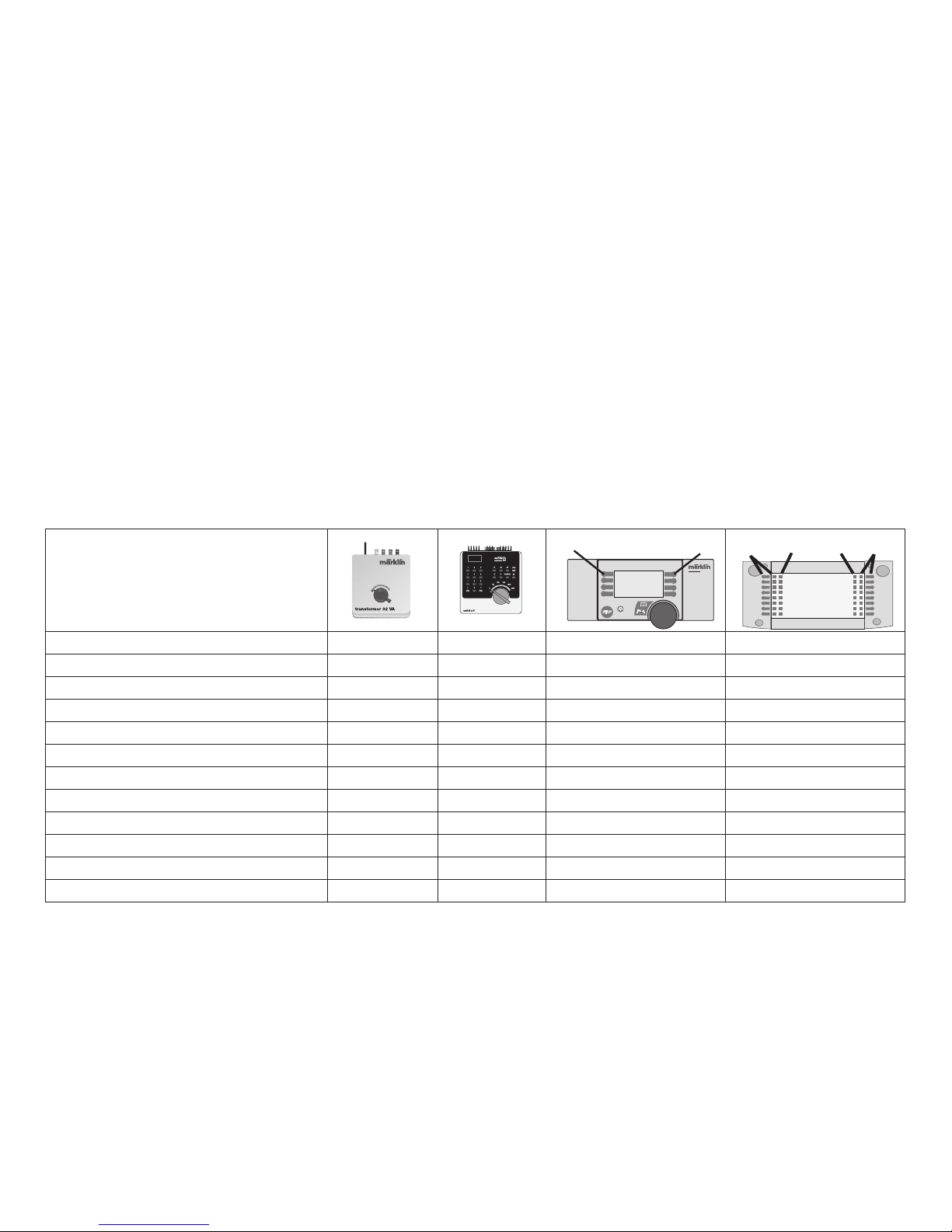
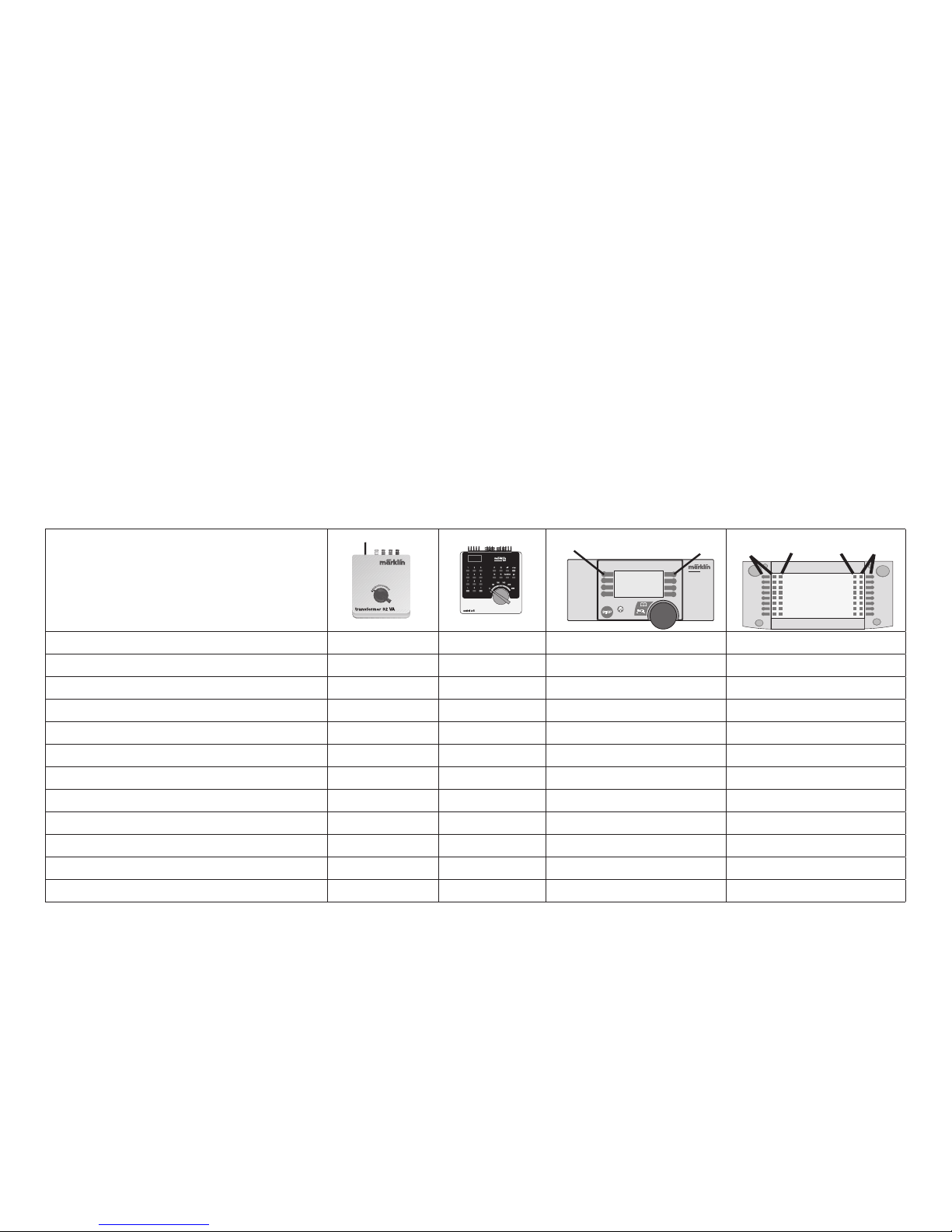
Schaltbare Funktionen
Spitzensignal Ein function + off Licht-Taste Taste f0
Geräusch: Gasturbine — f1 Taste 3 Taste f1
Geräusch: Betriebsgeräusch — f2 Taste 2 Taste f2
Geräusch: Signalhorn tief — f3 Taste 6 Taste f3
Rangiergang (nur ABV) — f4 Taste 4 Taste f4
Geräusch: Bremsenquietschen aus — — Taste 7 Taste f5
Stirnbeleuchtung Führerstand 2 aus — — Taste 1 Taste f6
Geräusch: Signalhorn hoch — — Taste 5 Taste f7
Stirnbeleuchtung Führerstand 1 aus — — Taste 8 Symbol f8
Geräusch: Bahnhofsansage — — — Symbol f9
Geräusch: Schaffnerpfiff — — — Symbol f10
Geräusch: Kompressor — — — Symbol f11
Funktion
• Mögliche Betriebssysteme: Märklin Transformer 6647,
Märklin Delta, Märklin Digital, Märklin Systems.
• Erkennung der Betriebsart: automatisch.
• Softdrive Sinus-Antrieb mit wartungsfreiem Motor.
• Fahrtrichtungsabhängige Stirnbeleuchtung.
• Einstellbare Adressen: 01 – 80.
Adresse ab Werk: 21
• Mfx-Technologie für Mobile Station / Central Station.
Name ab Werk: BR 210 001-4
STOP mobile station
systems
15
central
station
60212
f0 f0f8
f8
• Veränderbare Anfahr/Bremsverzögerung (ABV).
• Veränderbare Höchstgeschwindigkeit.
• Einstellen der Lokparameter elektronisch über
Control Unit, Mobile Station oder Central Station.
• Eingebaute Geräuschelektronik, nur im Betrieb mit Control Unit
oder Märklin Systems nutzbar.
• Zusätzliche schaltbare Geräusche.
• Veränderbare Lautstärke der Geräusche.
5
Lokparameter einstellen mit der Control Unit
1. Voraussetzung: Aufbau wie Grafik S. 20.
Nur die zu verändernde Lok ist auf dem Gleis.
2. „Stop“- und „Go“-Taste gleichzeitig drücken, bis „99“ in der
Anzeige aufblinkt.
3. „Stop“-Taste drücken.
4. Lokadresse „80“ eingeben.
5. Umschaltbefehl am Fahrregler halten. Während des Haltens
die „Go“-Taste drücken.
6. Licht der Lok blinkt langsam. Wenn nicht, ab Schritt 2 wie-
derholen.
7. Registernummer für den zu ändernden Parameter eingeben
(=> Liste auf Seite 22).
8. Fahrtrichtungswechsel betätigen.
9. Licht blinkt schnell.
10. Neuen Wert eingeben (=> Liste auf Seite 22).
11. Fahrtrichtungswechsel betätigen.
12. Licht blinkt langsam (Ausnahme Werkreset).
13. Nächste Parametereinstellung ab 6. oder beenden mit 14.
14. Vorgang beenden mit Drücken der „Stop“- Taste. Anschlie-
ßend Drücken der „Go“-Taste.
Central Station/Mobile Station
siehe jeweilige Gerätebeschreibung.
Zugunsten der guten Fahreigenschaften ist an dem Modell
die VMAX auf 88% (Mobile Station) bzw. 225 (Central Station)
voreingestellt. Ein weiteres Anheben dieses Wertes hat keine
Geschwindigkeitserhöhung zur Folge, sondern beeinflusst nur
die Fahreigenschaften negativ.
Sicherheitshinweise
• Die Lok darf nur mit einem dafür bestimmten Betriebssystem
(Märklin Wechselstrom-Transformator 6647, Märklin Delta,
Märklin Digital oder Märklin Systems) eingesetzt werden.
Keinesfalls Transformatoren für eine Eingangsspannung von
220 V - für USA 110 V - verwenden.
• Für den konventionellen Betrieb der Lok muss das Anschluss-
gleis entstört werden. Dazu ist das Entstörset 74046 zu ver-
wenden. Für Digitalbetrieb ist das Entstörset nicht geeignet.
• Beachten Sie unbedingt die Sicherheitshinweise in der
Gebrauchsanleitung zu Ihrem Betriebssystem.
Die bei normalem Betrieb anfallenden Wartungsarbeiten sind
nachfolgend beschrieben. Für Reparaturen oder Ersatzteile
wenden Sie sich bitte an Ihren Märklin-Fachhändler.
Jegliche Garantie-, Gewährleistungs- und Schadensersatzansprüche sind
ausgeschlossen, wenn in Märklin-Produkten nicht von Märklin freigege-
bene Fremdteile eingebaut werden und / oder Märklin-Produkte umgebaut
werden und die eingebauten Fremdteile bzw. der Umbau für sodann aufge-
tretene Mängel und / oder Schäden ursächlich war. Die Darlegungs- und
Beweislast dafür, dass der Einbau von Fremdteilen oder der Umbau in bzw.
von Märklin-Produkten für aufgetretene Mängel und / oder Schäden nicht
ursächlich war, trägt die für den Ein- und / oder Umbau ver antwortliche
Person und / oder Firma bzw. der Kunde.ö
WARNUNG! Dieses Produkt enthält Magnete. Das Verschlucken von mehr
als einem Magneten kann unter Umständen tödlich wirken. Gegebenenfalls
ist sofort ein Arzt aufzusuchen.
6
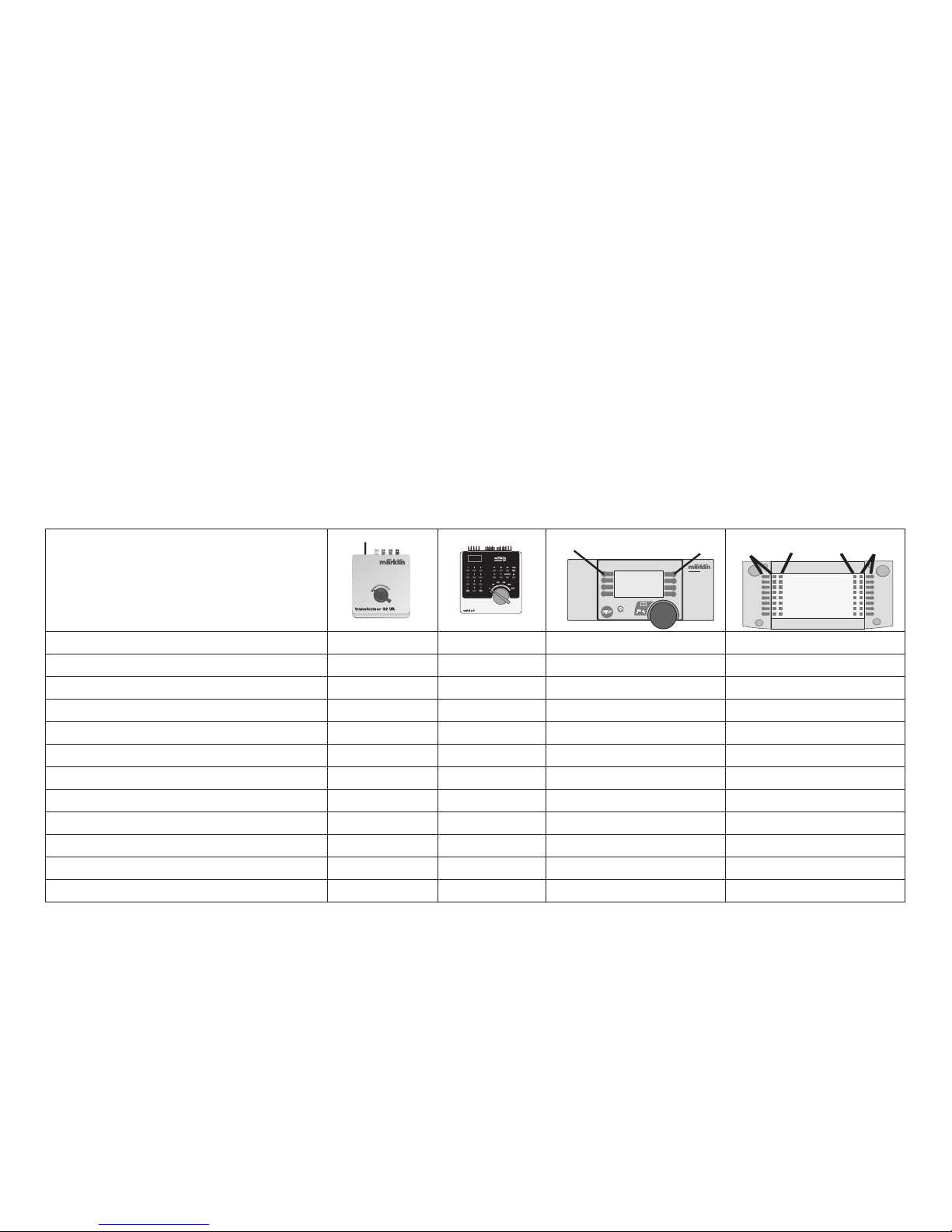
Controllable Functions
Headlights/marker lights On function + off Headlight button Button f0
Sound effect: Gas turbine — f1 Button 3 Button f1
Sound effect: Operating sounds — f2 Button 2 Button f2
Sound effect: Low pitched horn — f3 Button 6 Button f3
Low speed switching range (ABV) — f4 Button 4 Button f4
Sound effect: Squealing brakes off — — Button 7 Button f5
Headlights at engineer´s cab 2 off — — Button 1 Button f6
Sound effect: High pitched horn — — Button 5 Button f7
Headlights at engineer´s cab 1 off — — Button 8 Symbol f8
Sound effect: Station announcements — — — Symbol f9
Sound effect: Conductor whistle — — — Symbol f10
Sound effect: compressor — — — Symbol f11
• Adjustable Braking delay.
• Adjustable maximum speed.
• Setting the locomotive parameters electronically with the
Control Unit, Mobile Station or Central Station.
• Built-in sound effects circuit, can only be used in operation
with the Control Unit or Märklin Systems.
• Volume can be changed for the sound effects
• Additional sound effects that can be controlled.
Function
• Possible operating systems: 6646/6647 Märklin Transformer,
Märklin Delta, Märklin Digital, Märklin Systems.
• Recognition of the mode of operation: automatic.
• Softdrive Sinus propulsion with a maintenance-free motor.
• Headlights, changing over with the direction of travel.
• Addresses that can be set: 01 – 80
Address set at the factory: 21
• Mfx technology for the Mobile Station / Central Station.
Name set at factory: BR 210 001-4
STOP mobile station
systems
15
central
station
60212
f0 f0f8
f8
7
Setting Locomotive Parameters with the
Control Unit
1. Requirement: Setup as in diagram on page 20. Only the
locomotive to be changed can be on the track.
2. Press the “Stop” and “Go” at the same time until “99” blinks
in the display.
3. Press the “Stop” button.
4. Enter the locomotive address “80“.
5. Hold the control knob in the reverse direction area. While
holding the control knob here, press the “Go“ button.
6. The headlights on the locomotive will blink slowly. If they
don‘t, repeat Step 2.
7. Enter the register number for the parameter to be changed
(=> List on page 22).
8. Active the change of direction.
9. The headlights will blink rapidly.
10. Enter the new value (=>List on page 22).
11. Active the change of direction.
12. The headlights will blink slowly (exception: factory reset)
13. Enter the next parameter setting from 6 or end with 14.
14. End the process by pressing the “Stop“ button. Then press
the “Go“ button.
Central Station/Mobile Station:
see the description for the unit in question.
The VMAX has been preset at 88% (Mobile Station) and at 225
(Central Station) on the model in order to give good running
characteristics. Raising this value further will not increase
the speed; it will only have a negative effect on the running
characteristics.
Safety Warnings
• This locomotive is to be used only with an operating system
designed for it (Märklin 6646/6647 AC trans-former,
Märklin Delta, Märklin Digital or Märklin Systems). Under no
circumstances should transformers rated for an input of 220
volts be connected to the American 110 volt household current
system.
• The feeder track must be equipped to prevent interference
with radio and television reception, when the locomotive is to
be run in conventional operation. The 74046 interference sup-
pression set is to be used for this purpose. The interference
suppression set is not suitable for digital operation.
• Pay close attention to the safety warnings in the
instructions for your operating system.
The maintenance work necessary with normal operation of
this locomotive is described below. Please see your authorized
Märklin dealer for repairs or spare parts.
No warranty or damage claims shall be accepted in those cases where
parts neither manufactured nor approved by Märklin have been installed
in Märklin products or where Märklin products have been converted in
such a way that the non-Märklin parts or the conversion were causal to the
defects and / or damage arising. The burden of presenting evidence and
the burden of proof thereof, that the installation of non-Märklin parts or the
conversion in or of Märklin products was not causal to the defects and / or
damage arising, is borne by the person and / or company responsible for
the installation and / or conversion, or by the customer.
WARNING! This product contains magnets. Swallowing more than one
magnet may cause death in certain circumstances. If necessary, see a
doctor immediately.
8
Fonctions commutables
Fanal éclairage Marche function + off Touche Lumière Touche f0
Bruitage : Turbine à gaz — f1 Touche 3 Touche f1
Bruitage : Bruit d’exploitation — f2 Touche 2 Touche f2
Bruitage : trompe, signal grave — f3 Touche 6 Touche f3
Vitesse de manœuvre (Acc./Fr) — f4 Touche 4 Touche f4
Bruitage : Grincement de freins désactivé — — Touche 7 Touche f5
Fanal de la cabine de conduite 2 éteint — — Touche 1 Touche f6
Bruitage : trompe, signal aigu — — Touche 5 Touche f7
Fanal de la cabine de conduite 1 éteint — — Touche 8 Symbole f8
Bruitage : Annonce en gare — — — Symbole f9
Bruitage : Sifflet Contrôleur — — — Symbole f10
Bruitage : Compresseur — — — Symbole f11
• Temporisation d’accélération réglable.
• Vitesse maximale réglable.
•
Réglage des paramètres de la loco électroniquement à l’aide
de la Control Unit, de la Mobile Station ou de la Central Station
.
• Bruiteur électronique intégré, utilisable uniquement lors
d’exploitation avec la Control Unit ou Märklin Systems.
• Volume des bruitages réglable
• Bruitages complémentaires commutables.
Fonction
• Systèmes d’exploitation possibles : Märklin Transformer 6647,
Märklin Delta, Märklin Digital, Märklin Systems.
• Détection du mode d’exploitation : automatique.
• SoftdriveSinus avec moteur sans entretien
• Feux de signalisation avec inversion selon sens de marche.
• Adresses disponibles : 01 – 80.
Adresse encodée en usine : 21
• Technologie Mfx pour Mobile Station / Central Station. Nom en
codee en usine : BR 210 001-4
STOP mobile station
systems
15
central
station
60212
f0 f0f8
f8
9
Réglage des paramètres de la loco avec la Control Unit
1. Condition: Montage comme sur illustration en page 20.
Seule la loco à modifier peut se trouver sur la voie.
2. Pressez simultanément les touches «Stop» et «Go» jusqu’à
ce que le nombre «99» clignote sur l’écran.
3. Pressez la touche «Stop».
4. Introduisez l’adresse de loco „80“.
5.
Maintenir l’ordre de commutation sur le régulateur de marche.
Durant le maintien, appuyer sur la touche «Go».
6. Les feux de la locomotive clignotent lentement. Dans le cas
contraire, renouveler l’opération à partir de l’étape 2.
7. Indiquer le numéro d’enregistrement pour le paramètre à
modifier (=> liste page 22).
8. Activer l’inversion du sens de marche.
9. Les feux clignotent rapidement.
10. Entrer la nouvelle valeur (=> liste page 22).
11. Activer l’inversion du sens de marche.
12. Les feux clignotent lentement (exception : réinitialisation aux
valeurs d’usine).
13. Définition de paramètres suivante à partir du point 6 ou
terminer par le point 14.
14. Terminez le processus en pressant la touche «Stop“«
Ensuite, pressez la touche «Go».
Central Station/Mobile Station :
voir descriptions respectives des appareils.
En faveur de l’une des bonnes caractéristiques de roulement, la
VMAX du modèle est préréglée sur 88% (Mobile Station) ou 225
(Central Station). L’augmentation de cette valeur n’augmentera
pas la vitesse, mais risque uniquement d’altérer les caractéristi-
ques de roulement.
Remarques importantes sur la sécurité
• La locomotive ne peut être mise en service qu’avec un
système d’exploitation adéquat (Märklin courant alternatif
- transformateur 6647, Märklin Delta, Märklin Digital ou
Märklin Systems). N’utilisez en aucun cas de transformateurs
pour une tension à l’entrée de 220 V - 110 V pour les Etats-Unis.
• Pour l’exploitation de la locomotive en mode conventionnel,
la voie de raccordement doit être déparasitée. A cet effet,
utiliser le set de déparasitage réf. 74046. Le set de déparasita-
ge ne convient pas pour l’exploitation en mode numérique.
• Veuillez impérativement respecter les remarques sur la
sécurité décrites dans le mode d’emploi de votre système
d’exploitation.
Les travaux d‘entretien occasionnels à effectuer en exploitation
normale sont décrits plus loin. Pour toute réparation ou rempla-
cement de pièces, adressez- vous à votre détaillant-spécialiste
Märklin.
Tout recours à une garantie commerciale ou contractuelle ou à une
demande de dommages-intérêt est exclu si des pièces non autorisées
par Märklin sont intégrées dans les produits Märklin et / ou si les produits
Märklin sont transformés et si les pièces d’autres fabricants montées
ou la transformation constituent la cause des défauts et / ou dommages
apparus. C’est à la personne et / ou la société responsable du montage
/ de la transformation ou au client qu’incombe la charge de prouver que
le montage des pièces d’autres fabricants sur des produits Märklin ou la
transformation des produits Märklin n’est pas à l’origine des défauts et ou
dommages apparus.
ATTENTION ! Ce produit contient des aimants. L’ingestion de plusieurs
aimants peut être mortelle. Le cas échéant, consulter immédiatement un
médecin.
10
Schakelbare functies
Frontsein Aan functie + off Verlichtingstoets Toets f0
Geluid: Gasturbine — f1 Toets 3 Toets f1
Geluid: bedrijfsgeluiden — f2 Toets 2 Toets f2
Geluid: signaalhoorn laag — f3 Toets 6 Toets f3
Rangeerstand (optrek- afremvertraging) — f4 Toets 4 Toets f4
Geluid: piepende remmen uit — — Toets 7 Toets f5
Frontverlichting Cabine 2 uit — — Toets 1 Toets f6
Geluid: signaalhoorn hoog — — Toets 5 Toets f7
Frontverlichting Cabine 1 uit — — Toets 8 Symbool f8
Geluid: stationsomroep — — — Symbool f9
Geluid: conducteurfluit — — — Symbool f10
Geluid: compressor — — — Symbool f11
• Instelbare optrek- /afremvertraging.
• Instelbare maximumsnelheid.
• Elektronische instelling van de locomotiefparameters via de
Control Unit, Mobile Station of Central Station.
• Ingebouwde geluidselektronica, alleen bruikbaar in het bedrijf
met de Control Unit of Märklin Systems.
• Volume van de geluiden instelbaar.
• Extra schakelbare geluiden.
Werking
• Mogelijke bedrijfssystemen: Märklin Transformer 6647,
Märklin Delta, Märklin Digital, Märklin Systems.
• Herkenning van het bedrijfssysteem: automatisch.
• SoftdriveSinus met onderhoudsvrije motor.
• Rijrichtingafhankelijke frontseinen.
• Instelbare adressen: 01-80
Vanaf de fabriek: 21
• Mfx-technologie voor het Mobile Station / Central Station.
Naam af de fabriek: BR 210 001-4
STOP mobile station
systems
15
central
station
60212
f0 f0f8
f8