WARNING!
• This respirator/filter provides LIMITED protection. A respirator paired with an appropriate particulate filter may help reduce
exposure to airborne biological agents, including H1N1 (swine) flu virus, avian (bird) flu virus, other types of influenza,
SARS, or other bacterial or viral biological agents and help reduce the risk for infection during a pandemic, but WILL NOT
ELIMINATE the risk of exposure, infection, illness, or death.
• This respirator/filter is certified by NIOSH to comply with the requirements specified for the designated filter efficiency
level; however, appropriate authorities have NOT established a safe level of exposure to biological agents. Therefore, the
respirator may NOT prevent transmission of influenza virus.
• Refer to the Centers for Disease Control and Prevention (CDC) at www.cdc.gov for guidance on the use of respirators to
help decrease exposure to viral pathogens or other airborne biological agents in community, home, and occupational
settings. The CDC recommends fit testing, medical evaluations, and training for optimal effectiveness when a respirator is
used in a non-occupational setting. Neglecting these preparatory measures may cause an unsafe condition. Respirators
used in an occupational setting MUST be used in accordance with a complete respiratory protection program as required by
OSHA, which includes proper selection, training, fit-testing, and fitchecking. Detailed information on a respiratory
protection program is available by contacting OSHA or visiting www.osha.gov.
• Do NOT remove respirator in contaminated areas. The outer surface of the respirator MUST be treated as if it is
contaminated at all times. Tight-fitting safety goggles, or a full-facepiece respirator, may further help prevent transmission
of viral pathogens or other airborne biological agents.
• The CDC recommends frequent hand washing and wearing gloves to help prevent transmission of disease due to exposure
to surfaces where contaminants may be present, and also immediately following removal of the respirator.
• Do NOT reuse or share maintenance-free respirators. ALWAYS clean cartridge-style respirators before reuse in
accordance with the instructions provided.
• This respirator/filter is NOT for use by (a) children, or (b) people with a medical condition that may be adversely affected by
using it.
• This respirator is equipped with an exhalation valve. Exhaled air from the user passes, unfiltered, through the exhalation
valve and into the surrounding environment. Do not use where a sterile field is required.
• NIOSHdoes not evaluate respirators for use as surgical masks.
Failure to follow these warnings can result in serious personal injury or death.
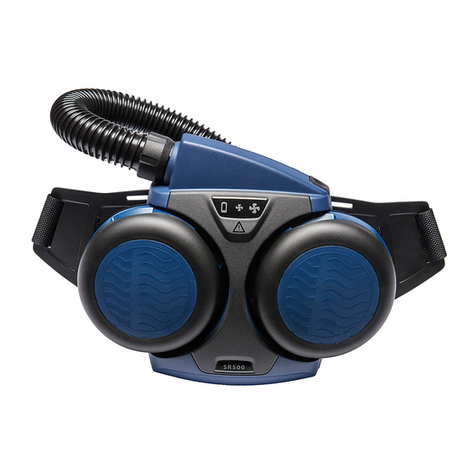
The tight-fitting OptimAir TL PAPR must be properly prepared for use, properly donned, and a negative pressure leak test must
be conducted in an area known to be free of contaminants before it can be used.
Before entry into a contaminated area, the maximum safe duration of use must be determined. The maximum safe duration of
use depends primarily on:
• The amount and type of contamination in the air and the capacity of the cartridge to filter that contaminant.
• The amount of airborne particles (dust) in the atmosphere.
• The charge contained in the battery.
• The physiological limits of the respirator user.
The maximum expected cartridge life shall be determined based on the amount of contaminant in the atmosphere and the
capacity of the cartridges together with the expected air flow through the cartridges.
A fully charged battery may be used for a minimum of four (4) hours depending on the cartridge type used and the conditions
under which the PAPR is used.
OptimAir TL PAPR 7
US 1 Introduction