Ottobock | 97E8
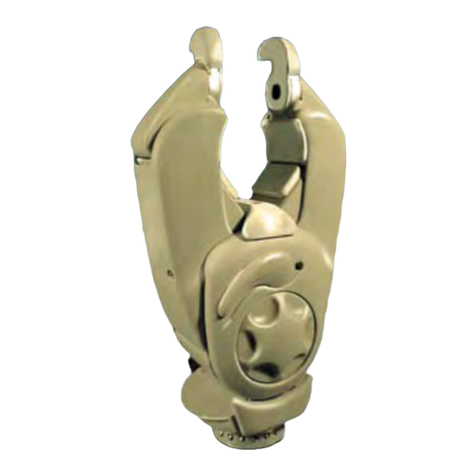
The hip joint and socket attachment plate are located anterior on the hip socket. Due to this arran-
gement and the low structural height (equalling the thickness of the laminate) a minimal amount
of pelvic tilt will occur when the patient sits down.
The lower joint section takes up the proximal end of the tube adapter which provides the connec-
tion to the knee joint.
3 Alignment
For connection to the knee joint the angular 2R48 Tube Adapter is available which is provided
for children up to a body height of approx. 120 cm. If the tube length which has consciously been
limited does not sufce, the 2R41=2 Tube Adapter may be employed (g. 2). In borderline cases,
especially with children which are somewhat corpulent and more than 140 cm tall, the 7E7 Hip
Joint is recommended.
4 Adjustment of the joint
4.1 Adjusting the tension of the extension assist
Turn the adjustment nut to increase or decrease the spring tension (g. 3).
Turning clockwise = increased tension
Turning counterclockwise = decreased tension
4.2 Adjusting abduction/adduction
Loosen the two cap screws with a 4 mm Allen wrench and position the joint on the attachment
plate (g. 4).
4.3 Adjusting exion/extension
Loosen the locking screw on the right side of the joint using a 1.5 mm Allen wrench (g. 5).
By means of the adjustment screw on the left side, exion and extension position, respectively are
adjusted with a 2.5 mm Allen wrench (g. 6).
Turning clockwise = increased exion
Turning counterclockwise = increased extension
Both Allen wrenches are enclosed.
5 Instructions for joint attachment
5.1 Reinforcing the attachment plate
When adapting the socket attachment plate to the plaster model, its anterior part should not be
bent, so that contact with the whole joint surface is provided. For safe attachment in the resin
laminate, the socket attachment plate must be prepared: Close the tapped bore holes with Plas-
tilin. Pass 699B1 Fiberglass Roving through the bore holes of the attachment plate and leave a
protruding length of approx. 4 cm (g. 7).
The hip socket lay-up of stockinette should be partially reinforced with 616G12 Carbon Fiber
Webbing. According to the strain, which may be expected due to the patient's weight and height,
carbon ber up to 3 layers should be applied between the perlon stockinette, each under and
over the socket attachment plate (g. 8).
5.2 Securing the abduction/adduction position
When denitively nishing the prosthesis, mark the joint position on the hip socket (g. 9).
Remove the joint from the hip socket, x the enclosed pattern with the cap screw and mark the
bore hole for the locking screw (g. 10).
Bore through the attachment plate and laminate using a 5 mm drill (g. 11).
Screw in the enclosed locking screw with a 3 mm Allen wrench (g. 12).