Trix 11632 User manual

Modell der Dampflokomotive BB II
11632
D GB USA F

2

3
Inhaltsverzeichnis Seite
Informationen zum Vorbild 4
Sicherheitshinweise 6
Wichtige Hinweise 6
Funktionen 6
Hinweis zum Digitalbetrieb 6
Schaltbare Funktionen 7
Configurations Variablen (DCC, CVs) 8
Parameter (SX2) 10
Wartung und Instandhaltung 24
Ersatzteile 30
Table of Contents Page
Information about the prototype 4
Safety Notes 12
Important Notes 12
Functions 12
Note on digital operation 12
Controllable Functions 13
Configuration Variables (DCC, CVs) 14
Paramètre (SX2) 16
Service and maintenance 24
Spare Parts 30
Sommaire Page
Informations concernant la locomotive réelle 5
Remarques importantes sur la sécurité 18
Information importante 18
Fonctionnement 18
Remarques relatives au fonctionement en mode digital 18
Fonctions commutables 19
Variables de configuration (DCC, CVs) 20
Parameter (SX2) 22
Entretien et maintien 24
Pièces de rechange 30

4
Informationen zum Vorbild
Im Rahmen des Ausbaus der bayerischen Lokalbahnen
wurden zunehmend Lokomotiven benötigt, die starke
Steigungen und enge Radien bewältigen konnten. Maffei
baute daraufhin eine 4-Zylinder-Verbund-Lokomotive der
Bauart Mallet.
Der hintere feste Hauptrahmen trug die Hochdruckzylinder
und im vorderen beweglichen Antriebsdrehgestell waren
die Niederdruckzylinder angeordnet. Da diese Lokomotiven
jedoch sehr unruhig liefen und zum Entgleisen neigten,
wurden sie von der DRG schon Mitte der 30er-Jahre des
letzten Jahrhunderts wieder ausgemustert und größtenteils
als Werkslokomotiven verkauft. So z.B. die „Zuckersusi“,
die an die Zuckerfabrik Regensburg geliefert wurde. Sie war
dort bis 1972 im Dienst und steht heute bei der Deutschen
Museums-Eisenbahn in Darmstadt.
Achsanordnung B‘B
Länge ü. Puffer 10.010 mm
Höchstgeschwindigkeit 45 km/h
Dienstmasse 42,6 t
Nennleistung 265 kW (380 PS)
Baujahr ab 1899
Wheel arrangement 0-4-4-0T
Length over the buffers 10.010 mm / 32 ft. 10-1/8
in.
Maximum speed 45 km/h / 28 mph
Service weight 42.6 metric tons
Nominal power 265 kilowatts / 380 hp
Built starting in 1899
Information about the Prototype
As part of the expansion of the Bavarian Local Railroad,
there was an increasing need for locomotives capable
of mastering the steep grades and sharp curves on this
railroad. Maffei built a 4-cylinder compound Mallet design
locomotive for this purpose.
The rear rigid main frame supported the high pressure
cylinders and the low pressure cylinders were located in
the front pivoting frame. Since these locomotives were
not very smooth in their operation and since they had a
tendency to derail, they were retired by the DRG as early as
the mid-1930s and were sold for the most part as industrial
locomotives. An example is the “Sugar Susie”, which was
sold to the Regensburg Sugar Refinery. It was in service
there until 1972 and is now at the German Railroad Museum
in Darmstadt.

5
Disposition d‘essieux B‘B
Longueur hors tampons 10.010 mm
Vitesse maximale 45 km/h
Poids en ordre de marche 42,6 t
Puissance nominale 265 kW (380 CV)
Construction à partir de 1899
Informations concernant le modèle réelle
L‘achèvement du réseau ferré local bavarois nécessitait un
nombre croissant de locomotives capables de rouler sur
les courbes serrées et de vaincre les sévères rampes de ce
réseau. Maffei a ainsi construit une série de locomotives à
4 cylindres compound du type Mallet.
Le groupe moteur fixe logé à l‘arrière était mû par les deux
cylindres à haute pression tandis le groupe moteur articulé
situé à l‘avant était entraîné par les deux cylindres à basse
pression. Du fait que ces locomotives se comportaient
très irrégulièrement et déraillaient facilement, la DRG les a
réformées vers le milieu des années trente du siècle passé
et en grande partie revendues comme locomotives d‘usine.
C‘est ainsi que la «Zuckersusi», par exemple, est arrivée
sur les rails de la fabrique de sucre Regensburg. Elle y est
restée en service jusqu‘en 1972 et est actuellement remisée
au Deutsche Museums-Eisenbahn à Darmstadt.

6
Sicherheitshinweise
• DieLokdarfnurmiteinemdafürbestimmtenBetriebssys-
tem eingesetzt werden.
• DieLokdarfnichtmitmehralseinerLeistungsquelle
versorgt werden.
• BeachtenSieunbedingtdieSicherheitshinweiseinder
Bedienungsanleitung zu Ihrem Betriebssystem.
• Analog14Volt=,digital22Volt~.
• FürdenkonventionellenBetriebderLokmussdas
Anschlussgleis entstört werden. Dazu ist das Entstörset
14972 zu verwenden. Für Digitalbetrieb ist das Entstörset
nicht geeignet.
• SetzenSiedasModellkeinerdirektenSonneneinstrah-
lung, starken Temperaturschwankungen oder hoher
Luftfeuchtigkeit aus.
• DasverwendeteGleisanschlusskabeldarfmaximal
2 Meter lang sein.
• ACHTUNG! Funktionsbedingte scharfe Kanten und Spitzen.
Wichtige Hinweise
• DieBedienungsanleitungunddieVerpackungsind
Bestandteile des Produktes und müssen deshalb aufbe-
wahrt sowie bei Weitergabe des Produktes mitgegeben
werden.
• FürReparaturenoderErsatzteilewendenSiesichbittean
Ihren Trix-Fachhändler.
• GewährleistungundGarantiegemäßderbeiliegenden
Garantieurkunde.
• Entsorgung:www.maerklin.com/en/imprint.html
Allgemeiner Hinweis zur Vermeidung elektromagnetischer
Störungen:
Um den bestimmungsgemäßen Betrieb zu gewährleisten, ist
ein permanenter, einwandfreier Rad-Schiene-Kontakt der
Fahrzeuge erforderlich. Führen Sie keine Veränderungen an
stromführenden Teilen durch.
Funktionen
• EingebauteElektronikzumwahlweisenBetriebmit
konventionellem Gleichstrom-Fahrgerät (max. ±12 Volt),
Trix Systems, Trix Selectrix (SX1) und Selectrix 2 (SX2)
oder Digitalsystemen nach NMRA-Norm.
• AutomatischeSystemerkennungzwischenDigital-und
Analog-Betrieb.
• KeineautomatischeSystemerkennungzwischenden
Digital-Systemen.
• Zweilicht-SpitzensignalmitderFahrtrichtungwechselnd.
Hinweis zum Digitalbetrieb
• BeimerstenBetriebineinemDigital-System(SX1,SX2
oder DCC) muss der Decoder auf dieses Digital-System
eingestellt werden. Dazu ist der Decoder einmal in
diesem Digitalsystem zu programmieren (z.B. Adresse
ändern).

7
Schaltbare Funktionen
Spitzensignal fahrtrichtungsabhängig an F0
ABV, aus — — F4
2
7
1
6
STOP
PR
3
8
Sx
5
ON
Lz
4
9
1/2
Central-Control
66800 f0 - f3 f4 - f7

8
CV Bedeutung Wert DCC ab Werk
1 Adresse 1 – 127 3
2 Minimalgeschwindigkeit 0 – 15 0
3 Anfahrverzögerung 0 – 255 3
4 Bremsverzögerung 0 – 255 3
5 Maximalgeschwindigkeit 0 – 127 92
8 Reset 8 —
13 Analog Funktionen; Bit 0 – 7
=
^
F1 – F8 0 – 255 1
14 Analog Funktionen; Bit 0 – 5
=
^
F9 – F12 0 – 63 3
17 ErweiterteAdresse(obererTeil)(CV29,Bit5=1) 0 – 255 192
18 ErweiterteAdresse(untererTeil)(CV29,Bit5=1) 0 – 255 0
19 Traktionsadresse(0=inaktiv,Wert+128=inverseFahrtrichtung) 0 – 127 0
21 Traktions-Modus; Bit 0 – 7
=
^
F1 – F8 0 – 255 0
22 Traktions-Modus; Bit 0 – 1
=
^
FLf – FLr, Bit 2 – 5
=
^
F9 – F12 0 – 63 0
29
Bit0:UmpolungFahrtrichtung
Bit1:AnzahlFahrstufen14-28/126
Bit2:DCCBetriebmitBremsstrecke
DCC-, Selectrix- und Gleichstrombetrieb
Bit5:Adressumfang7Bit/14Bit
0 – 255 14
33 Funktionszuordnung F0 vorwärts 0 – 255 9
34 Funktionszuordnung F0 rückwärts 0 – 255 6
35 Funktionszuordnung F1 0 – 255 0

9
CV Bedeutung Wert DCC ab Werk
36 Funktionszuordnung F2 0 – 255 0
37 Funktionszuordnung F3 0 – 255 16
38 Funktionszuordnung F4 0 – 255 128
39 Funktionszuordnung F5 0 – 255 32
40 Funktionszuordnung F6 0 – 255 0
41 Funktionszuordnung F7 0 – 255 0
42 Funktionszuordnung F8 0 – 255 0
43 Funktionszuordnung F9 0 – 255 0
44 Funktionszuordnung F10 0 – 255 0
45 Funktionszuordnung F11 0 – 255 0
46 Funktionszuordnung F12 0 – 255 0
52 Dimmung Licht 0 – 31 31
54 Dimmung AUX 1 0 – 31 31
55 Dimmung AUX 2 0 – 31 31
902 Lautstärke 0 – 255 255
Die Werte für die Funktionszuordnung sind folgender Tabelle zu entnehmen. Die Werte können addiert werden.
RG/AUX6 ABL/AUX5 AUX4 AUX3 AUX2 AUX1 LR LV
Wert 128 64 32 16 8 4 2 1

10
par Bedeutung Wert SX2 ab Werk
001 Adresse Einer- u. Zehner-Stelle 0 – 99 1
002 Adresse Hunderter- u. Tausender-Stelle 0 – 99 10
008 Traktionsadresse Einer- u. Zehner-Stelle 0 – 99 0
009 Traktionsadresse Hunderter- u. Tausender-Stell 0 – 99 0
011 Anfahrverzögerung 0 – 255 3
012 Bremsverzögerung 0 – 255 3
013 Maximalgeschwindigkeit 0 – 127 92
014 Mindestgeschwindigkeit 0 – 15 0
018 Geschwindigkeit Rangiergang 0 – 127 63
021 Bremsabschnitte; 1 oder 2 0, 1 0
028 Traktions-Modus; Bit 0 – 7
=
^
F1 – F8 0 – 255 1
029 Traktions-Modus; Bit 0 – 1
=
^
FLf – FLr, Bit 2 – 5
=
^
F9 – F12 0 – 255 3
061 Funktionszuordnung F0 vorwärts 0 – 255 9
062 Funktionszuordnung F0 rückwärts 0 – 255 6
063 Funktionszuordnung F1 0 – 255 0
064 Funktionszuordnung F2 0 – 255 0
065 Funktionszuordnung F3 0 – 255 16
066 Funktionszuordnung F4 0 – 255 128
067 Funktionszuordnung F5 0 – 255 32
Table of contents
Languages:
Other Trix Toy manuals
Trix
Trix Minitrix BR 218 User manual
Trix
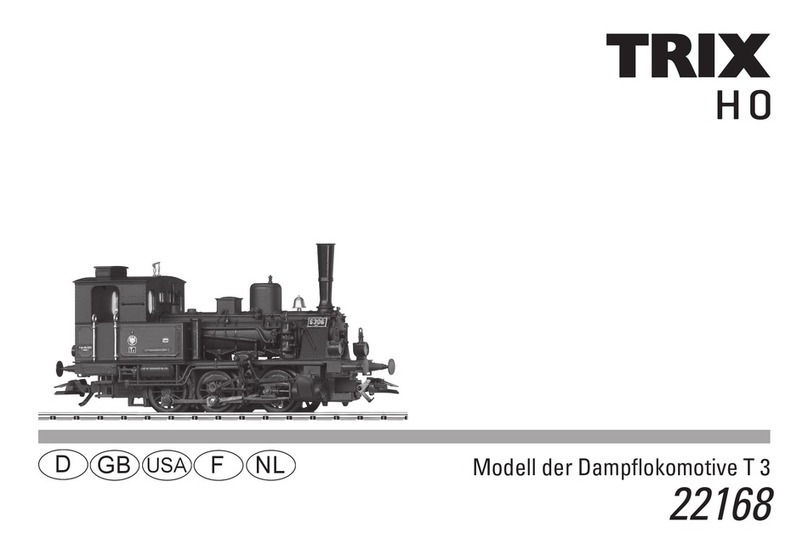
Trix BB 22200 Series User manual
Trix
Trix h0 series User manual
Trix
Trix 22605 User manual

Trix
Trix H0 3969 User manual
Trix
Trix Minitrix 66304 User manual

Trix
Trix BR 185.2 User manual
Trix
Trix G 2000 BB User manual
Trix
Trix H6 User manual
Trix
Trix BR V 60 User manual
Trix
Trix Minitrix 66140 User manual
Trix
Trix 22598 User manual
Trix
Trix BR 08 User manual
Trix
Trix Minitrix BD D 220 User manual

Trix
Trix BR 98 OBB User manual
Trix
Trix BR 798 User manual
Trix
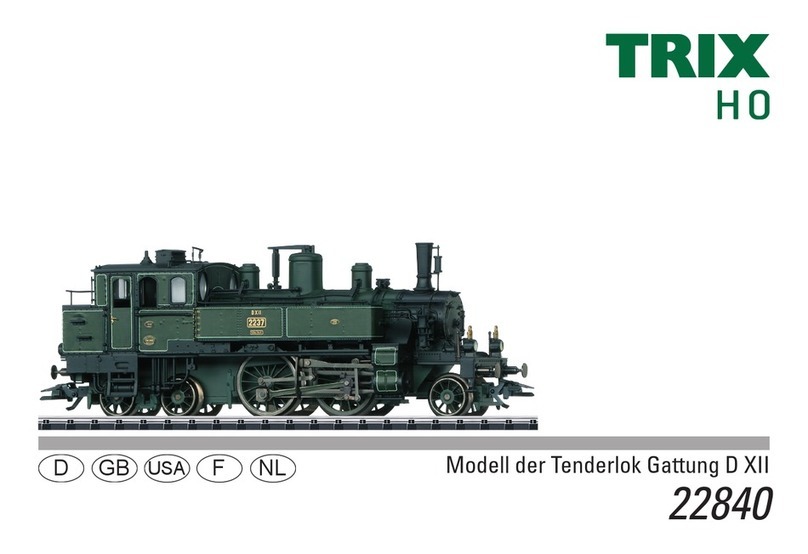
Trix D XII User manual
Trix
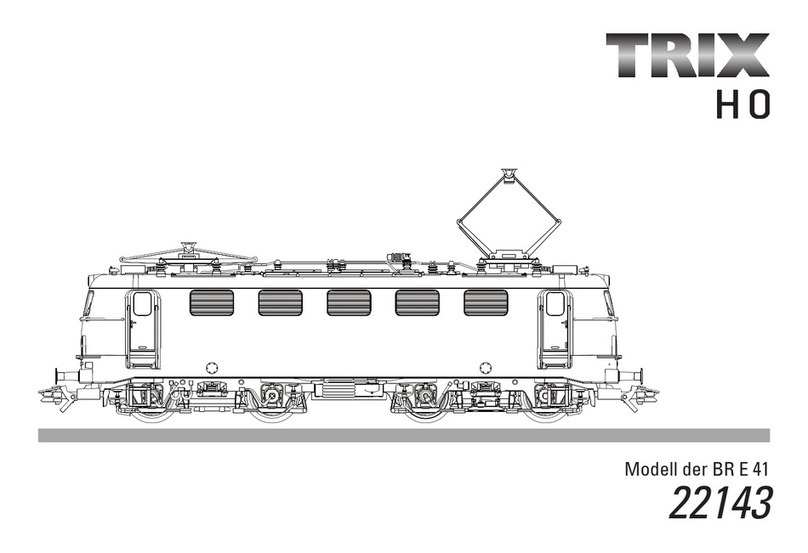
Trix BR E 41 22143 User manual
Trix
Trix BR 01 150 User manual
Trix
Trix 38 Series User manual