ES4350.1 Carrier Board8
1.3 Hardware Features
This section contains a description of the different hardware features of the
ES4350.1 Carrier Board.
These are:
• "Carrier Board for Piggybacks" on page 8
• "Synchronization Signals" on page 8
• "RPM Signals" on page 8
• "Generating an Interrupt" on page 9
• "Versioning Data" on page 9
1.3.1 Carrier Board for Piggybacks
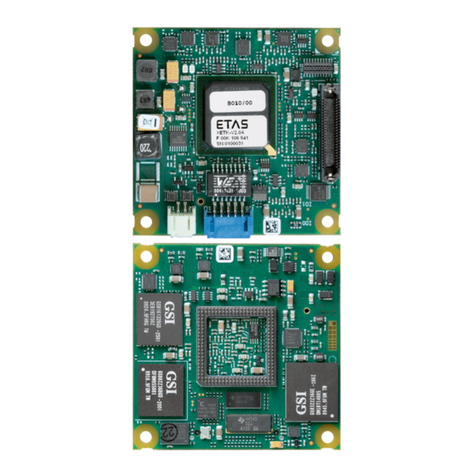
The ES4350.1 Carrier Board is used as a carrier board for I/O modules in VXIbus
systems. I/O modules are available for various tasks, such as the generation and
measuring of ECU signals in real time.
All modules of types ”PB4350XXX” and ”PB1651XXX” can be used. This
means that the LabCar test system can be equipped both with the standard I/
O modules for the ES1651 Carrier Board (VME system) as well as with the
highly precise I/O modules for the ES4350.1 Carrier Board. Up to six I/O mod-
ules of both types mentioned above can be used per ES4350.1 Carrier Board.
1.3.2 Synchronization Signals
The ES4350.1 Carrier Board also offers functions for synchronous signal gen-
eration and measuring on all I/O modules of a carrier board.
There are six synchronization signals available on an ES4350 Carrier Board.
Each of these six signals is routed to each of the I/O modules – there is also a
connection to the ES4350 I/O-FPGA and the VXIbus interface.
A synchronization signal can be generated from each of the described sources.
A synchronization signal can be activated in the FPGA via the user interface of
the ES4350.1 in the Real-Time Execution Connector.
This kind of signal can also be generated in an I/O module which is capable of
generating synchronization signals via the user interface of an I/O module in
the Real-Time Execution Connector.
Up to 2 synchronization signals can be transferred via the VXIbus for synchro-
nization of several ES4350.1 Carrier Boards in one ES4300 system.
1.3.3 RPM Signals
An RPM signal is used to transfer the engine speed and consists of three indi-
vidual signals, i.e. ”clock cycle”, ”trigger” and ”direction”.