10 Subject to change without notice
Basic signal measurement
Signals which can be measured
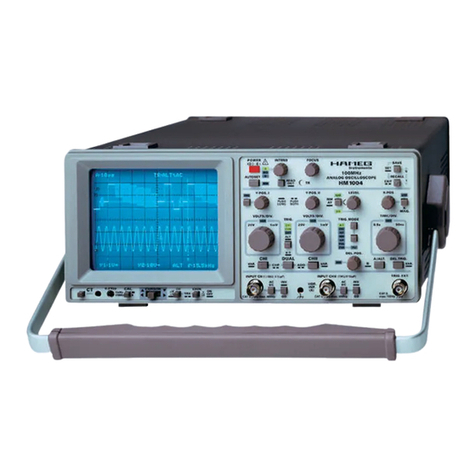
The oscilloscope HM1000 can display all repetitive signals
with a fundamental repetition frequency of at least 100MHz.
The frequency response is 0 to 100MHz (-3 dB). The vertical
amplifiers will not distort signals by overshoots, undershoots,
ringing etc.
Simple electrical signals like sine waves from line frequency
ripple to hf will be displayed without problems. However, when
measuring sine waves, the amplitudes will be displayed with
an error increasing with frequency. At 80MHz the amplitude
error will be around –10 %. As the bandwidths of individual
instruments will show a certain spread (the 100MHz are a
guaranteed minimum) the actual measurement error for sine
waves cannot be exactly determined.
Pulse signals contain harmonics of their fundamental frequency
which must be represented, so the maximum useful repetition
frequency of nonsinusoidal signals is much lower than 100MHz.
The criterion is the relationship between the rise times of the
signal and the scope; the scope’s rise time should be <1/3 of
the signal’s rise time if a faithful reproduction without too much
rounding of the signal shape is to be preserved.
The display of a mixture of signals is especially difficult if it con-
tains no single frequency with a higher amplitude than those of
the other ones as the scope’s trigger system normally reacts to
a certain amplitude. This is e.g. typical of burst signals. Display
of such signals may require using the HOLD-OFF control.
Composite video signals may be displayed easily as the instru-
ment has a tv sync separator.
The maximum sweep speed of 5 ns/cm allows sufficient time
resolution, e.g. a 100MHz sine wave will be displayed one period
per 2 cm.
The vertical amplifier inputs may be dc or ac coupled. Use dc
coupling only if necessary and preferably with a probe.
Low frequency signals when ac coupled will show tilt (ac low
frequency – 3 dB point is 1.6 Hz), so if possible use dc coupling.
Using a probe with 10:1 or higher attenuation will lower the
–3 dB point by the probe factor. If a probe cannot be used due
to the loss of sensitivity dc coupling the scope and an external
large capacitor may help which, of course, must have a sufficient
DC rating. Care must be taken, however, when charging and
discharging a large capacitor.
Dc coupling is preferable with all signals of varying duty cycle,
otherwise the display will move up and down depending on the
duty cycle. Of course, pure dc can only be measured with DC
coupling. The readout will show which coupling was chosen:
= stands for DC, ~ stands for AC.
Amplitude of signals
In contrast to the general use of rms values in electrical en-
gineering oscilloscopes are calibrated in Vpp as that is what is
displayed. Derive rms from Vpp: divide by 2.84. Derive Vpp from
rms: multiply by 2.84.
Values of a sine wave signal
Vrms = rms value
Vpp = pp – value
Vmom = momentary value, depends on time vs period.
The minimum signal for a one cm display is 1 mVpp ±5 % provi-
ded 1 mV/cm was selected and the variable is in the calibrated
position.
The available sensitivities are given in mVpp or Vpp. The cursors
allow to indicate the amplitudes of the signals immediately on
the readout as the attenuation of probes is automatically taken
into account. Even if the probe attenuation was selected manu-
ally this will be overridden if the scope identifies a probe with
an identification contact as different. The readout will always
give the true amplitude.
It is important that the variable be in its calibrated position. The
sensitivity may be continuously decreased by using the variable
(see Controls and Readout). Each intermediate value between
the calibrated positions 1–2–5 may be selected. Without using
a probe thus a maximum of 400 VPP may be displayed (20 V/div
x 8 cm screen x 2.5 variable).
Amplitudes may be directly read off the screen by measuring
the height and multiplying by the V/div. setting.
Please note!
Without a probe the maximum permissible voltage
at the inputs must not exceed 400 Vp irrespective of
polarity.
In case of signals with a dc content the peak value DC + AC
peak must not exceed + or – 400 VP. Pure ac of up to 800 VPP
is permissible.
If probes are used their possibly higher ratings are
only usable if the scope is dc coupled.
In case of measuring dc with a probe while the scope input is
ac coupled the capacitor in the scope input will see the input
dc voltage as it is in series with the internal 1 MΩ resistor. This
means that the maximum dc voltage (or DC + peak AC) is that
of the scope input, i.e. 400 VP! With signals which contain DC
and AC the DC content will stress the input capacitor while
the ac content will be divided depending on the ac impedance
of the capacitor. It may be assumed that this is negligible for
frequencies >40 Hz.
Considering the foregoing you may measure dc signals of up to
400 V or pure AC signals of up to 800 VPP with a HZ200 probe.
Probes with higher attenuation like HZ53 100:1 allow to measure
DC up to 1200 V and pure ac of up to 2400 VPP. (Please note the
derating for higher frequencies, consult the HZ53 manual).
Stressing a 10:1 probe beyond its ratings will risk destruction of
Basic signal measurement
VpVrms
Vmom
Vpp