7
TRANSMITTER AND RECEIVER BINDING
APPENDIX
The control signal of 2.4GHz transmitter contains an unique identication
code that allows the receiver recognized the signal of “its own” transmitter
and responded only to the right signal - no matter how many other 2.4 trans-
mitters is operating in the vicinity. When a 2.4GHz RC set is prepared for the
rst use and always when a new receiver is to be used with your transmitter,
you have to perform a procedure called “binding” in order to establish the
link between your transmitter and receiver. During this process the receiver
will recognize the ID of your transmitter and store it to its memory. From now
on it will respond just to the signal of your transmitter.
T8FB/R8EF Binding Procedure
1. Place the transmitter and the receiver close to each other (within one meter).
2. Turn your transmitter ON and then your receiver.
3. There is a black binding button on the side of the R8EF receiver; press and
hold the receiver binding button for about 2 seconds until the LED starts
to blink on the receiver. After about 8 blinks the process is accomplished
and the receiver LED will glow red steady.
4. Turn the receiver o and then on again; check the correct operation of all
servos.
• Please perform the range check in the beginning of each ying session.
• Before every take o please check the correct control surface movement.
• After every landing check the plane for any damage, loose push rod con-
nectors or push rods, bent undercarriage, damaged propeller etc. Do not
y again until the damage is repaired.
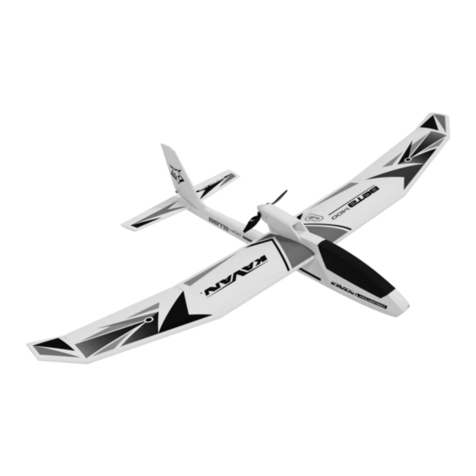
Although your BETA 1400 is manufactured of the extra tough and virtually un-
breakable extruded polyolephine (EPO) foam, damage or broken parts may
occur. A minor damage can be repaired simply gluing the parts together with
cyanoacrylate (CA) glue or with a clear sticky tape. In a case of a major damage
it is always better to purchase a brand new spare part. A wide range of genuine
spare parts and accessories is available through the KAVAN dealers.
In the unfortunate event of a crash or heavy landing, no matter how
minor or major, you must lower the throttle stick to its lowest positions
as quickly as possible to prevent damage to the electronic speed con-
troller in the control unit.
Failure to lower the throttle stick and trim to the lowest possible positions
in the event of a crash could result in damage to the ESC, which may require
replacement of the ESC.
Note: Crash damage is not covered under warranty.
REPAIRS AND MAINTENANCE
KAVAN R-20B INSTRUCTION MANUAL
Congratulation on your purchase of a KAVAN Line electronic controller for brushless motors. The
state-of-the-art KAVAN Line covers almost the entire range of electric powered planes own by
a Sunday yer. All the ESCs can be quickly programmed using your transmitter and even easier
with the optional KAVAN Card.
PROGRAMMABLE FUNCTIONS
1. Programmable Brake Setting (use the brake on for folding props applications only).
2. Programmable Battery Type (LiPo or NiCd/NiMH).
3. Programmable Low Voltage Cut-O Type (power reduction or immediate shut down ).
4. Programmable Low Voltage Cut-O Setting.
5. Programmable Soft Acceleration Start Ups (for gearbox and helicopter applications).
6. Programmable Timing Settings (to enhance ESC eciency and smoothness).
KAVAN R-6B...R-80SB
BEC Type Current (A)
Cont./Burst
Input Voltage
No. of cells
Weight (g) BEC
(Voltage/Current)
Dimensions
(mm)
KAVAN R-6B *BEC 6A\8A 2Lipo 5.5g 5V/0.8A 32x12x4.5
KAVAN R-12B *BEC 12A\15A 2-3Lipo 9g 5V/1A 38x18x6
KAVAN R-15B *BEC 15A\20A 2-3Lipo 16.5g 5V/2A 48x22.5x6
KAVAN R-20B *BEC 20A\25A 2-3Lipo 19g 5V/2A 42x25x8
KAVAN R-30B *BEC 30A\40A 2-3Lipo 37g 5V/2A 68x25x8
KAVAN R-40B *BEC 40A\55A 2-3Lipo 39g 5V/3A 68x25x8
KAVAN R-40SB **SBEC 40A\55A 2-4Lipo 43g 5V/3A 65x25x12
KAVAN R-50SB **SBEC 50A\65A 2-4Lipo 41g 5V/7A 65x29x10
KAVAN R-60SB **SBEC 60A\80A 3-6Lipo 63g 5V/7A 77x35x14
KAVAN R-80SB **SBEC 80A\100A 3-6Lipo 82g 5V/7A 86x38x12
*) BEC - linear BEC **) SBEC - powerfull switching BEC
SPECIFICATION
Programmable Electronic Controllers for Brushless Motors
red
Battery Motor
ESC
Motor
To receiver, throttle channel/
/KAVAN Programming Card
KAVAN ESC Wiring Diagram
Please bear in mind improper polarity or short circuit will damage the ESC therefore it is
your responsibility to double check all plugs for proper polarity, and proper connection
BEFORE connecting the battery pack for the rst time.
POWERING UP FOR THE FIRST TIME & THE AUTOMATIC THROTTLE CALIBRATION
The KAVAN ESC features Automatic Throttle Calibration to ensure the smoothest throttle
response and resolution throughout the entire throttle range of your transmitter. This step
has to be performed just once to allow the ESC to “learn and memorize” the throttle output
signal of your transmitter. It only needs to be repeated if you changed your transmitter.
1. Switch on the transmitter, move throttle stick to the top position.
2. Connect battery pack to the ESC, and wait for about 2 seconds.
3. The “Beep-Beep-” tone should be emitted, means the top point of throttle range has been
conrmed.
4. Move throttle stick to the bottom position, several “beep-” tones should be emitted to
present the amount of battery cells.
5. A long “Beep-” tone should be emitted, means the lowest point of throttle range has been
correctly conrmed.
The throttle has been calibrated now and your ESC is ready for operation.
NORMAL ESC START-UP PROCEDURE
1. Move throttle stick to bottom position and then switch on transmitter.
2. Connect battery pack to ESC, special tone like “123” means power supply is OK.
3. Several “beep-” tones should be emitted to present the amount of lithium battery cells.
4. When self-test is nished, a long “beep-----” tone should be emitted.
5. Slowly move the throttle stick up, the prop should start to rotate clockwise (looking from
the cockpit of the plane). If it spins in the opposite direction, pull the throttle stick back,
disconnect the ight battery and swap any two of the three cables between the motor
and the ESC. The re-check again.
PROTECTION FUNCTION
1. Start up failure protection: If the motor fails to start within 2 seconds of throttle ap-
plication, the ESC will cut-o the output power. In this case, the throttle stick MUST be
moved to the bottom again to restart the motor. (Such a situation happens in the follow-
ing cases: The connection between ESC and motor is not reliable, the propeller or the
motor is blocked, the gearbox is damaged, etc.).
2. Over-heat protection: When the temperature of the ESC is over about 110 Celsius de-
grees, the ESC will reduce the output power.
3. Throttle signal loss protection: The ESC will reduce the output power if throttle signal is
lost for 1 second, further loss for 2 seconds will cause the output to be cut-o completely.
PROGRAMMABLE FUNCTIONS OF THE KAVAN ESC
1. Brake: ON/OFF
ON - Sets the propeller to the brake position when the throttle stick is at the minimum posi-
tion (Recommended for folding props).
OFF - Sets the propeller to freewheel when the throttle stick is at the minimum position.
2.Battery type: LiPo or NiCd/NiMh
3. Low Voltage Cuto Type: Reduce Power / Hard Cut-o
Reduce Power – ESC reduces motor power when the preset Low Voltage Protection Thresh-
old value is reached.
Hard Cut-o – ESC instantly cuts motor power o when the preset Low Voltage Protection
Threshold value is reached
4. Low Voltage Protection Threshold: (Low / Medium / High)
1) For Li-xx packs - the battery cell number is calculated automatically. Low / Middle / High
cuto voltage for each cell is: 2.85V/3.15V/3.3V. For example: For a 3S Lipo, when “Middle”
cuto threshold is set, the cut-o voltage will be: 3.15*3=9.45V.
2) For Ni-xx packs - low / medium / high cuto voltages are 0%/50%/65% of the startup volt-
age (i.e. the initial voltage of battery pack), and 0% means the low voltage cut-o function
is disabled. For example: For a 6 cells NiMH battery, fully charged voltage is 1.44*6=8.64V,
when “Middle” cut-o threshold is set, the cut-o voltage will be: 8.64*50%=4.32V.
5.Soft Acceleration Start up: Normal / Soft / Very Soft
Normal mode is suitable for xed-wing aircraft. Soft or Very Soft modes are suitable for
helicopters. The initial acceleration of the Soft and Very Soft modes are slower, it takes 1.5
second for Soft startup or 3 seconds for Very Soft startup from initial throttle advance to full
CONNECTING THE KAVAN ESC
The speed controller can be connected to the motor by soldering directly or with high qual-
ity connectors. Always use new connectors, which should be soldered carefully to the ca-
bles and insulated with heat shrink tube. Use only high quality connectors to connect the
ESC to the ight pack as well - 2 mm gold plated connectors (KAV36.119 or KAV36.120) for
currents up to 20A; 3,5 mm (KAV36.122), 4 mm (KAV36.126) gold plated connectors or DEAN-
T® (KAV36.108) for currents up to 60A and 6 mm (KAV36.128) for currents up to 80A. The
maximum length of the battery pack wires should be within 15 cm (6 inches).
Plug the UNI servo connector cable of the ESC to your receiver throttle output. The ESCs
featuring BEC or SBEC voltage stabilizer will feed your receiver and servos from the ight
battery pack.