ENGLISH FRANÇAIS DEUTSCH ITALIANO ESPAÑOL PORTUGUÊS
EN-7
Warning
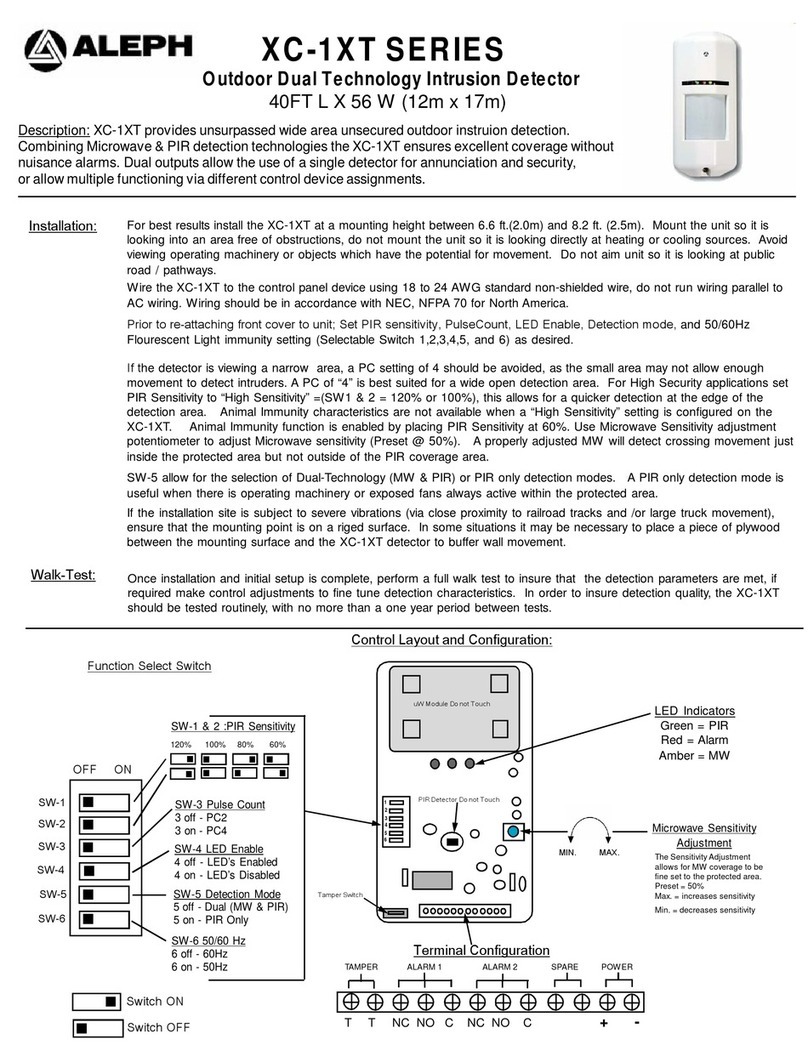
Do not exceed the voltage or current rating
specified for any of the terminals during installation,
doing so might cause fire or damage to the devices.
[AX-70/130/200TN]
[AX-100/200TF]
N.C. / N.O. selection Swich
N.C. N.O.
3
OFF ON
4WIRE CONNECTION
Connect respective wires to the terminals shown in the following figure.
• Ensure that the wiring distance from the power supply is within the range shown in the table on the below.
• When using two or more units on one wire, the maximum length is obtained by dividing the wire length listed
below by the number of units used.
For UL Listed applications, the units shall be connected
to a UL Listed control unit or Listed Burglar Power
Supply capable of providing a minimum of 4 hours
standby power.
-Terminal
-Wiring distance between power supply and detector
Non-Voltage contact output
Resistive load only
Note>>
Note>>
Alarm output (N.C.)
Non-voltage contact output
Contact capacity: 28VDC and 0.2A (max.)
< Receiver >
< Receiver >
Tamper output
(It opens when cover is removed)
Non-voltage contact output
Contact capacity: 28VDC and 0.1A (max.)
Power input
10.5 to 28VDC
Power input
10.5 to 28VDC
Power input
10.5 to 28VDC
Power input
10.5 to 28VDC
Tamper output : (BE) Model only
(it opens when cover is removed)
Non-voltage contact output
Contact capacity: 28VDC and 0.1A (max.)
< Transmitter >
< Transmitter >
Alarm output: (N.C./N.O.) switch (In case of using N.O., contact is
not reversed when power supply is off.)
Non-voltage contact output
Contact capacity: 28VDC and 0.2A (max.)
Tamper output
(It opens when cover is removed)
Non-voltage contact output
Contact capacity: 28VDC and 0.1A (max.)
Use the COM. terminal for both alarm
output and D.Q. circuit.
Environmental Disqualification (N.C.)
Non-Voltage contact output
Contact capacity : 28VDC and 0.2A (max.)
Tamper output : (BE) Model only
(it opens when cover is removed)
Non-voltage contact output
Contact capacity: 28VDC and 0.1A (max.)
AWG22
(0.33mm2)
Wire size
AWG20
(0.52mm2)
AWG18
(0.83mm2)
AWG16
(1.31mm2)
500 m (1700 ft.)
700 m (2200 ft.)
1100 m (3600 ft.)
1700 m (5500 ft.)
2400 m (7800 ft.)
12VDC 24 VDC
Power supply voltage
3500 m(11400 ft.)
5500 m (18000 ft.)
8000 m (26200 ft.)
5ALIGNMENT
The optical alignment is an important adjustment to increase reliability. In accordance with the procedure indicated
in the items 1. and 2. in this chapter, make sure to align the monitor jack that monitor output nothing to attain the
maximum level.
• While looking through the viewfinder, turn the dial to make alignment in such a way that the other detector is
at the center of the sights.
• After the rough alignment using the
viewfinder, check the light receiving
status by the Alarm Indicator.
When making the adjustment by the monitor jack, be
careful not to intercept the optical unit with your hand,
the tester pin cord, etc.
Note>>
< Horizontal alignment > < Vertical alignment >
< Receiver / Transmitter >
Checking of the illumination of the Alarm Indicator
• After checking the receiving level of optical axis by using the alarm indicator, make sure to make fine alignment for
both transmitter and receiver with voltmeter until it reaches maximum monitor output over “Good” level.
Fine adjustment with monitor jack
< Receiver >
< Receiver >
Alarm Indicator
View Finder
• For Horizontal/Vertical alignment, refer to the following
illustration.
AX-100/200TF
Alarm
Indicator
Light
interrupting Light receiving
ON(red) fast
flicker slow
flicker OFF
Monitor
output
Realign
Less than 1.0V
Fair
1.0V
or more
Good
2.0V
or more
Excellent
2.5V
or more
AX-70/130/200TN
Alarm
Indicator
Light
interrupting Light receiving
ON(red) OFF
Monitor
output
Realign
Less than 2.2V
Fair
2.2V
or more
Good
2.5V
or more
Excellent
2.9V
or more
The relation between monitor output and receiving level of optical axis.
5-1
OPTICAL ALIGNMENT
1Rough alignment by viewfinder
2Checking of the illumination and Fine alignment
Turn the horizontal alignment
dial by fi ngers to make
alignment
Set the voltmeter range to 5 to 10VDC and connect
the voltmeter probes and to and of the
monitor jack respectively.
The horizontal / Vertical alignment.
Turn the vertical alignment
dial with a screwdriver to
make alignment
The alignment
can be completed. Realignment
(example)
The beam is not
properly aiming at the
center of viewfinder.